
A validator is a network participant who verifies incoming data. Essentially, they ensure that no erroneous or suspicious transactions enter the network, thereby ensuring the stability and security of the system.
Source : GoMining
How does a validator work?
1. Consensus algorithms. Most validators operate in blockchains that use Proof of Stake (PoS) or Delegated Proof of Stake (DPoS) mechanisms. Such networks do not require computing power, as is the case with Proof of Work (PoW). Instead, participants earn the right to confirm blocks based on the number of coins they «freeze» in staking.
— Proof of Stake (PoS) — In PoS, new blocks are confirmed by participants who have frozen their coins in staking.
— Delegated Proof of Stake (DPoS) — In DPoS, users do not validate blocks themselves.
— Proof of Work (PoW) — In PoW, miners use computing power to solve complex mathematical problems.
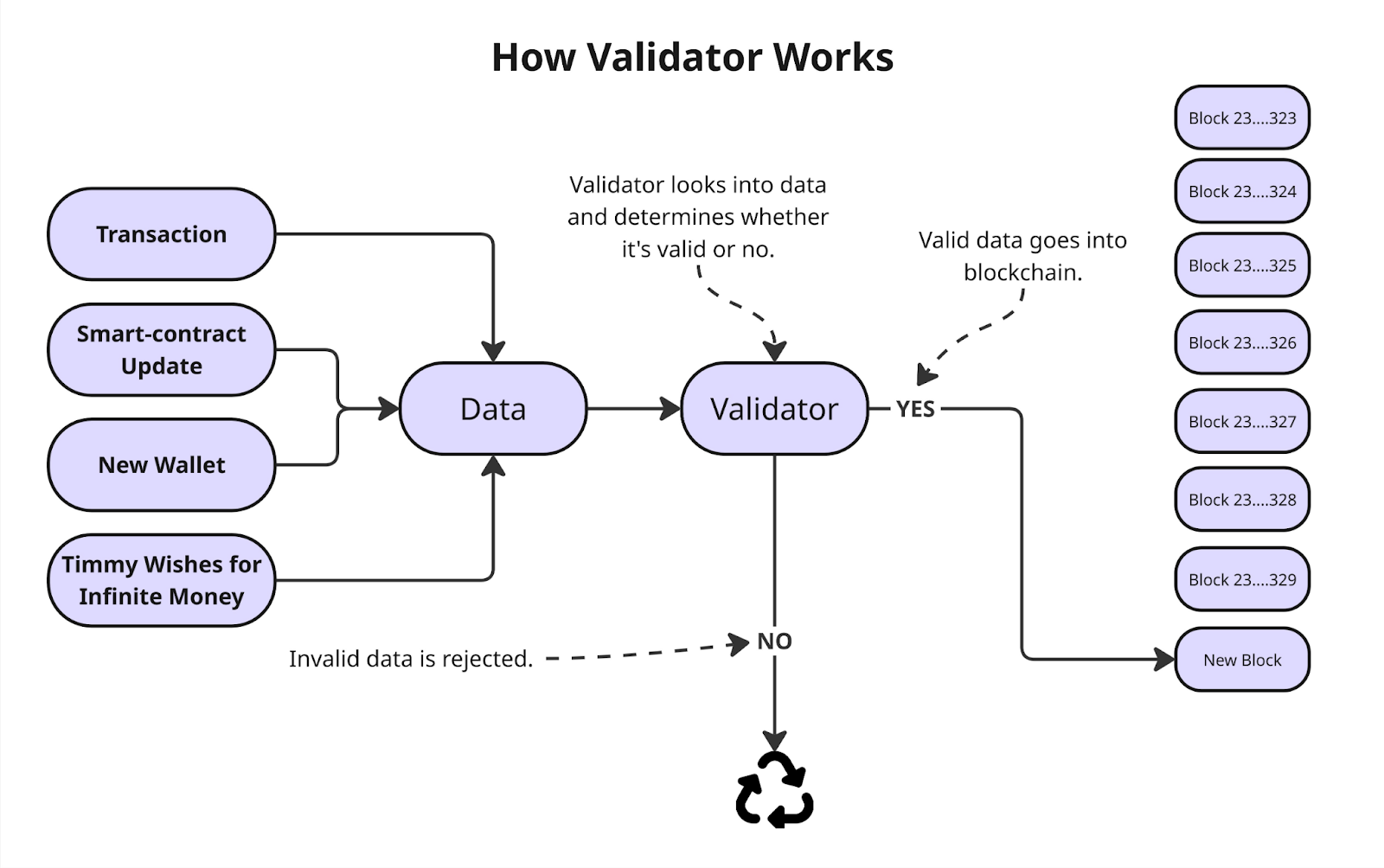
2. Verification of transactions. When new transactions appear on the network, the validator analyzes their correctness and combines them into a block. Only after confirmation does the information officially enter the chain.
3. Reward. Validators receive a reward for participating in supporting the network — most often, this is a portion of the commission or freshly minted tokens of a particular blockchain. This incentivizes them to perform their duties honestly and ensure the smooth operation of the network.
Types of validators
Blockchain networks usually distinguish between two main types of validators:
1. Full Node Validators. These nodes store the entire blockchain history. They independently process and verify each transaction, actively participate in the formation of new blocks, and ensure the highest level of network security. Their role is to be the foundation on which the reliability of the registry rests.
2. Light Node Validators. Light nodes do not download the entire blockchain. They store only a portion of the data and refer to full nodes to obtain information for verifying transactions. This type of validator is used where resources are limited, such as on mobile devices or in networks with low bandwidth.
Light nodes are also called partial validators because they do not contain the entire ledger, but only work with the necessary fragments of data.
Stages of validator work
Before delving into the processes, it is worth understanding the role of a validator. If we imagine a blockchain as a newspaper where each page is created by different authors, then validators are a kind of editor. They check the information before it is «published» on the network, ensuring the accuracy and reliability of the data.
The validator's work process includes several key steps:
1. Receiving a transaction. The validator receives new transactions for analysis.
2. Verifying authenticity. Each transaction is evaluated according to the established rules of the network.
3. Forming a block. After confirming the authenticity of the transactions, they are combined into a block.
4. Consensus mechanism. Other validators check the block for compliance with network standards.
5. Adding to the chain. When the check is successful, the block is officially added to the blockchain.
These actions result in the creation of a secure, transparent, and reliable digital registry that can be relied upon.
Is it difficult to become a validator and how to do it
Almost anyone can become a validator, but it requires certain resources, knowledge, and technical skills. It is important to understand that validators are responsible for network security, so candidates must meet strict requirements.
The main steps for a validator candidate are:
1. Select a network. Identify a blockchain with a Proof of Stake (PoS) algorithm or its variants, where the role of validator is provided.
2. Purchase cryptocurrency. Buy the minimum amount of network tokens required for staking.
3. Set up a node. Install client software on a server or computer and prepare a node for verifying transactions.
4. Choose a platform. Decide which platform you will use to participate — directly through a network node, through a wallet, or through an exchange that supports staking.
5. Staking. Lock up your coins so they become a «stake» in the blockchain, which gives you the right to validate transactions.
6. Connect to the network. Activate your node and start participating in the blockchain.
7. Support the network. Verify transactions, follow the network rules, and act honestly. Violations can result in the loss of frozen cryptocurrency or penalties.
The process and requirements may vary depending on the specific blockchain, so it is important to carefully review the instructions and rules of your chosen network before getting started.
How validators detect errors
Validators use a range of tools and technologies to detect errors and maintain network security. These include data segmentation, special server settings, monitoring systems, and modern encryption methods. The consistent application of proven security practices allows validators to keep the network under control.
The process of verifying transactions and blocks is based on consensus mechanisms such as PoW (Proof of Work) and PoS (Proof of Stake). Validators must:
1. Detect attempts at manipulation or fraud;
2. Protect the integrity of the blockchain;
3. Eliminate technical failures at the hardware and software level;
4. Have a clear action plan to ensure stable and uninterrupted network operation.
Thanks to these measures, validators not only confirm the correctness of transactions, but also prevent potential threats to the entire system.
How does a validator differ from a miner?
The main differences between a validator and a miner are in their working methods, technical requirements, and remuneration:
1. Working method. Miners compete to solve complex mathematical problems, and the block is added to those who are the first to complete the calculation. Validators are selected based on the number of coins they have «frozen» in staking.
2. Technical base. Mining requires powerful equipment and high computing resources. A validator only needs to have a sufficient number of tokens and a configured node.
3. Energy consumption. Mining consumes a significant amount of electricity. Staking by validators requires minimal energy consumption.
4. Reward. Miners receive a reward in the form of newly generated coins. Validators earn interest on the stake, proportional to the amount of tokens frozen.
As a result, validators operate in a more environmentally friendly manner, with lower costs and without the race for computing power, unlike traditional miners.
In conclusion
Every participation in a blockchain network involves certain risks and responsibilities that require attention and accountability. If you have decided to become a validator and are fully aware of your obligations to other network participants, you can proceed to apply for this status.
Subscribe and get access to the GoMining course on cryptocurrency and Bitcoin, which is still free: https://academy.gomining.com/courses/bitcoin-and-mining