Jupiter DEX — Jupiter decentralized exchange
Jupiter (JUP) — is a service on the Solana network that finds the best rate for exchanging tokens. It collects offers from different DEXs and shows the most profitable option to make it easier and faster for users to exchange their tokens.
In addition to regular swaps, Jupiter offers trading tools such as limit orders and cost averaging strategies.

Source: Plisio.net
Team and project history
Jupiter was developed by an anonymous team led by a developer known by the pseudonym meow. In the world of cryptocurrencies, anonymity is common practice, as it helps shift the focus from the individual to the product itself and its community.
Work on the project began long before the JUP token appeared. The team's main focus was on developing the aggregator and technical infrastructure. The platform was launched in 2021 and quickly became one of the key tools for Solana traders.
Growth occurred naturally — thanks to favorable exchange rates, stable performance, and recommendations from users themselves.
The JUP token appeared after the functionality was fully formed. It was a logical step towards further decentralization of the project, rather than an attempt to launch a token for the sake of hype.
How Jupiter ensures convenient and efficient trading
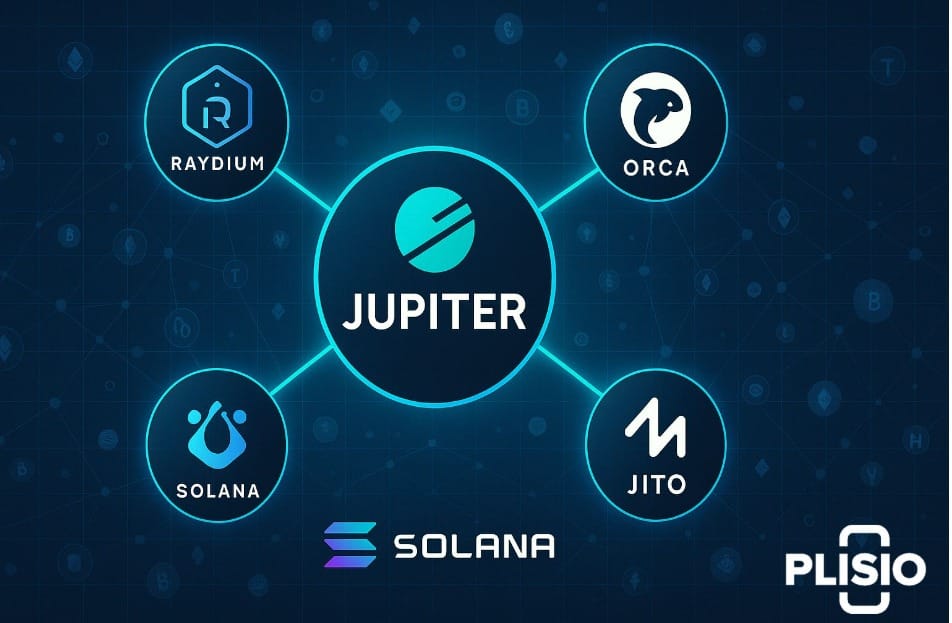
Jupiter works as a DEX aggregator on Solana and selects the best prices by automatically connecting to platforms such as Raydium, Orca, and Jito. The service distributes orders across different liquidity sources, reduces slippage, and helps to make the exchange as profitable as possible.
It combines liquidity from both AMM pools and market makers, ensuring fast and stable trades for any connected wallet.
What sets Jupiter apart:
1. Smart routing of trades across multiple DEX
2. Ability to place limit orders
3. Tools for DCA (dollar-cost averaging) strategy
4. Real-time analytics
Thanks to these features, Jupiter is suitable for both those who are just starting out in trading and experienced traders who value flexibility and tools for more accurate trading.
Source: Plisio.net
Jupiter DEX technology
The technical part of Jupiter is based on the power of the Solana blockchain and fast off-chain calculations.
1. Smart routing engine. This is a key element of Jupiter. When a user initiates an exchange, the service does not take the price from just one DEX — it analyzes several paths and selects the most profitable one.
2. Proof-of-History (PoH). Jupiter's speed is ensured by the speed of Solana itself. PoH is a cryptographic timestamp mechanism that allows validators to process transactions in parallel. Thanks to this, blocks are formed in a fraction of a second, and transactions are completed almost instantly.
3. Security and audits. Jupiter is part of the Solana infrastructure, and security is its top priority. Smart contracts are regularly audited by industry experts. In addition, as an aggregator, Jupiter reduces the overall risk for users. Even if one of the DEXs fails, the router redirects liquidity along a secure path. Funds are only involved in the process for the duration of a specific transaction.
The role of Jupiter Dex in the Solana ecosystem
Jupiter Dex plays a key role in the Solana ecosystem, serving as a central hub for decentralized trading. Its influence extends to several important aspects:
1. Growth in DEX trading volumes. The aggregator combines liquidity from various DEXs on Solana, increasing the overall trading turnover. This benefits individual exchanges through increased fees and strengthens the overall liquidity pool of the network.
2. Attracting institutional investors. High-quality trade execution and transparency make Jupiter Dex attractive to large players. Institutions can conduct large transactions with minimal market impact, maintaining price stability and the efficiency of their investments.
3. Stimulating innovation and competition. The presence of a leading DEX aggregator encourages other Solana platforms to develop and improve. This contributes to the emergence of more user-friendly interfaces, increased security, and overall trading efficiency, which benefits the entire ecosystem.
Thus, Jupiter Dex not only improves the user experience but also contributes to the development and strengthening of the entire Solana ecosystem.
How to connect cross-chain assets using Jupiter
The Jupiter bridge aggregator Jupiter makes it easy to transfer assets between different blockchains. Here are the step-by-step instructions:
1. Select a bridge. Open the «Bridge» section and specify the source and target networks.
2. Select tokens. Specify the asset you want to transfer, such as USDC or SOL.
3. Review routes. Jupiter will offer several transfer options with fees and execution times. Select the one that suits you best.
4. Complete the transfer. Confirm the transaction and follow the instructions of the selected bridge to complete the operation.
This approach makes cross-chain transfers fast, transparent, and convenient for users.
JUP Token Utility
The JUP token is at the heart of the Jupiter ecosystem, providing governance, rewards, and access to exclusive features. The main uses of the token are:
1. Governance. JUP holders participate in voting through DAO Jupiter, influencing platform updates, liquidity distribution, and new ecosystem initiatives.
2. Community rewards. Tokens are distributed through airdrops, trading incentives, and grants to active users.
3. Exclusive features. JUP gives priority access to projects on LFG Launchpad and can reduce fees for holders.
4. Ecosystem support. Tokens help provide liquidity and fund the long-term development of the platform.
In this way, JUP stimulates community activity and contributes to the growth of Jupiter as the leading DEX aggregator on Solana.
Key news and events Jupiter
1. October 2021. Launch of the Jupiter swap aggregator on the Solana mainnet. The platform quickly gains an audience.
2. January 31, 2024. The largest JUP airdrop — nearly a million wallets received a total of 1 billion tokens. On the same day, DAO Jupiter officially launched, causing a surge of activity on Solana.
3. March 2024. Start of the LFG Launchpad beta test — the first projects are voted on by JUP holders, demonstrating the practical use of the token for governance.
4. Today. Jupiter continues to expand its ecosystem through new partnerships and integrations, such as the SOL debit card in collaboration with Sanctum, showing how DeFi can become part of everyday life.
In conclusion
Jupiter is not just a token exchange platform, but a full-fledged gateway to the DeFi ecosystem on Solana. The service offers swaps, limit orders, cost averaging tools, and other features, allowing users to trade efficiently and conveniently.
Whether you are trading Solana tokens or exploring DeFi strategies, understanding how platforms like Jupiter work helps you get the most out of decentralized finance.
Subscribe and get access to the GoMining course on cryptocurrency and Bitcoin, which is still free: https://academy.gomining.com/courses/bitcoin-and-mining
January 5, 2026