

Web3 news in 2026 is increasingly practical: privacy, self‑sovereign computing, and user tooling that can genuinely replace parts of Web2. A standout signal this month came from Ethereum cofounder Vitalik Buterin, who framed 2026 as a year to reclaim “computing self‑sovereignty” — and tied it to concrete workflow changes.
Key Takeaways
Web3 narratives are rotating from hype to self‑sovereignty: privacy, local compute, and open-source tools. (Cointelegraph)
Vitalik Buterin called 2026 “the year we take back lost ground in computing self-sovereignty.” (Cointelegraph)
Adoption shows up in everyday workflows: messaging, docs, identity, and storage — not just trading. (Cointelegraph)
Watch UX + regulation: they will determine whether Web3 tools become mainstream.
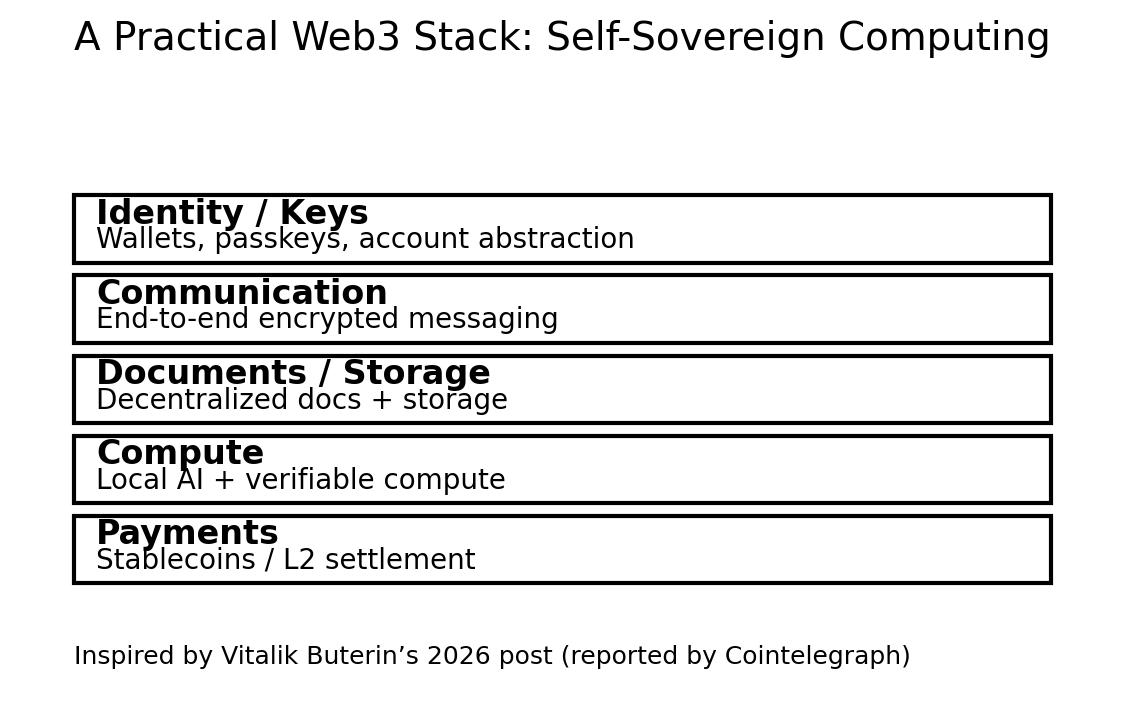
Self-sovereign Web3 stack (original visual), inspired by Vitalik Buterin’s 2026 post reported by Cointelegraph.
The headline Web3 story: self‑sovereign computing
Cointelegraph reported that Vitalik Buterin declared 2026 to be “the year we take back lost ground in computing self-sovereignty,” starting with his own devices and software stack. The framing shifts Web3’s pitch from “speculation” to a direct consumer value proposition: control over data, fewer centralized choke points, and privacy by default.
Web3 often gets discussed in terms of tokens and trading. But self‑sovereignty focuses on workflows: where your messages live, how your documents are stored, and whether you can run useful tools locally without sending everything to a third party.
A practical read of Web3 news: substitution, not slogans
Instead of tracking every new token, a more useful lens is substitution: which Web2 dependency is being replaced, and what’s the tradeoff? If a decentralized document platform reduces reliance on centralized storage, that’s tangible. If a messaging shift reduces metadata leakage, that’s tangible. If local AI makes it feasible to keep personal data on-device, that’s tangible.
Buterin’s post (as reported) pointed to concrete changes in daily tooling to reduce reliance on centralized platforms. Whether one agrees with each tool choice, the bigger point is that Web3 narratives are becoming operational.
Three Web3 trends to track next
1) UX improvements: account abstraction, safer key management, and better onboarding. 2) Privacy tooling: encrypted messaging, private computation, and data minimization. 3) Local compute: on-device AI and verifiable compute that reduces reliance on centralized clouds.
The adoption question is no longer “can Web3 exist?” It’s “can Web3 be convenient enough that normal users choose it?” Web3 news worth following is the news that improves that answer.
Why it matters beyond crypto markets
If self‑sovereign tools grow, they can reshape platform power and data control. Adoption may appear first in niches — journalists, activists, founders, high‑risk users — then spread as UX improves. That’s why infrastructure and user-facing apps are central to Web3 coverage in 2026.
Sources
Cointelegraph — Buterin calls 2026 the year to reclaim self-sovereign computing (contains quoted phrase): https://cointelegraph.com/news/vitalik-buterin-declares-2026-self-sovereign-computing