

Price Recovers as Mining Pressures Ease
April marked a clear shift in market tone.
Bitcoin moved higher through the month, closing up 11.1% at $75,779 and briefly trading above $78,000. After March’s modest recovery, April showed a more convincing improvement in market tone, supported by renewed ETF inflows and easing pressure across the mining network.
At the same time, pressure within the mining sector began to ease. Network hashrate declined from over 1,000 EH/s to 940 EH/s, while hashprice recovered. This points to a reduction in marginal supply, as less efficient operators were forced offline after an extended period of compressed margins.
Taken together, April reflects the early stages of a supply-side adjustment, where improving mining conditions are beginning to coincide with renewed demand.
TLDR;
BTC: $75,779 ▲ 11.1%
Open: $68,233 | Close: $75,779 | High: $78,661 | Low: $66,889
Hashprice: $35.56/PH/day ▲ 10.2%
Open: $32.28 PH/day | Close: $35.56 PH/day | High: $36.47 PH/day | Low: $30.53 PH/day
Hashrate: 940 EH/s ▼ 8.2%
Open: 1,017 EH/s | Close: 940 EH/s | High: 1,028 EH/s | Low: 924 EH/s
Bitcoin Moves Higher as Supply Pressure Eases
April’s price action was steady rather than explosive.
Bitcoin opened at $68,233 and trended higher through the month, reaching $78,661 before closing just below that level. The move suggests accumulation rather than short-term positioning, with fewer sharp reversals than earlier in the year.
The key shift was on the supply side. The forced selling and deleveraging that defined the start of 2026 began to ease, allowing price to move higher on relatively modest incremental demand.
April was the clearest period this year where price strength and improving underlying conditions moved in the same direction.
Institutional Demand Accelerates
Institutional demand strengthened meaningfully through April.
U.S. spot Bitcoin ETFs recorded approximately $2.44 billion in net inflows during the month, nearly doubling March levels and marking the strongest monthly inflow of 2026 to date. The majority of this demand was concentrated within an eight-day period in mid-April, where ETFs absorbed over $2.1 billion as Bitcoin moved from $68,000 to $77,000.
Corporate treasury activity added to this trend. Large-scale accumulation continued alongside ETF flows, with combined institutional demand absorbing multiples of newly mined supply over the month.
This reflects a shift in behaviour. Capital is increasingly being deployed during consolidation rather than momentum, suggesting a more strategic and longer-duration allocation profile.
While flows moderated briefly toward month-end around the FOMC meeting, the overall trend remained firmly positive.
Mining Reset Begins to Show in the Data
The most important development in April was on the mining side.
Hashrate declined 8.2% over the month, closing at approximately 940 EH/s after peaking above 1,000 EH/s. This is one of the more meaningful drawdowns in network compute since 2022 and a clear signal that marginal operators are being forced offline.
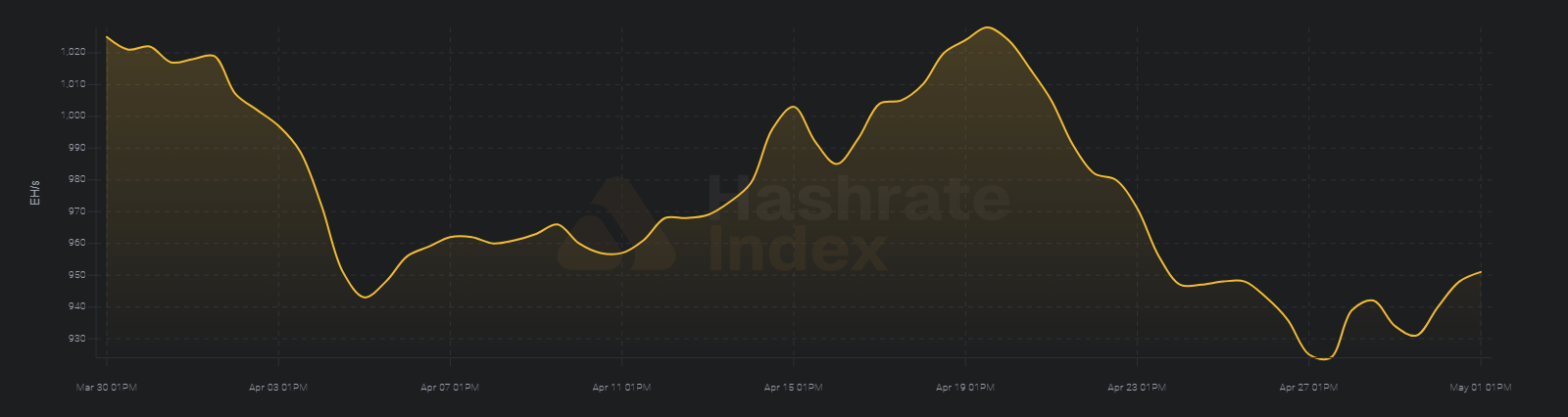
Bitcoin Network Hashrate, April 2026 (Source: Hashrate Index)
At the same time, hashprice increased 10.2% month on month to $35.56 per PH per day, recovering from deeply compressed levels.
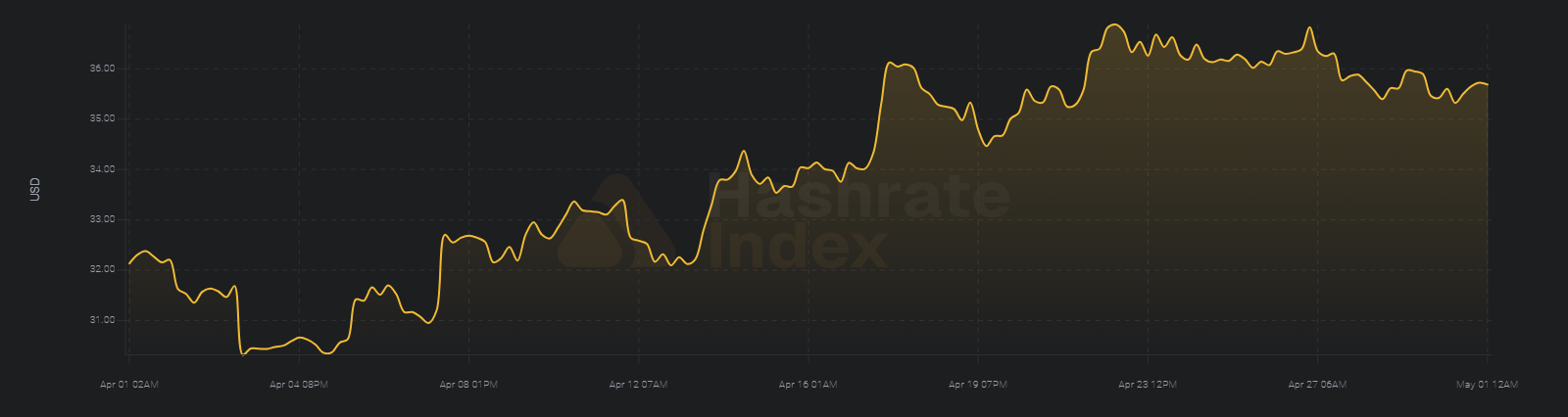
Bitcoin Hashprice, April 2026 (Source: Hashrate Index)
This combination is constructive. It reflects:
- Reduced competition at the margin
- Improving economics for remaining operators
- Early signs of supply-side rebalancing
While profitability remains uneven, the direction of travel has begun to improve.
Quantum Readiness Enters the Institutional Conversation
April brought Bitcoin’s long-term security roadmap into sharper focus, with renewed discussion around quantum computing and post-quantum cryptography.
The important distinction is between Bitcoin’s mining layer and its signature layer. Recent research suggests that using quantum computing to attack Bitcoin mining or materially influence proof-of-work remains physically unrealistic. One study estimated that attacking Bitcoin mining at mainnet difficulty would require approximately 10²³ physical qubits and around 10²⁵ watts of power, approaching the energy output of a star. In practical terms, quantum computing is not a near-term threat to Bitcoin’s mining network.
The more relevant long-term question is wallet security. Bitcoin currently relies on elliptic-curve signatures, and sufficiently powerful future quantum computers could create risks for exposed public keys and older wallet formats. This is why recent proposals have focused on post-quantum migration pathways rather than changes to proof-of-work itself.
The issue is not whether Bitcoin’s network can be “switched off” by quantum computing. It is whether the ecosystem can plan and coordinate a careful transition toward quantum-resistant address and signature schemes over time.
That process is already being discussed. Recent Bitcoin Improvement Proposals have explored quantum-resistant address formats and staged migration paths away from legacy signature schemes. As with any Bitcoin upgrade, the process is likely to be cautious, technical, and conservative. That can slow adoption, but it is also part of what protects the credibility of the base layer.
The takeaway is balanced. Quantum risk is a long-term cryptographic issue that the ecosystem needs to address, not an imminent threat to mining. Bitcoin’s proof-of-work network remains extremely difficult to attack, while the protocol community is already discussing how to strengthen the parts of the system that may need to evolve.
Energy, Jurisdiction and Infrastructure Matter
April reinforced that Bitcoin mining is increasingly shaped by jurisdiction, energy access and regulatory clarity, not just Bitcoin price.
In the U.S., the clearest signal came from MARA’s agreement to acquire Long Ridge Energy & Power, including a 505 MW natural gas power plant in Ohio and a large industrial site intended for future data centre development. The transaction reflects a broader shift among large miners toward greater control of power and infrastructure, which is becoming increasingly important as mining margins remain compressed.
Regulation is also becoming more structured across Asia. During April, Australia, Japan, Hong Kong and South Korea were all reported to be advancing digital asset rulebooks, with changes focused on licensing, asset classification and operational requirements. This matters because institutional capital typically follows markets where custody, trading access and compliance obligations are clearer.
At the same time, mining remains geographically concentrated. Recent CoinShares-linked reporting showed that the U.S., Russia and China accounted for roughly two-thirds of recorded global hashrate in Q1 2026. That concentration highlights the importance of jurisdictional risk, energy policy and infrastructure availability in determining where mining capacity can grow.
The broader takeaway is simple. Bitcoin mining is becoming more institutional, but also more location-sensitive. Operators with access to reliable power, supportive jurisdictions and scalable infrastructure are better positioned to operate through compressed margin environments.
Closing Thoughts
April marked a shift in direction.
Bitcoin price recovered as supply pressure eased, while mining conditions began to stabilise following a period of significant stress. At the same time, institutional demand strengthened, with ETF inflows and corporate accumulation absorbing a meaningful portion of new supply.
The result is a more balanced and constructive market structure.
For both operators and investors, the takeaway is clear. Mining continues to reward efficiency, discipline, and long-term positioning. The current adjustment is not a sign of weakness, but a necessary step in the evolution of the network.