

For institutional investors, the core objective is not simply to grow capital, but to preserve and compound real purchasing power over time. In practice, that means consistently outperforming inflation after accounting for fees, taxes, and operational friction.
This “real return hurdle” is higher than many portfolios implicitly assume. Once these factors are included, most institutional allocators face a baseline target of roughly 5–8% in real terms just to stand still.
Nominal returns, therefore, are largely irrelevant. A portfolio that delivers 10% annual returns in a 6% inflation environment, with 2% in total fees and costs, has not created value in real terms. It has merely kept pace. For long-term investors such as pension funds, endowments, sovereign wealth funds, and family offices, this distinction is critical. Their liabilities are real, not nominal. Future spending power, not headline performance, is what ultimately matters.
Yet much of the investment industry continues to frame success in nominal terms, anchored to benchmarks like the S&P 500 or broad bond indices. This creates a structural mismatch between what investors need to achieve and what they are measuring. The true benchmark for any institutional portfolio is not a market index but inflation plus opportunity cost - the minimum return required to maintain and grow real wealth.
The Real Return Problem aka Global Monetary Expansion
Over the past decade, the global financial system has been defined by unprecedented monetary expansion. In the United States alone, broad money supply (USD M2) has nearly doubled, while real global GDP growth has averaged only 2–3% per year. This imbalance between liquidity creation and real economic output has created a structural backdrop where more money is competing for a relatively fixed set of productive assets.
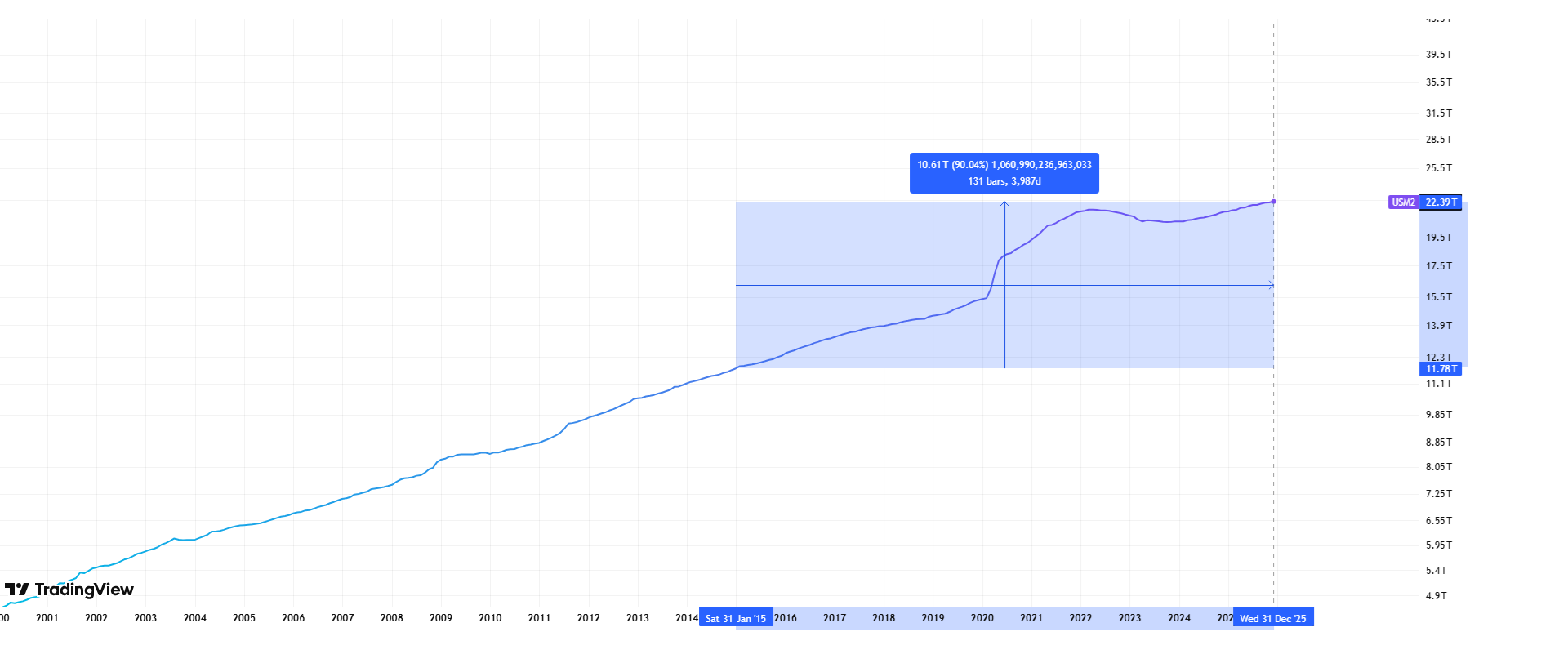
USD M2 Money Supply has Nearly Doubled over the Past Decade (Source: TradingView)
The result is persistent inflation pressure, not just in consumer prices, but across financial markets. Excess liquidity has flowed into equities, real estate, private markets, and alternative assets, driving valuations higher and compressing forward-looking returns. As asset prices rise faster than underlying cash flows, the real return potential for new capital steadily declines. In simple terms, more capital is now chasing the same return streams, making genuine alpha increasingly scarce.
For institutional investors, this dynamic is global. In markets with pegged currencies, such as the UAE with the AED tied to the U.S. dollar, local portfolios directly inherit the effects of U.S. monetary policy. Inflation, liquidity cycles, and valuation inflation are imported rather than avoided. Whether based in New York, London, or Dubai, allocators are exposed to the same structural erosion of real returns. This is why maintaining purchasing power has become harder across all traditional asset classes, not just in isolated markets.
What Investors Actually Need
Translating macro conditions into portfolio reality reveals a much higher bar for success than most investors formally acknowledge. Headline CPI inflation provides only a partial view of the problem. For institutional allocators, the more relevant metric is investment inflation, the rising cost of accessing assets that can generate sustainable returns.
In practice, the real return hurdle is not simply CPI, but CPI plus the cost of capital and operational friction. Management fees, performance fees, financing costs, hedging expenses, custody, compliance, and governance all compound into a significant drag on net performance. When these are combined, many institutional portfolios implicitly require mid single digit real returns, often in the 5–8% range once inflation, fees, and operational costs are fully accounted for, just to preserve purchasing power.
Crucially, investment inflation often runs higher than consumer inflation. This is particularly visible in private markets, where capital inflows have compressed entry yields and pushed valuations above underlying cash flow growth, reducing forward-looking return expectations. Asset prices across equities, real estate, private markets, and alternatives have risen faster than underlying cash flows. At the same time, fees remain structurally embedded in most investment vehicles, leverage has become more expensive, and illiquidity premiums are increasingly compressed as capital floods into private markets.
The institutional challenge is therefore not achieving “great returns,” but achieving reliable real returns. A portfolio that delivers 7–10% nominal performance may still fail in real terms once inflation and costs are accounted for. For long-term allocators, success is defined not by outperforming an index, but by consistently clearing a real return hurdle that keeps rising as global capital becomes more abundant and competition for yield intensifies.
How Traditional Asset Classes Perform Against the Real Hurdle
Across traditional asset classes, consistently clearing the 5–8% real return hurdle has become increasingly difficult. In public markets, long-term real returns have compressed as valuations expanded and beta became fully accessible and efficiently priced. Outperformance after inflation and volatility is rare and highly cyclical.
Hedge funds are marketed as sources of alpha, yet the median fund underperforms after fees. Performance dispersion remains extreme, with a small group of top-performing managers driving the majority of long-term industry alpha, creating a persistent access and selection problem for allocators.
Private credit offers a yield narrative, but returns remain highly sensitive to default cycles, recovery rates, and leverage conditions. In stress environments, performance often converges toward traditional credit beta.
Private equity and venture exhibit the most extreme dispersion. The top quartile drives industry returns, while market timing and illiquidity dominate outcomes. For most investors, realized performance falls short of headline expectations.
The allocator reality is consistent across markets: only the top 5–10% of managers generate true real outperformance. Most institutional capital earns benchmark-like returns, while assuming higher risk, longer lockups, and greater structural complexity.
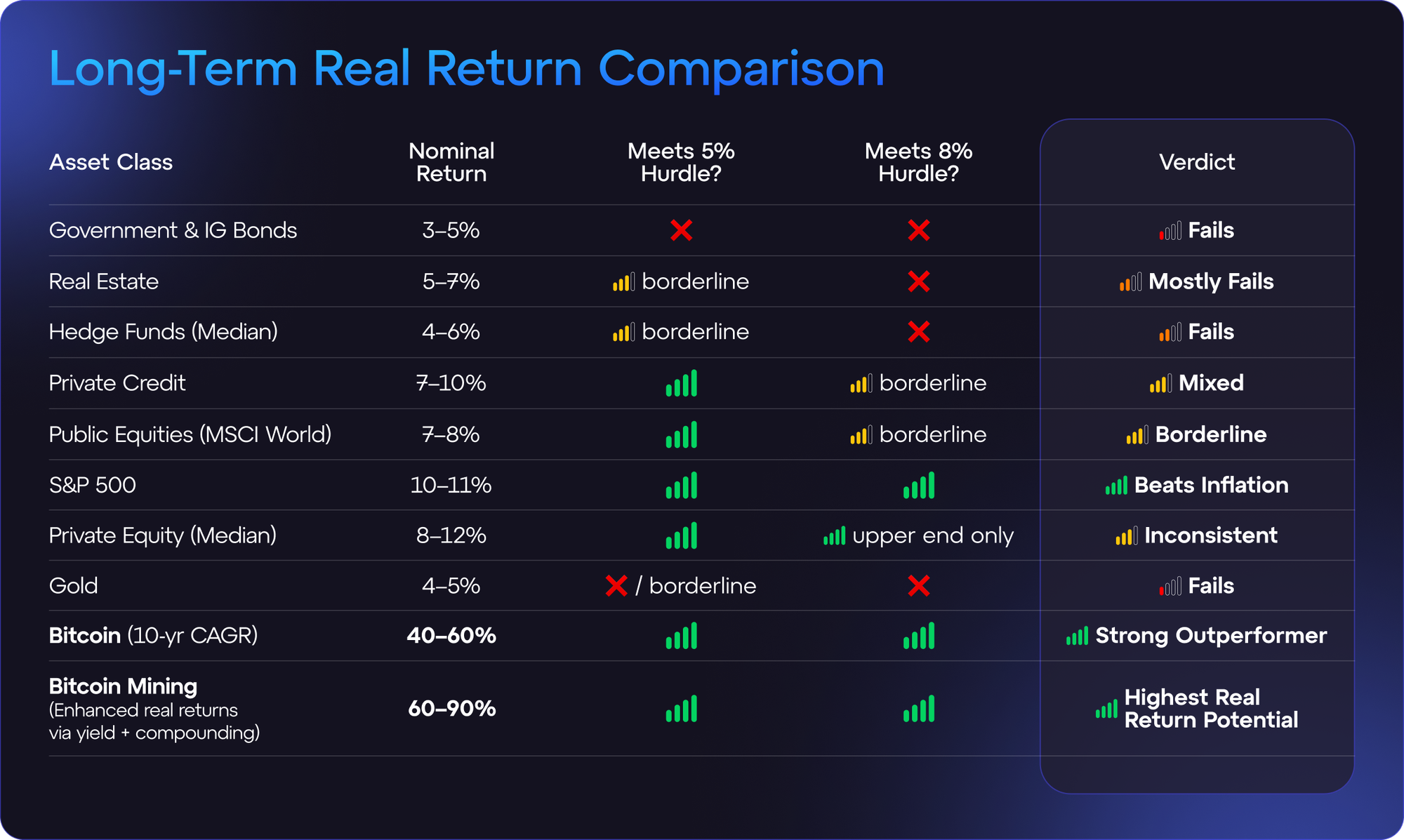
Long-Term Real Return Comparison
Bitcoin as a Real Return Asset
Against this backdrop, Bitcoin increasingly stands out not as a speculative instrument, but as a macro reserve asset with distinct monetary properties. Its supply is algorithmically fixed, making it structurally scarce in a financial system defined by continuous monetary expansion. While short-term volatility remains elevated relative to traditional reserve assets, its long-term supply predictability contrasts sharply with discretionary monetary systems. Unlike fiat currencies or yield-based assets, Bitcoin is not subject to discretionary issuance, positioning it as a long-term hedge against monetary debasement.
This narrative is no longer theoretical. Bitcoin has become institutionalized through spot ETFs, sovereign and corporate balance sheet allocations, regulated custody solutions, and integration into mainstream portfolio frameworks. Capital flows into Bitcoin today are driven less by retail speculation and more by strategic allocation decisions.
The framing has fundamentally shifted. Bitcoin is no longer primarily a high-volatility trade; it has matured into a macro reserve asset class. For institutional investors, it increasingly serves the same portfolio role as gold or inflation-linked instruments, but with superior scarcity dynamics and a digitally native settlement layer. In a world where real returns are structurally harder to achieve, Bitcoin is being evaluated not for short-term price appreciation, but for its role in preserving long-term purchasing power.
Turning Bitcoin Into a Return Strategy
If Bitcoin is increasingly treated as a strategic macro asset, the next logical question for institutional investors is no longer whether to hold Bitcoin, but how to generate returns on that exposure. In traditional markets, capital is rarely allocated to assets without a yield framework. Equities produce dividends, credit produces interest, real estate produces rent. Bitcoin, by contrast, is structurally scarce but natively non-yielding.
This is where the investment conversation naturally shifts from asset allocation to strategy design. For allocators operating under a real return mandate, the challenge is not simply owning Bitcoin, but integrating it into a portfolio in a way that contributes to long-term real performance.
If Bitcoin addresses the monetary side of the real return equation through fixed supply and scarcity, the structural question becomes whether exposure can also exhibit cash-flow characteristics consistent with institutional mandates.
One pathway institutions are exploring is Bitcoin mining. Mining transforms exposure from a passive balance-sheet position into an operational strategy with identifiable cost structures, energy inputs, and revenue mechanics tied to network economics. In this sense, mining can be evaluated through an infrastructure lens, where capital discipline, operational efficiency, and cost leadership drive outcomes.
In a world defined by rising capital competition and structurally compressed real returns, the conversation is evolving. The question is no longer whether Bitcoin belongs in institutional portfolios, but how it can be incorporated in ways that align with real return frameworks and long-term capital stewardship.
Whether through direct allocation, treasury integration, or infrastructure-linked strategies such as mining, Bitcoin is increasingly being assessed not as a tactical trade, but as a structural component of portfolio construction in a changing monetary environment.
Nico Smid – Research Analyst at GoMining Institutional