
Quant-trading is the art of turning chaos into something measurable. At first glance, the crypto market looks like a noisy casino where prices move because someone tweeted a meme. But if you look closer, you’ll notice patterns: certain events repeat, liquidity cycles come and go, and human behavior—no matter how digital the environment—still follows predictable impulses.
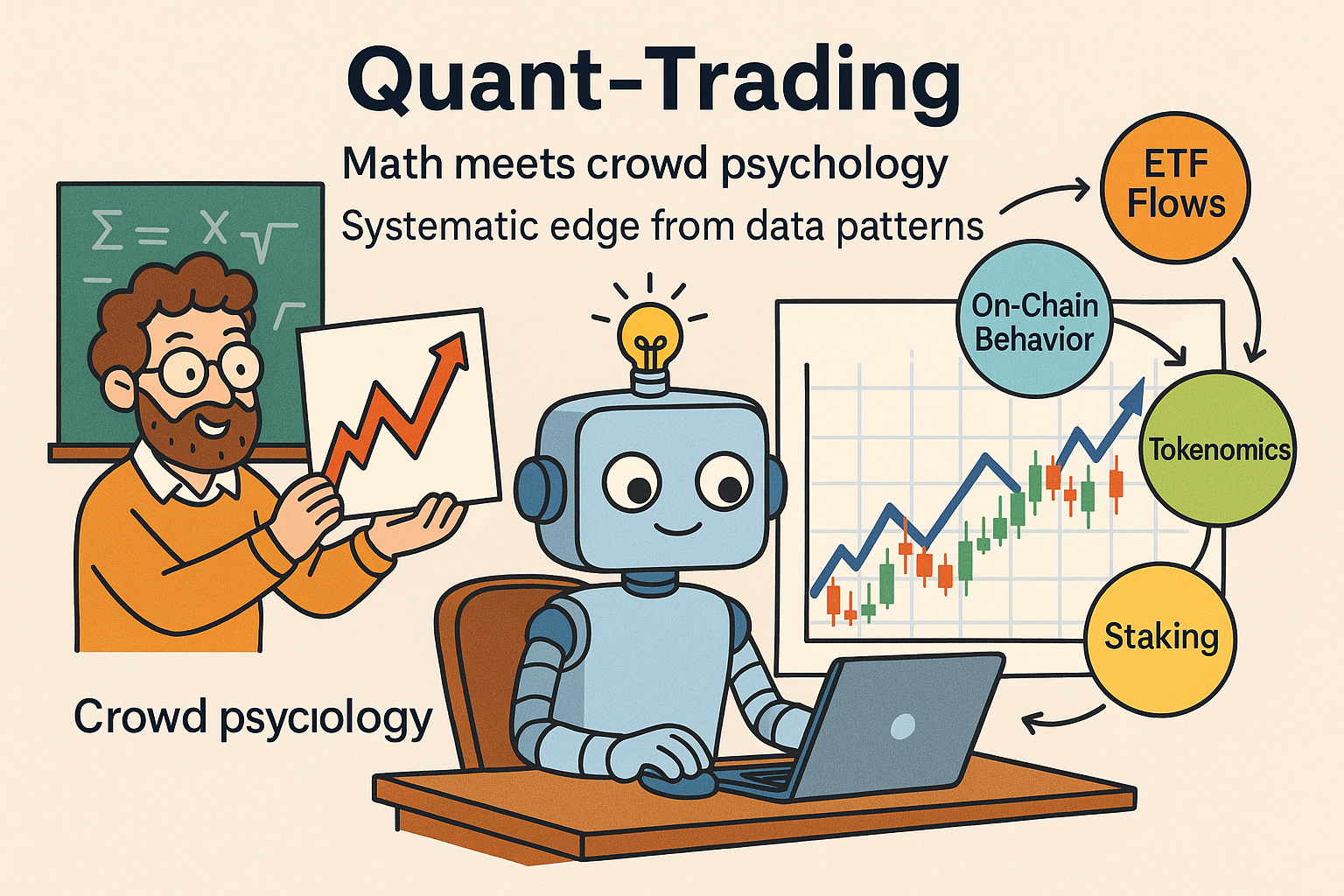
The essence of quant-trading is simple: don’t guess where the price will go. Measure what the market is doing, find a recurring pattern, and act only when the odds are in your favor. It’s not magic. It’s math applied to crowd psychology.
Why Everyone Suddenly Needs Quant-Trading
If you have ever opened a Bitcoin chart and tried to guess where it goes next, you have already faced the very problem quant-trading was created to solve. The human brain looks for patterns even where none exist. Algorithms only look for what statistically repeats.
Before 2018, most crypto traders relied on emotions, Telegram channels, and “intuition.” The market is different now. Asset prices no longer move because someone tweets “we’re going to the moon,” but because:
- funds inject liquidity into ETFs,
- institutional players rebalance their portfolios,
- stakers move coins,
- on-chain metrics indicate rising activity.
Thus, the crypto market has turned into a game of data. And those who can read the data faster and more accurately than others win.
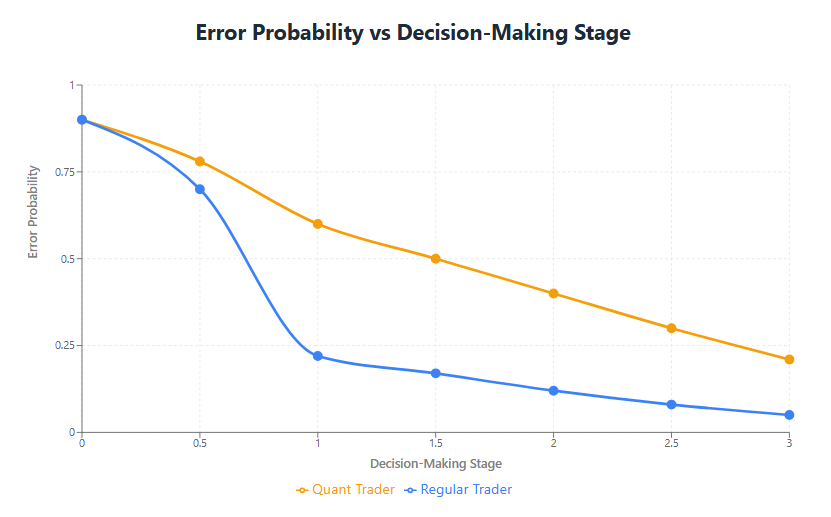
Quant-trading is an attempt to turn the chaos of the crypto market into a model where decisions are made according to predefined rules.
What Quant Trading Means
Forget complex formulas for a moment. Imagine a casino where the roulette wheel is not random. In this universe, the wheel nudges toward certain numbers every time a man in a blue suit enters the room. If you notice that pattern — you can profit.
Quant-trading does the same thing with markets. It looks for repeating patterns:
- how price reacts to stablecoin inflows,
- what happens before halving events,
- how whales behave,
- when liquidity flows into ETFs and where it exits afterward.
If you can measure a phenomenon, you can build a strategy around it. And here’s the key:
Quant-trading does not predict the future. It bets on events that statistics consider more probable.
Where Quant-Trading Works Best in Crypto
Crypto is a perfect playground for quants. Why?
- All transactions are public.The banking world is opaque — crypto isn’t. Chain data lets you see capital movement before it shows up in price.
- The market is young and inefficient.Many inexperienced participants → more arbitrage opportunities.
- Crowd behavior is cyclical.Every cycle repeats itself, even if slightly differently: hype → euphoria → panic → capitulation.
- Staking and PoS mechanics create predictable token flows.Ethereum validators earn rewards and periodically sell part of them — a pattern waiting to be used.
How the Quant Approach Works: A Simple Model for Beginners
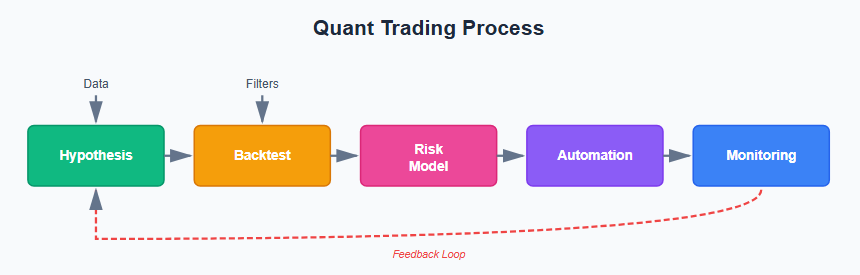
To avoid drowning in terminology, break the process down into steps:
Step 1 — Formulate a hypothesis.Example: “If stablecoin balances on exchanges increase, BTC tends to rise over the next 3–10 days.”
Step 2 — Check the raw data.Use statistics from CoinGlass, Kaiko, or DeFiLlama.
Example: according to CoinGlass, a February 2025 USDT inflow preceded a 7.4% rise in BTC within a week.
Step 3 — Backtest the strategy.If a rule made money in the past, it doesn’t guarantee success — but if it worked in multiple conditions, you gain an edge — a statistical advantage.
Step 4 — Automate execution.Robots follow rules without emotions.
Step 5 — Monitor risk.Quant is not just about entering a trade — it’s about surviving long enough to profit.
How Not to Do Quant-Trading
This is the painful part. Beginners:
❌ think bots replace thinking❌ copy someone else’s strategy❌ start by buying an algorithm instead of learning❌ forget about risk management❌ still trade emotionally even if they have an algorithm
The biggest mistake is replacing statistics with hope.
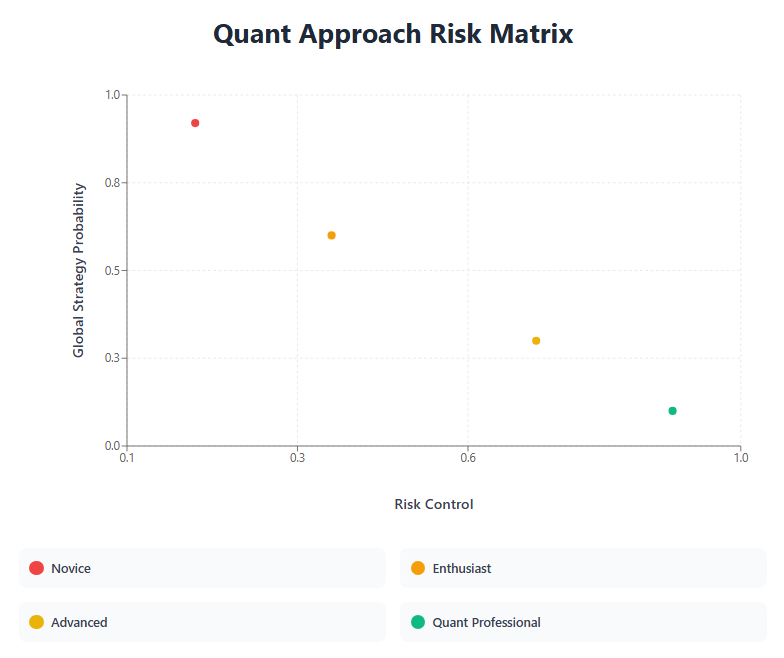
If you bought a bot and expect miracles — you are not a quant-trader. You are outsourcing responsibility to code. Quant-trading begins when you can explain why your strategy works.
What Drives the Market in 2025–2026
The crypto market is no longer a meme show with “to the moon” predictions. Its direction is now formed by capital flows — who moves money, where, and why. If you understand these flows, you see the market before it shows up on the chart. Here’s what truly influences price and where to track it live:
Crypto ETFs and Institutional Flows
Since BlackRock, Fidelity, and other giants entered crypto, the market moves according to their schedule. ETF flows are Bitcoin’s new breathing pattern.
Logic: when ETFs buy coins → supply drops → price rises.
Where to track:
- Bloomberg ETF dashboards: https://www.bloomberg.com/crypto
- SEC filings: https://www.sec.gov/edgar/search
Stablecoin Inflows and Outflows
Stablecoins are the blood of crypto. More stablecoins on exchanges = readiness to buy. Outflows = profit-taking and fear. Core logic:
USDT inflow ↑ → liquidity ↑ → altcoins and BTC get momentum
Where to track:
- CoinGlass — Exchange Stablecoin Reserves: https://www.coinglass.com
- DeFiLlama — Stablecoins Overview: https://defillama.com/stablecoins
Staking Yield and Validator Behavior
In Proof-of-Stake systems, staking rewards influence how long users hold coins. When yields rise, validators tend to lock tokens longer. When yields fall, some sell part of their rewards. Where to track:
- Staking Rewards: https://stakingrewards.com
- Beacon Chain Dashboard: https://beaconcha.in
Changes in PoS Systems and Tokenomics
Any update in PoS protocols—slashing penalties, emission adjustments, validator incentives—reshapes capital flows. Each modification affects how long investors hold assets and when they decide to sell. Where to track:
- Ethereum Roadmap: https://ethereum.org/en/roadmap
- Messari Research: https://messari.io
On-Chain User Activity and Wallet Behavior
Dormant wallets waking up, large incoming transfers, smart money accumulation — all of this hints at market intentions before price movement becomes visible. Where to track:
- Nansen Smart Money: https://nansen.ai
- Glassnode on-chain metrics: https://glassnode.com
Whales and Liquidity Distribution
Whales shape price corridors. Their buying creates market floors, while their selling forms resistance. Liquidity pools act like magnets: price moves toward areas with clusters of liquidity because that’s where market makers can execute volume efficiently. Where to track:
- Whale Alert: https://whale-alert.io
- CryptoQuant: https://cryptoquant.com
The idea is not to predict the future. The idea is to notice trends before the public sees them, by understanding where capital is preparing to move. Those who watch these metrics are not “smarter.” They’re simply earlier.
How to Build Your First Quant Strategy
You don’t need a PhD in mathematics or access to Goldman Sachs’ secret servers. You simply need to understand that the market isn’t mysticism — it’s a set of repeating habits shared by people and capital. Your job is to notice those habits and turn them into rules.
Find One Clear Signal
Don’t try to grasp the entire market at once — that’s the mistake 99% of beginners make. Choose one metric that actually means something. For example:
- when the amount of stablecoins on exchanges grows, someone is preparing to deploy capital;
- when TVL in DeFi increases, it means people are locking funds and expecting returns;
- when Ethereum network activity rises, something is brewing under the surface.
One signal > ten random ideas.
Look at What Happened to Price Before
Don’t invent a strategy out of thin air — the market has already lived through every scenario.
Ask yourselfe:
“When this metric increased before — did Bitcoin usually fall, stay flat, or go up?”
If you see that most of the time the result was growth, it’s not a coincidence — it’s a trail.
Test the Idea on History, Not on Emotions
In the quant world, this is called a backtest, but don’t let the word intimidate you. The meaning is simple:
- find 10–20 similar situations in the past,
- measure how they ended,
- if 7 out of 10 outcomes were in your favor, it’s no longer guessing — it’s a statistical advantage.
That advantage is called an edge. Without an edge, trading becomes a casino — just without the free alcohol.
Add Common Sense (a.k.a. Filters)
Sometimes even a working pattern breaks, because the market is under pressure from external events. Typical red zones where any strategies become useless:
- Federal Reserve (FOMC) meetings,
- abrupt ETF capital flows,
- sudden regulatory announcements.
During such periods, the market behaves irrationally — and quant strategies are built on rationality.
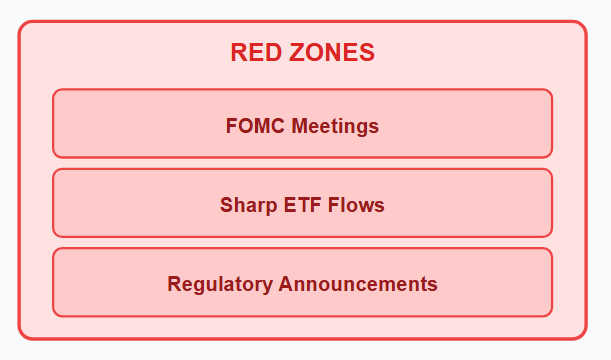
A filter = the right not to enter a trade when you don’t understand what’s happening.
Write Down How Much You Are Ready to Lose
This is the most unpleasant step, which is why people avoid it — and that’s a mistake. A strategy without defined risk is like a car without brakes: the highway may be straight now, but sooner or later, there will be a turn. Define:
- how many percent of your capital you are willing to pay for the right to be wrong;
- how you exit the position if the market reverses;
- what you'll do if the signal disappears.
A strategy exists only when it has boundaries.
A Simple Example of a Working Hypothesis
Let’s take a real scenario:
Hypothesis:When stablecoin balances on exchanges increase, Bitcoin tends to grow within the next 3–10 days.
Why it works:
- Stablecoins represent dry capital,
- They appear on exchanges before purchase,
- Price reacts with a delay.
Your task is not to believe — your task is to check the data. If it works in 7 out of 10 cases, this is no longer a coincidence. It's an edge.
Quant-Trading Without Risk Control Does Not Exist
Beginners focus on setups. Professionals focus on limits. Before entering a trade, define:
- where you exit if you're right,
- where you exit if you're wrong,
- how much you are willing to lose.
A strategy without risk rules is not a strategy — it’s a wish. Wishes don’t survive in the market. Rules do.
Common Beginner Traps
- Searching for a “magic bot.”
- Believing code replaces understanding.
- Trading without reviewing past behavior.
- Ignoring risk.
- Mixing quant logic with emotions.
If you don't know why your trade should work — you’re not a quant. You're a dreamer.
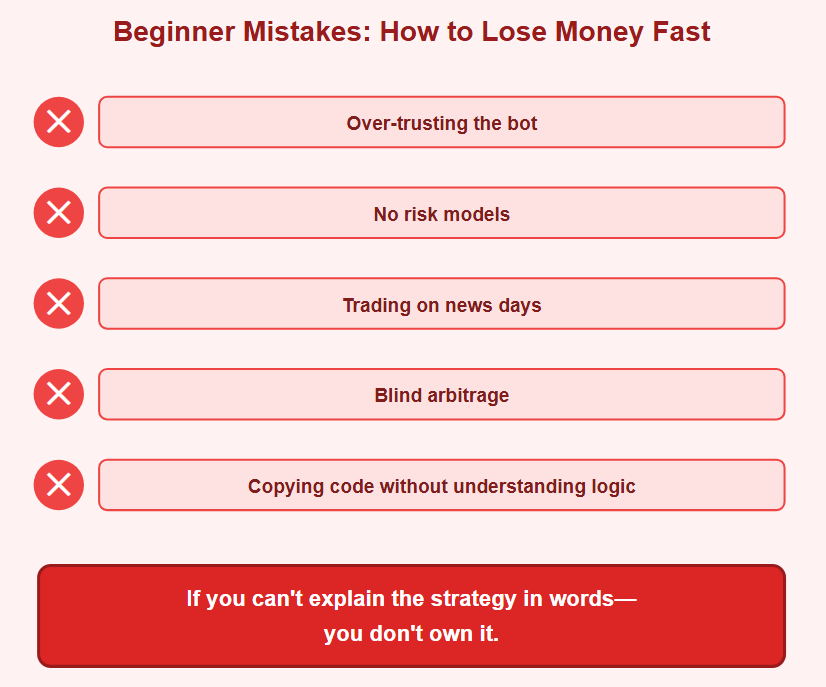
The moment you can explain the logic behind your trade in one clear sentence — that’s when quant-trading begins.
Why Quant-Trading Works
Most people lose money not because the market is unbeatable, but because they behave irrationally. They enter trades without rules, exit based on fear, and constantly chase narratives. Quant-trading removes emotions from decisions by transforming the market into a set of measurable conditions.
A quant does not ask:
“Will Bitcoin go up?”
A quant asks:
“What is the probability of Bitcoin rising if certain conditions are met?”
This shift in thinking is where profitability begins. Profit doesn't come from guessing the right direction — it comes from repeatedly acting only when the odds favor your position.
What Makes Crypto Special for Quants
Traditional markets are influenced by delayed reports, opaque processes, and information asymmetry. Crypto is transparent:
- every transaction is recorded on-chain,
- liquidity movements are visible,
- whale activity is traceable,
- staking incentives and system upgrades are public.
In other words, the crypto market leaves footprints. Quant strategies follow those footprints.
Once you start treating the market as a source of signals rather than a battlefield of emotions, you realize something important: crypto doesn’t punish you — your reactions do.
FAQ
What is quant-trading?Trading based on verifiable statistical rules rather than intuition or emotions.
Why do we need the quant approach at all?To remove guessing and replace it with a probabilistic advantage grounded in data.
How does it work in crypto?Algorithms analyze on-chain metrics, liquidity, capital flows, and whale behavior to forecast the most likely price movements.
Which metrics matter in 2025?TVL, stablecoin volumes, ETF flows, network activity, MCAP, FDV, whale tracking, and staking-related changes.
Where should a beginner start?Choose one metric, find a recurring pattern, and test it against historical data — without trying to be clever or collect everything at once.
Do I need to know how to code?No. In the beginning, Excel and publicly available dashboards (Glassnode, CoinGlass, Nansen) are more than enough.
Can I lose money?Easily. Without defined risk and exit rules, any strategy turns into a lottery.
Why is the quant approach considered fair?Because it is based on facts rather than “I feel like it’s going up.”
Is quant-trading guaranteed profit?No. It’s not a magic button, but a system that gives you better-than-average odds over the long run.
How does quant-trading affect the crypto market?It reduces emotional decisions and amplifies the role of data, making the market more mature and predictable.
What will change in 2026?Algorithms will incorporate more on-chain behavioral patterns, and strategies will shift from “guessing the price” to analyzing flows and network activity.
Where can I follow updates on this topic?On analytical dashboards, on-chain services, and educational platforms with real statistics — not in random “signal” channels.
Final Thoughts
Quant-trading in crypto is still in its early phase. Over the next few years, this segment will move from a niche solution to an essential tool for anyone who wants to compete in a market driven by:
- public blockchains,
- staking economics,
- token supply mechanics,
- institutional inflows,
- and measurable user behavior.
The question is not whether quant-trading will define the future of crypto.
It already does.
The only question left:
Will you participate as a player — or remain part of the crowd?
Want to keep going?If you’ve read this far, you’re no longer gambling — you’re building a system. Save this article, come back to it in a month, and notice which patterns you’ll start recognizing without effort. In the next materials, we will cover:
- how to read on-chain data,
- how to track ETF flows,
- how the market builds trends around whales.
Subscribe to Crypto Academy and get access to the crypto and Bitcoin course. It’s free — while everyone else is still waiting for a signal.
Telegram | Discord | Twitter (X) | Medium | Instagram