
Imagine opening a Bitcoin chart — candles, levels, volume spikes. Someone buys, someone sells, and it looks like a chaotic crowd of traders trying their luck. But that picture is misleading. The price doesn’t move because ten thousand retail traders clicked “Buy.” It moves because three to seven major wallets shifted capital. These players push liquidity, set market direction, and shape entire cycles.
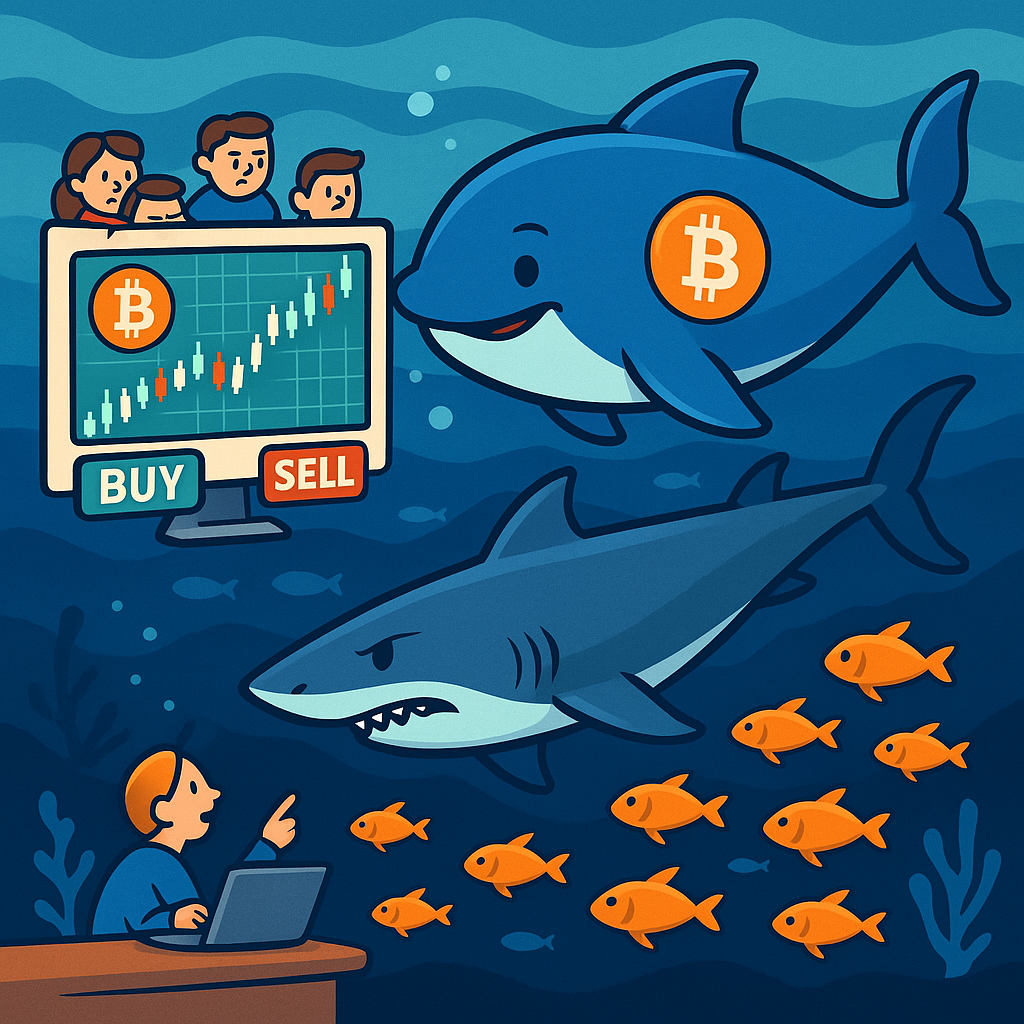
Crypto feels decentralized and democratic, but in reality, the market behaves like an ocean with a hierarchy. Retail traders are small fish, funds and exchanges are sharks, and whales — the biggest holders — are the ones who can buy, sell, or freeze assets in a way that makes the next year look “predictable,” but only in hindsight.
Crypto whale hunting isn’t about hunting anyone. It’s the skill of reading money trails, spotting where the big capital moves, and positioning yourself early — not because you outsmart the market, but because you follow the forces shaping it.
Why This Becomes Critical in 2025
Crypto once ran on emotions. In 2022–2023, the market was fueled by hype, meme coins, rumors, and FOMO-driven trades. Prices rose not because of strategic capital, but because the crowd didn’t want to miss out. Signals were rare — noise dominated everything.
Then 2024 arrived, and the industry changed almost overnight. Institutional capital stepped in — hedge funds, banks, ETF operators, corporate treasuries. These players don’t gamble; they operate with multi-year horizons, compliance frameworks, and clear objectives. They don’t chase memes — they deploy capital strategically, and those movements now leave visible digital traces.
This shift makes 2025 a turning point. A new analytical toolkit appeared that reveals where big money goes — and this transparency transforms the entire market:
Spot Bitcoin ETFsA single ETF deposit isn’t just a purchase — it’s a statement of long-term demand. If ETF inflows rise, liquidity grows and the market usually follows. These signals are public, so you can literally watch whales enter the market in real time.
On-chain analyticsEvery major crypto transfer is permanently recorded on the blockchain. You can now see when a wallet holding thousands of BTC, ETH, or stablecoins wakes up and moves funds. What used to be hidden now looks like watching an oil tanker move across a calm sea — impossible to ignore.
Stablecoin reservesA spike in USDT or USDC on exchanges usually signals the same thing: whales are preparing to buy. It predicts price action better than headlines or influencer tweets.
Proof-of-Stake and Layer-2 networksWhales no longer just hold coins — they earn yield. Major ETH stakers and L2 operators influence network fees and liquidity flows. Their moves create measurable economic signals.
DeFi liquidityWhen large capital enters a liquidity pool, yields shift, fees adjust, and tokens of that ecosystem often react afterward. Liquidity now speaks louder than narratives.
Whales have stopped being myths. In 2021–2022, you could only guess who was driving the market. In 2025, you can:
- see their entries,
- understand their intentions,
- and profit from their consequences.
This is no longer a casino. Crypto is turning into a readable system of capital flows — and those who learn to read it gain an actual edge over the crowd.
What Crypto Whale Hunting Really Means
Crypto whale hunting is a strategy built around watching what the wealthiest players do — those with large balances of Bitcoin, Ether, and stablecoins. They are called whales for a reason: when they move, the market feels the wave.
The point isn’t guessing where the price will go or chasing Telegram “signals.” You look at real money in motion — when major wallets buy, sell, or move stablecoins onto exchanges. These actions are visible in the blockchain, ETF flows, and exchange data.
If whales are accumulating, markets tend to rise. If they begin offloading or pulling liquidity, a downturn often follows. Their decisions come first; the price reacts later. Your job is not to fight them — just notice and align. This strategy stands apart because:
- you don’t predict the future,
- you don’t rely on opinions,
- you don’t worship influencers,
—you simply follow the money that shapes reality.
Why Whales Almost Always Win, and Retail Almost Never Does
Whales operate in a different reality from ordinary traders. They don’t rely on hype, breaking news, or someone’s prediction on social media. They hold three advantages that retail traders simply don’t have:
Information. Whales know what’s coming long before headlines hit the public. They have access to private research, institutional flows, regulatory signals, and inside infrastructure data. By the time news reaches retail, whales have already positioned themselves.
Capital. Retail reacts to price. Whales change price. When you can deploy millions in a single move, you don’t wait for a trend — you create it.
Time. Retail traders are impatient and often need quick results. Whales don’t. They can wait weeks, months, or entire cycles. In crypto, patience isn’t a virtue — it’s a weapon.
Retail behaves in the opposite way:
- they react to news after moves have happened,
- they sell at the bottom and buy at the peak,
- they trade emotions, not capital flows.
This is why whale hunting isn’t about being smarter — it’s about being attentive. If you track what whales are doing, you don’t need predictions. You need awareness.
How Whale Hunting Works
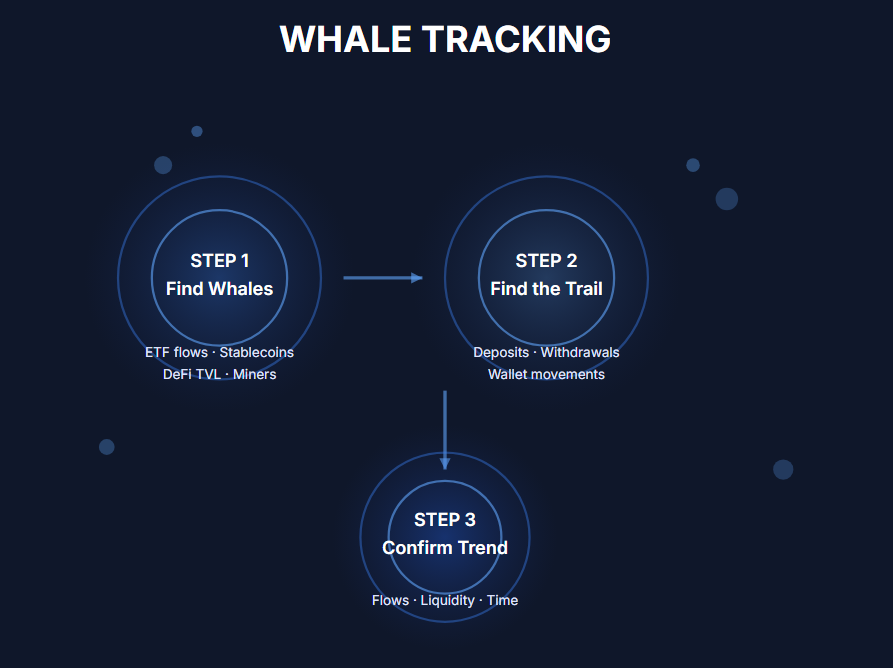
STEP 1 — Find Where Whales Live
Whales are not hiding. Their movements leave footprints in specific parts of the crypto ecosystem — places where big money must pass through:
Bitcoin ETFs. These vehicles are now the largest structural buyers of Bitcoin. Persistent inflows = higher demand, lower sell pressure, and a bullish environment. Their data is public and updated daily. ( https://farside.co.uk, https://sosovalue.com/).
Stablecoin reserves. An increase in USDT or USDC on exchanges is like fuel before takeoff. It means whales are preparing to buy. More stablecoins = more liquidity ready to deploy. (https://glassnode.com).
DeFi TVL and yield changes. When TVL (Total Value Locked) rises sharply, it’s rarely an accident. Money enters first, price reacts later. In many ecosystems, token growth follows TVL increases by 8–14 weeks — a timeframe you can verify historically. (https://defillama.com).
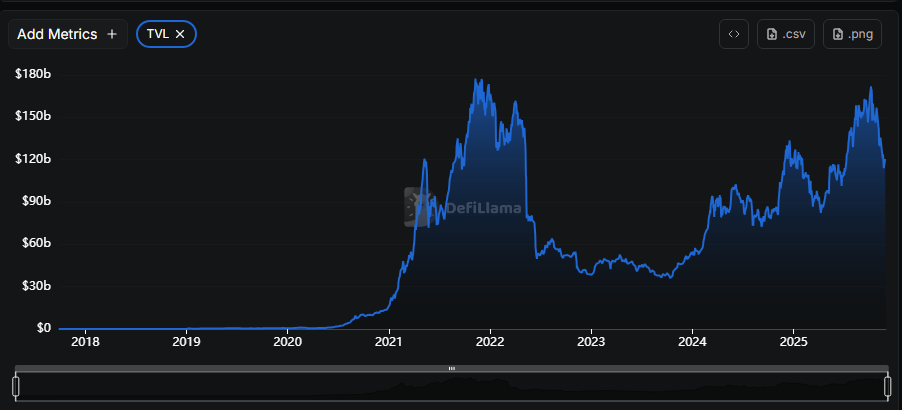
Source: defillama.com
Miner flows. Miners are forced sellers over time. When they hold or accumulate instead of selling, the market strengthens. When they sell aggressively, it cools. Miners' wallets act like a pressure gauge for Bitcoin cycles. (https://coinglass.com).
These aren’t abstract indicators — they are the habitats where whale activity becomes measurable.
STEP 2 — Find the Trail
Whales rarely move in one grand gesture. They act in sequences — quiet, deliberate, and logical. If you know what to watch, the signals appear in order:
- they add assets to exchanges before selling,
- accumulate stablecoins before a push upward,
- move coins to cold wallets to reduce sell pressure,
- increase open interest before a trend forms.
Think of it like tracking footprints in snow. One mark means nothing. A trail means direction.
STEP 3 — Confirm the Trend
Only three things never lie: flows, liquidity, and time.
Charts can mislead, narratives can distract, but money behaves with mathematical consistency. If capital moves in one direction, price eventually follows — not instantly, but inevitably.
Where the Money Really Is
The biggest misconception is that profits come from predicting whales. They don’t. Profits come from reacting to the consequences of whale actions. Here’s how it works in practice:
When a whale moves stablecoins to an exchange, they are preparing to buy. As demand grows, prices rise. You position yourself early.
When a whale withdraws Bitcoin to cold storage, they signal they’re not planning to sell. Lower supply = less selling pressure = calmer or rising markets.
When a whale enters DeFi pools, liquidity increases, yields improve, and ecosystem tokens often rally shortly after.
When a whale participates in ETFs, fiat flows into the market, strengthening structural demand. ETF inflows are now one of the strongest bullish signals available.
You are not guessing the future. You are aligning with decisions that have already been made.
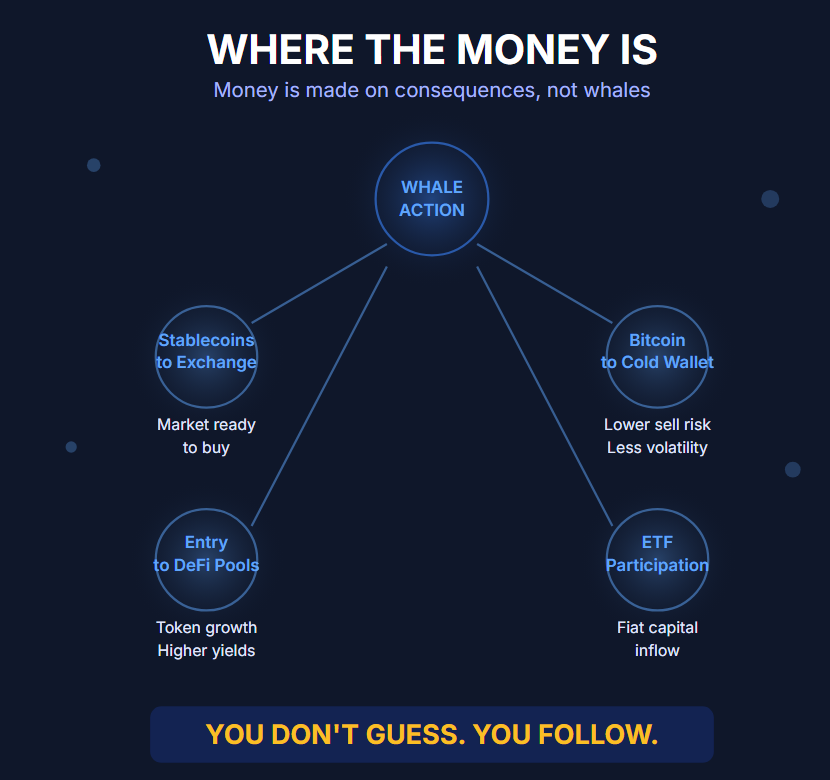
Whales move first. Prices move later. The gap between those two events — that’s where your money is.
The Numbers That Turn Theory Into Reality
To understand why whale hunting stopped being a metaphor and became a real strategy, you need to look at the data. In 2025, the crypto market stopped behaving like a casino and turned into something predictable — not because prices became stable, but because capital leaves evidence.
Today, most major Bitcoin movements are not driven by retail frenzy. They are controlled by roughly one hundred of the largest wallets. Not thousands of traders, not Telegram chats, but a tiny group of holders who can shift market direction with a single allocation.
According to late-2025 market research, over 73% of large BTC transfers can be traced back to these wallets. If you follow them, you’re not just observing traders — you’re tracking the nervous system of the entire market.
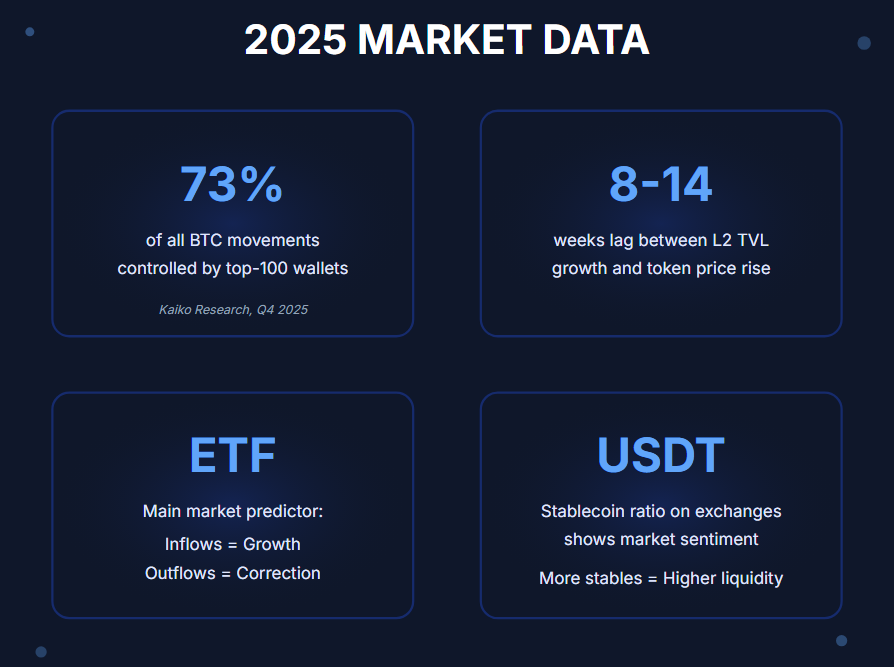
Another critical metric is the Layer-2 sector. Whenever Total Value Locked (TVL) rises in L2 ecosystems, token prices tend to follow with a delay of eight to fourteen weeks. This pattern has repeated across multiple cycles: liquidity arrives first, attention follows, price reacts last.
ETF inflows have become one of the strongest market indicators. When money flows into ETFs, the market expands. When it flows out, corrections begin. This single metric now often outperforms all the emotional predictions of “where Bitcoin is headed.”
Finally, stablecoins act as sentiment fuel. A rise in USDT or USDC on exchanges means whales are preparing to take positions. Money rarely appears on exchanges without intent — it arrives to be deployed.
These metrics are not opinions. They are footprints — left by real money.
Why Whale Hunting Is Especially Profitable in 2025–2026
The market no longer behaves like a roulette wheel. In previous years, investors guessed, hoped, reacted to tweets, and chased volatility. That era is over.
Crypto has matured. Bitcoin ETFs brought institutional capital. Corporations now hold digital assets on balance sheets. Proof-of-Stake turned holding into a yield-generating activity. DeFi made liquidity visible, measurable, and monetizable. This transparency changed the rules:
- You can now watch whales move,
- You can see how liquidity builds,
- You can observe how trends begin before price reacts.
Whales cannot hide billion-dollar transfers, ETF inflows, or sudden surges in DeFi liquidity. Their actions, once invisible, are now public signals.
For the first time, even newcomers — without coding skills, insider access, or years of trading experience — can leverage capital flows instead of trying to predict them.
The takeaway is simple:
Don’t fight whales. Follow them. They don’t move markets because they’re smarter — they move markets because they have money. And now, you can see where that money goes.
The Main Risks
Whale hunting sounds straightforward: track big wallets, align with the trend, profit. But there are traps that catch beginners almost immediately:
False signals. Sometimes a massive transaction is nothing more than a wallet reshuffling its own funds. Without context, you might mistake internal transfers for buying pressure.
Data lag. Blockchain and on-chain dashboards update fast, but not instantly. If you act too late, you might enter when the move has already matured.
Misreading metrics. TVL rising doesn’t always mean a bull run. Stablecoin inflow may be hedging, not accumulation. Understanding why something happens matters more than the number itself.
Trying to outrun whales. This is the deadliest mistake. People believe they can predict what whales will do next. They rush ahead — and become exit liquidity.
Whales move slowly, deliberately, and with purpose. If you try to race them, you’re not a hunter — you’re food.
Expert Quotes
Alex Brant, FlowMetrics Research Analyst: "Whale behavior isn’t mystical or conspiratorial. It’s capital too large to hide. If you follow where the money flows, you see where the market will go long before headlines catch up."
Irina Vasilieva, CTO at Helix Protocol: "Beginners watch prices. Professionals watch liquidity. Price is a result; liquidity is a cause. Whales operate at the cause, which is why they almost never lose."
FAQ
What is crypto whale hunting?A market strategy based on tracking the actions of large holders and profiting from the market shifts they trigger.
Why are whales so important?They control liquidity. A handful of large wallets can move prices faster than thousands of retail traders combined.
How does whale hunting work in practice?You analyze capital flows — ETF inflows/outflows, stablecoin balances, TVL growth, mining activity — not just price charts. These metrics show intent ahead of price.
Can you actually earn money this way?Yes. Profit comes not from guessing market direction, but from aligning with moves whales have already initiated.
What data matters most?Bitcoin ETF flows, stablecoin distribution, DeFi liquidity, and major wallet movements. These reveal where capital is going.
How is this different from regular trading?Trading is emotional and speculative. Whale hunting is observational — you react to real money, not narratives.
Why does retail lose so often?Retail enters after the move, exits at the wrong time, and trades based on headlines instead of capital flows.
What are the main risks?Fake signals, metric delays, wrong interpretations, and attempts to outrun whales.
How do I confirm a whale move is real?Look for a sequence: stablecoin inflows → TVL rise → ETF participation → liquidity shift. One signal is noise; patterns confirm intent.
What will change in 2026?ETF adoption and PoS economics will further expose whale behavior. Tracking flows will become a standard skill — guessing will die out.
Where can I track whales now? Glassnode, CoinGlass, Nansen, and DefiLlama provide real-time capital flow analytics without guesswork.
Final Thought
You can argue about charts forever. You can debate indicators, narratives, and predictions. But markets always migrate toward capital. Whales aren’t enemies — they are navigators.
If you learn to read their movement, you won’t chase the market — you’ll arrive before everyone else.
Want to stay ahead of everyone else? Join us and get access to GoMining’s free crypto and Bitcoin course — while it’s still free.
Telegram | Discord | Twitter (X) | Medium | Instagram