

When people first hear about Ethereum, they almost always make the same mistake. They see ETH as just another cryptocurrency — the number-two coin after Bitcoin, with charts, price targets, and endless arguments about whether Proof-of-Work or Proof-of-Stake is superior. That perspective belongs to the past. In 2025, it no longer explains what Ethereum has become.
Ethereum today is not a coin. It is an economy — a network that doesn’t simply store value, but redistributes it, processes it, services it, and turns it into a flow. There is no bank inside Ethereum, yet there is a yield. There is no government, yet there are rules. There is no regulator, yet there is a mechanism that protects users more reliably than most state institutions.
Since The Merge in September 2022, Ethereum stopped being a mined asset. It became a staked asset. You no longer “mine” ETH — you validate its existence.
And here lies the first fracture between the old world and the new one. In the old world, money sits still. In the new world, money works.
What Is Ethereum (ETH) Staking?
Stripping away the jargon, staking is surprisingly down-to-earth. Imagine a city that doesn’t hire guards, but instead asks residents to put down a security deposit as proof that they care about its safety. In return, citizens receive a share of the city’s operational income. This is exactly how Ethereum functions after switching to Proof-of-Stake.

Source: GoMining.Com
You stake ETH — the network uses it as a signal of trust — and you receive rewards. It’s not “interest.” It is participation. The yield doesn’t materialize out of thin air. It comes from:
- base issuance,
- transaction fees,
- ETH burning under EIP-1559,
- MEV rewards for validators (optimizing transaction ordering),
- competition for liquidity across protocols.
You can verify all of this yourself:
https://ultrasound.moneyhttps://etherscan.iohttps://nansen.aihttps://defillama.com
Once you see the numbers, you understand: this isn’t a promise of yield — it is a model.
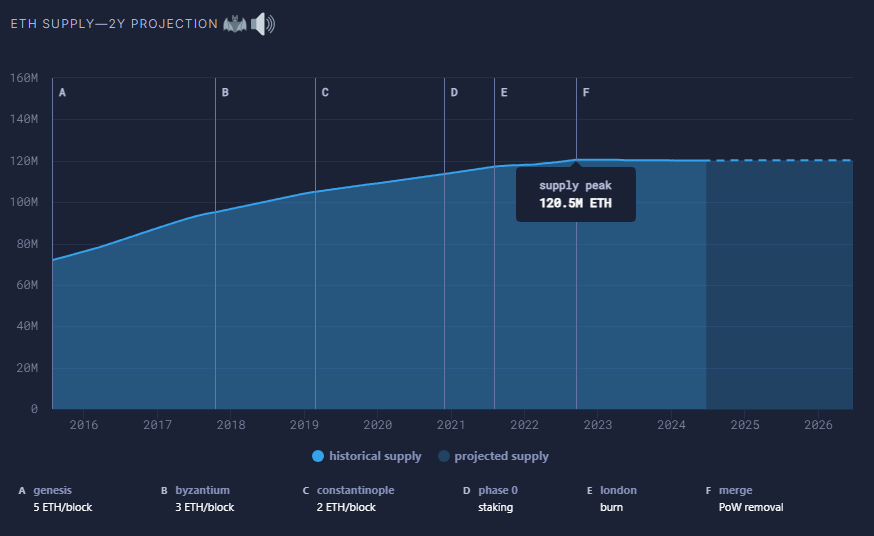
Source: ultrasound.money
Why Ethereum (ETH) Staking Mechanism Changed Investor Behavior
Traditional finance is built on passive instruments: deposits, bonds, dividends. Ethereum inverted the logic:
“You don’t earn yield for owning an asset. You earn yield if your asset helps the network.”
This single shift split crypto participants into two groups:
- people who hold a token,
- people who assign it a role.
The first group remains speculators. The second becomes on-chain investors.
For the first time in history, capital isn’t serviced by an external institution — capital itself provides the service. It is as if your bank deposit earned returns not because the bank wanted it, but because the system literally depends on your participation.
From Holder to Investor: The Journey Everyone Makes
Your journey mirrors the evolution of participation in any economy:
At first, you buy ETH because “they say it will go up.” That’s the hope stage. You have no plan, only a desire for a miracle.
Then you learn you can stake ETH and earn yield. That’s the discovery stage. You compare APRs, choose a provider, read reviews.
A few months later, something odd happens: the asset that just sat there yesterday now works inside the network. You follow TVL, check burn ratios, read Glassnode, and understand why ETH supply is in deflation.
From that moment, you stop reacting to whale trades. Price becomes secondary. Flows become the primary signal.
This is the birth of on-chain thinking — the moment you stop asking “When will it moon?” and start asking:
“How can my ETH contribute to the economy and generate yield regardless of price?”
Where the Real Game Begins: Liquid Ethereum (ETH) Staking and Restaking
If staking is the basic level, the real magic begins when you receive a liquid staking token — stETH, rETH, sfrxETH, ETHx.
This is not a deposit receipt. It’s a new asset. You can use it:
- as collateral in Aave,
- for yield farming,
- for lending,
- for restaking in EigenLayer.
Restaking means your ETH earns twice: it helps Ethereum and services external protocols. It’s like renting out an apartment to two tenants — one uses the rooms, the other installs a 5G tower on the roof and pays for it.
This is a new market, already measured in billions. Look at the data:
https://app.eigenlayer.xyzhttps://defillama.com/charts/restaking
Why Ethereum (ETH) Yield Is the New Interest Rate of the Internet
When Nansen analysts first called Ethereum staking yield the base yield of Web3, many didn’t understand what they meant. But it’s simple:
- The U.S. has Treasuries — the anchor of traditional finance.
- Web3 had no anchor — until Ethereum PoS.
Now there is an asset that offers:
- global yield,
- access from any device,
- independence from banks and states,
- transparent on-chain economics.
This is the interest rate of the future internet.
Risks Without Illusions
There are always risks. The absence of risk is a myth. But these risks are honest, on-chain, and transparent:
- liquidity concentration around Lido,
- regulatory shocks tied to ETFs,
- a restaking bubble if yield becomes the goal,
- slashing for validator mistakes.
These risks aren’t hidden inside legal PDFs. They are on-chain, where anyone can inspect them.
Where Ethereum (ETH) Yield Actually Comes From
Many think staking is just “interest.” Wrong.
Bank interest is compensation for letting the bank use your funds. Ethereum staking rewards are compensation for securing the network. Yield comes from:
- Base issuance — changes with the share of ETH staked
- Transaction fees — paid every time someone uses the network
- EIP-1559 burning — making ETH deflationary (see https://ultrasound.money)
- MEV — the invisible engine of blockchain economics
- Restaking — external protocols paying for Ethereum security
It’s like your bank deposit simultaneously working for another business without withdrawing funds.
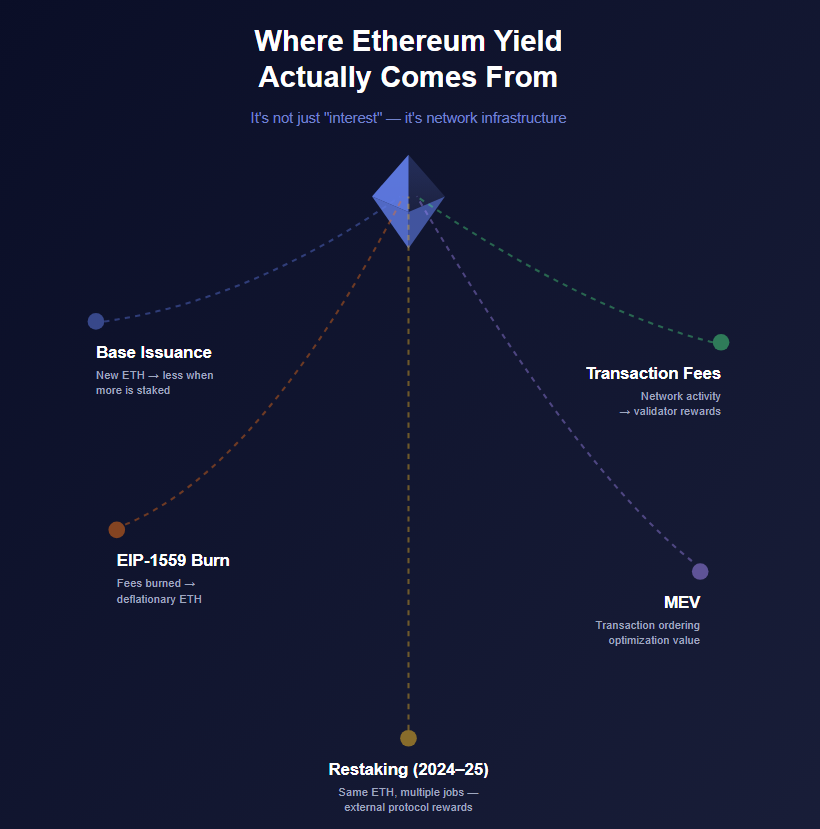
Source: GoMining.Com
Liquid Staking and Why It Turned Ethereum’s (ETH) Economy Upside Down
The moment Lido introduced stETH was the turning point. Before that, staking ETH was like a fixed-term deposit: frozen funds, no access. Now there’s a liquid receipt.
stETH, rETH, sfrxETH, ETHx — these are not tokens. They are collateral for the future economy. You can:
- stake ETH,
- get stETH,
- use it as collateral in Aave,
- borrow against it,
- buy more ETH,
- repeat the cycle.
This isn’t magic. It’s capital under management. And liquid staking TVL is one of the fastest-growing DeFi sectors:
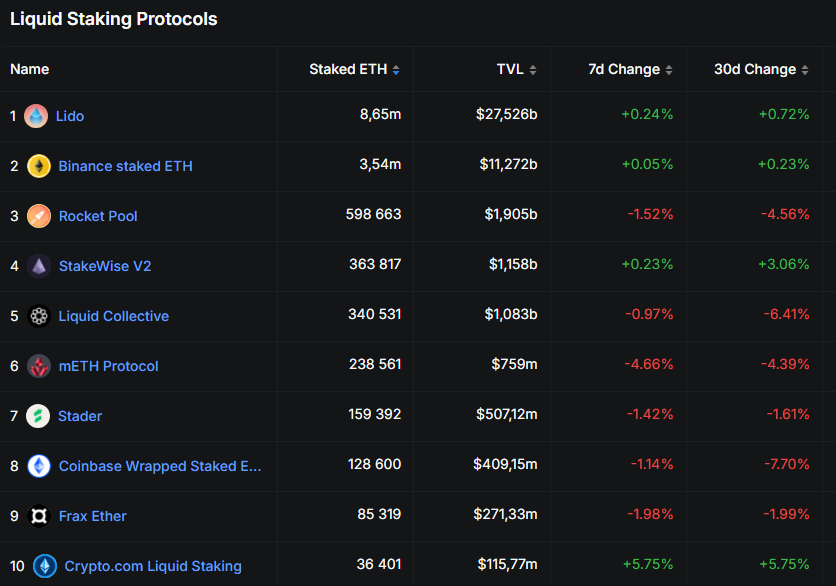
Source: defillama.com
Ethereum (ETH) Restaking: When Capital Works Twice
Here the second layer of meaning appears. EigenLayer made the impossible real: Ethereum’s security can be reused. If your ETH already confirms blocks, it can also secure other networks — L2s, oracles, DA layers.
If staking is renting out an apartment, restaking is putting a cell tower on the roof and charging for it. This is a new financial standard — and it hasn’t even reached full speed.
Look at the numbers:
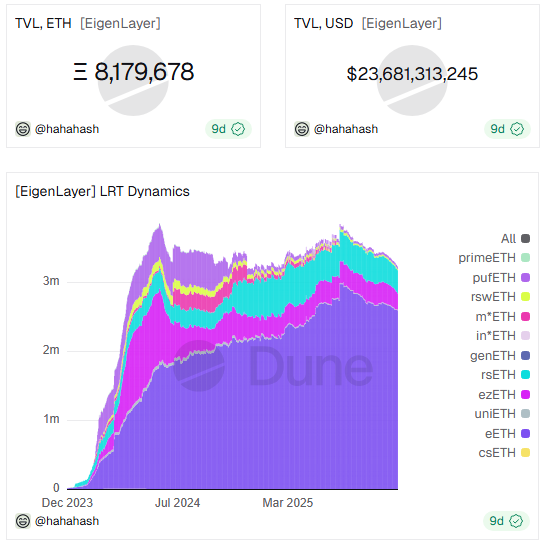
Source: dune.com/hahahash/eigenlayer
How a Real On-Chain Portfolio Looks at $1 000, $10 000, and $10 0000
Let’s look at three versions. Not as financial advice, but as architecture of on-chain reasoning.
Portfolio for $1 000
You can't afford to take unnecessary risks. You need to understand the mechanics.
- 40% ETH → Lido (stETH)
- 30% ETH → Rocket Pool (rETH)
- 30% ETH → keep liquid on an exchange to observe behavior
This is not about yield. This is education.
Portfolio for $10 000
You’re no longer a tourist.
- 50% stETH → collateral for borrowing
- 25% sfrxETH → auto-compounding yield
- 25% ETHx → gateway to restaking
You begin to feel the speed of capital.
Portfolio for $100 000
This is the adult tier.
Part of the capital earns through Ethereum staking.Part earns through EigenLayer.Part serves as cross-protocol collateral.
You stop looking at charts.You start looking at block yield.
Ethereum turns into a new global benchmark for yield.
Ethereum (ETH) Is Becoming the New Base Interest Rate of the Internet
In the traditional financial system, there is an unquestioned point of reference: the yield on U.S. 10-year Treasuries. That number defines the cost of capital, mortgage rates, corporate borrowing, dollar strength, and global investment appetite.
For decades, Web3 had no such benchmark. Until 2023, the crypto market was chaos: every asset lived on its own island, and any yield depended on someone else’s mistakes.
Ethereum changed that.
ETH staking created the first decentralized base yield of the internet — an on-chain rate that doesn't depend on regulation, geography, or banks.
This is no metaphor. It is now an institutional fact.
Ethereum staking functions as a technological equivalent to Treasuries for the crypto economy:
What banks do with interest rates, Ethereum does with Proof-of-Stake. The difference is simple:
Banks promise yield.Ethereum produces it.
Comparing LSTs: What Are You Actually Choosing?
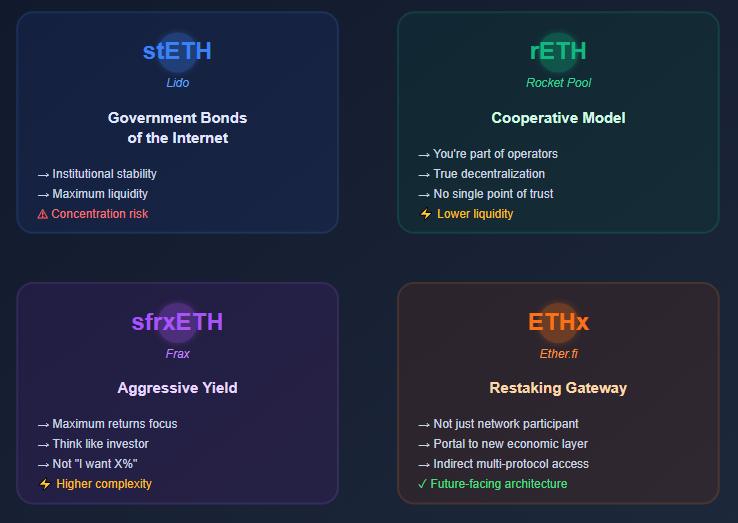
Liquid staking is no longer a “button for passive income.” It’s an infrastructure layer through which an investor chooses what model of Ethereum security they support. Each LST token represents a philosophy, a risk profile, and a destination for capital.
stETH (Lido)
Lido remains the largest liquid staking provider. Its dominance raises concerns about concentration of power, but it also makes stETH the industry standard: deep liquidity, simple integration, and institutional clarity.
Website: https://lido.fiData: https://defillama.com/protocol/lido
Choosing stETH is like purchasing government bonds: predictable, scalable, but dependent on a large centralized operator.
rETH (Rocket Pool)
Rocket Pool uses a different model. It prioritizes decentralization and validator participation over scale. rETH grows more slowly and has less liquidity, but its architecture removes the single point of control.
Website: https://rocketpool.netMetrics: https://dune.com/rocketpool/Rocket-Pool-Network-Overview
For users who value distributed governance and resistance to centralization, rETH aligns with their goals.
sfrxETH (Frax Finance)
Built for higher yields, sfrxETH uses active DeFi mechanics. It doesn’t rely on scale — it optimizes returns.
Website: https://frax.financeData: https://defillama.com/protocol/frax-ether
This is not a beginner’s asset. If you don’t understand where the extra yield comes from, you probably shouldn’t be here.
ETHx (Ether.fi)
ETHx connects classic liquid staking with EigenLayer restaking. It lets capital participate in Ethereum’s base layer and the emerging market of reused trust.
Website: https://ether.fiContext: https://app.eigenlayer.xyz
ETHx appeals to those who see restaking not as a bonus, but as the next financial frontier.
Source: GoMining.Com
Not Tokens — Roles
LSTs are not just alternative coins. They are functional roles embedded in the Ethereum economy:
- stETH — a bet on scale and network infrastructure
- rETH — a bet on decentralization
- sfrxETH — a bet on yield optimization
- ETHx — a bet on the trust market of restaking
Choosing an LST is not choosing “the highest APR.” It’s choosing where your ETH will work.
What a Real Staking Strategy Looks Like
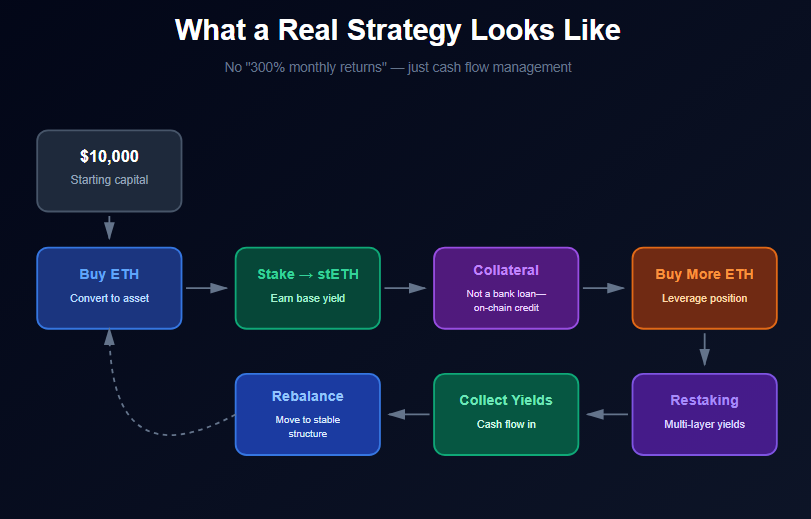
Let’s skip the “300% APY scams.” A grown-up strategy looks like this:
You buy ETH → stake it → receive stETH → use it as collateral → borrow → buy more ETH → move part into restaking → accumulate yield → allocate into a more resilient structure.
At some point, something clicks:
You are no longer “holding crypto.”You are managing a cash flow.
Source: GoMining.Com
That, by definition, is an on-chain investor — not a person with coins, but a person controlling roles of capital.
Ethereum (ETF) Changes Everything
Ethereum ETFs are not just a “legal gateway for institutions.” They represent official recognition that PoS yield is a financial product.
BlackRock, Fidelity, Franklin Templeton, Grayscale — none of them are “playing with crypto.” They are acquiring:
- time,
- yield,
- and security.
The ETF is not the tail wagging the dog. It is the doorway through which a new class of capital enters — one that doesn’t sell assets, but deploys them.
Ethereum’s golden age won’t begin at $5 000. It will begin when ETF balances rival staking pools. And that shift is already visible on-chain — more reliably than in news cycles.
Who Will Win: PoW or PoS?
Bitcoin is a statue. It stands still and reminds the world that freedom is possible. Ethereum is a road. People are already walking on it. The debate is pointless. They are not competing. They are two different forms of money:
BTC = protectionETH = service
Which one will be more valuable in the long run? We’re already beginning to see the answer.
Summary
Ethereum staking isn’t a trick or a hidden yield mechanism — it is the redefinition of what capital does. In this model, money doesn’t wait for value to appear somewhere else. It generates value by ensuring the network functions. The holder becomes an on-chain investor the moment they understand the shift:
From storing capital → to employing it. From hoping for price appreciation → to participating in the network. From passive ownership → to active contribution.
This is the new base yield of the internet — measurable, transparent, and independent of institutions. The network doesn’t promise yield. The network produces it.
And Ethereum turns participation itself into value.
FAQ
What is Ethereum staking?
It’s the process through which a regular ETH holder stops relying on passive price speculation and starts earning yield by participating in Ethereum’s Proof-of-Stake network. Instead of waiting for the price to rise, the asset takes on a role in the network and generates income through real economic activity.
How does Ethereum staking work in crypto?
You stake ETH, the network treats it as a signal of trust, and you receive rewards for helping secure the system. Over time, you learn how staking, liquid staking tokens, and restaking turn ETH from a passive holding into an active economic unit.
What are the advantages and risks of Ethereum staking?
The advantage is transparent, on-chain yield that comes from the network itself, not from intermediaries. The risks are structural: concentration of liquidity among large providers, potential regulatory shocks, a restaking bubble if yield becomes the goal, and slashing in case validators misbehave.
How can Ethereum staking be used in 2025?
It turns ETH into working capital. You can stake it, receive a liquid staking token, use it as collateral, borrow against it, and extend participation through restaking — transforming your ETH into a self-sustaining yield engine.
Which metrics are related to Ethereum staking?
Burn rates, staking ratios, TVL in liquid staking protocols, MEV revenue, and restaking activity. All of them are visible and verifiable directly on-chain.
Can you earn money with Ethereum staking?
Yes — not through speculation, but through participation. Yield is created by the network and distributed to those who help it function. The income isn’t promised — it’s produced by protocol mechanics.
What mistakes do beginners make with Ethereum staking?
They treat ETH like a passive asset, chase APR without understanding where yield comes from, ignore risks, and think staking is “interest,” when in reality it’s payment for providing security to the network.
How does Ethereum staking affect the crypto market?
It creates the first on-chain base yield — an economic benchmark that doesn’t depend on banks or states. This shifts capital flows from speculation to participation and changes how value is generated in Web3.
What do experts forecast for Ethereum staking in 2026?
They expect Ethereum’s staking yield to become the benchmark rate of the internet economy, and restaking to evolve into a new global market for programmable trust.
Where can you follow updates on Ethereum staking?
Directly on-chain and through platforms that reflect real data: staking dashboards, liquid staking statistics, and restaking metrics that show how capital behaves inside the network.
Want to continue?If you’ve made it this far, you’re no longer gambling — you’re building a system. Save this article, come back to it in a month, and see which patterns you’ve already begun to notice. In the next materials, we will break down:
- how to read on-chain data,
- how to track ETF flows,
- how the market builds trends around whales.
Subscribe to Crypto Academy and get access to the course on crypto and Bitcoin. It’s free — while everyone else is still waiting for a signal.
Telegram | Discord | Twitter (X) | Medium | Instagram