Key Takeaways
- GoMining compared five popular physical ASICs across the market range: Bitaxe Gamma, Fluminer T3, Canaan Avalon Q, Antminer S21+ and S21 Pro against a GoMining digital bitcoin miner.
- Entry cost is where the gap is widest. The smallest GoMining digital miner starts at $21.99. The cheapest home device costs around 5 times that, and the industrial machines 150-180 times, before shipping and customs. Hardware prices can move in both directions over time.
- Cost per unit of mining power is close between compared models, and less consistent. Most machines land between ~$10-$21 per TH/s with no clean size gradient, and GoMining sits inside that band at $17.60-21.99.
- A digital bitcoin miner is billed at 12 W/TH, better than any ASIC you could run at home — the best residential machines sit near 15. Only Bitmain’s newest S23 family beats it, and those are three-phase industrial units costing five figures.
- Upgradeability is the difference that compounds. ASIC efficiency improves every generation, but a physical machine is fixed the day you buy it, while a digital miner's power and efficiency can be upgraded in place.
- Running costs differ on both sides: data-center electricity rates rather than household ones, and equipment service handled for you as a daily maintenance fee deducted from BTC rewards.
- Physical mining makes sense if the hardware itself is the appeal. If the goal is to find an easy-to-manage solution with a low entry price, a digital miner removes most of the logistics, while also offering upgrade options (albeit not without price).
What Options for Bitcoin Mining Are There?
If you’re looking into starting your own BTC mining operation, one common option is to buy a physical mining machine, an ASIC, hardware built for this one job, that you own, plug in, and take full responsibility for. These range from small, quiet units like the Bitaxe Gamma to loud, industrial machines such as the Antminer S21 Pro.
The alternative is to own a digital bitcoin miner through a platform like GoMining. Instead of buying a physical ASIC machine, you own a digital miner backed by real computing power in GoMining’s data centers, and the facility handles running, cooling and maintaining the equipment. BTC rewards are calculated daily; their size depends on your miner’s power and efficiency, on Bitcoin network difficulty and on the BTC price, so they vary from day to day.
Same goal, very different experience of getting there — and, as it turns out, a very different asset a year later.
Costs to Start Bitcoin Mining: Physical Hardware vs. GoMining Digital Miners
To compare what an individual actually pays to start mining, while also covering hosting and maintenance, we looked at five ASIC models that span the real range of the market, benchmarked against a GoMining digital miner:
- Bitaxe Gamma: a tiny open-source device, quiet enough for a desk.
- Fluminer T3: built specifically for residential use, with far lower noise than farm hardware.
- Canaan Avalon Q: a mid-size home unit.
- Antminer S21+: industrial machine built for a mining farm.
- Antminer S21 Pro: a higher-efficiency variant of S21+.
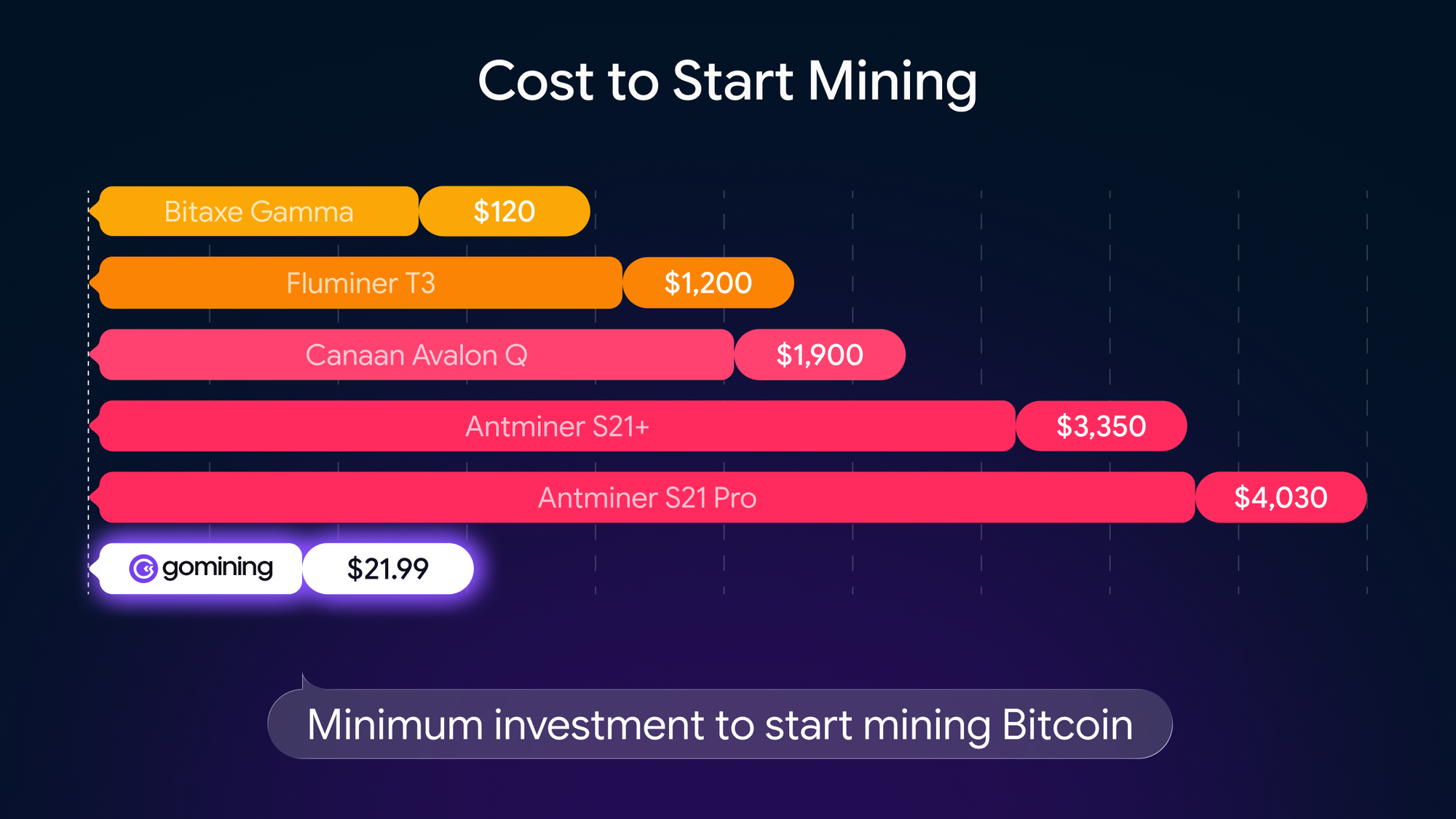
At those prices, the cheapest home device cost about 5 times more to start than the smallest GoMining digital miner, and the industrial machines 150-180 times more. Neither figure includes shipping or customs, costs a digital BTC miner skips entirely.
Hardware pricing is volatile: over the three months after we collected these figures, prices for machines in our set moved by more than 25% in both directions. But the entry gap doesn’t close, because it isn’t a matter of a few percent. Even at the cheapest listings available in September 2026, the lowest-cost way into physical mining still costs several times what the smallest digital miner does, and that’s the smallest device on the market, producing a fraction of the hashrate of anything else here.
Comparing cost per TH/s puts things in a different light, though not the light you might expect.
But first, let’s unpack the TH/s as a metric. Bitcoin mining is a guessing game. Machines make trillions of guesses per second, competing to be first to find the number that unlocks the next block of Bitcoin. A terahash per second (TH/s) is 1 trillion of those guesses every second, and it’s how mining machines are measured — the same way a car engine is measured in horsepower. More TH/s means more guesses, which means a bigger share of the rewards.
The tiny hobbyist board is in a category of its own: a 1.2 TH/s Bitaxe Gamma works out to roughly $100 per TH/s at the price above. You're paying for the learning experience, not the hashrate. Everything else lands between about $10 and $21 per TH/s, and there’s no neat size gradient inside that band: the best value in our set was a home-class machine, and one mid-size home unit came in above both industrial models. GoMining’s digital miners were priced at $17.60-21.99 per TH/s over the same period, inside the same band, with no shipping, customs, hosting or electricity bill attached.
Two caveats worth keeping in mind.
First, per-TH pricing is vendor-dependent to the point of being unreliable: by September 2026, live listings for the same Antminer S21 Pro ranged from under $5 to over $25 per TH/s across different retailers. Any single figure is a snapshot, not a rate.
Second, industrial machines demand significant upfront capital and real setup knowledge, which raises the practical bar for entry regardless of what the per-TH math says. You can check current GoMining parameters with our bitcoin mining calculator.
So the two figures tell you different things. Entry cost is the clean one: large, verifiable, and stable across every price swing — it’s the difference between needing twenty dollars and needing a few thousand. Per-TH price tells you something narrower, that once you’re in, you're paying a broadly comparable rate for mining power. What neither captures is the third thing, which only shows up later: what happens to the machine you bought.
The Electricity Bill Nobody Budgets For
A bitcoin mining machine never really turns off. It runs 24 hours a day, every day, which makes electricity the second price tag nobody mentions in the ad — and often the bigger one.
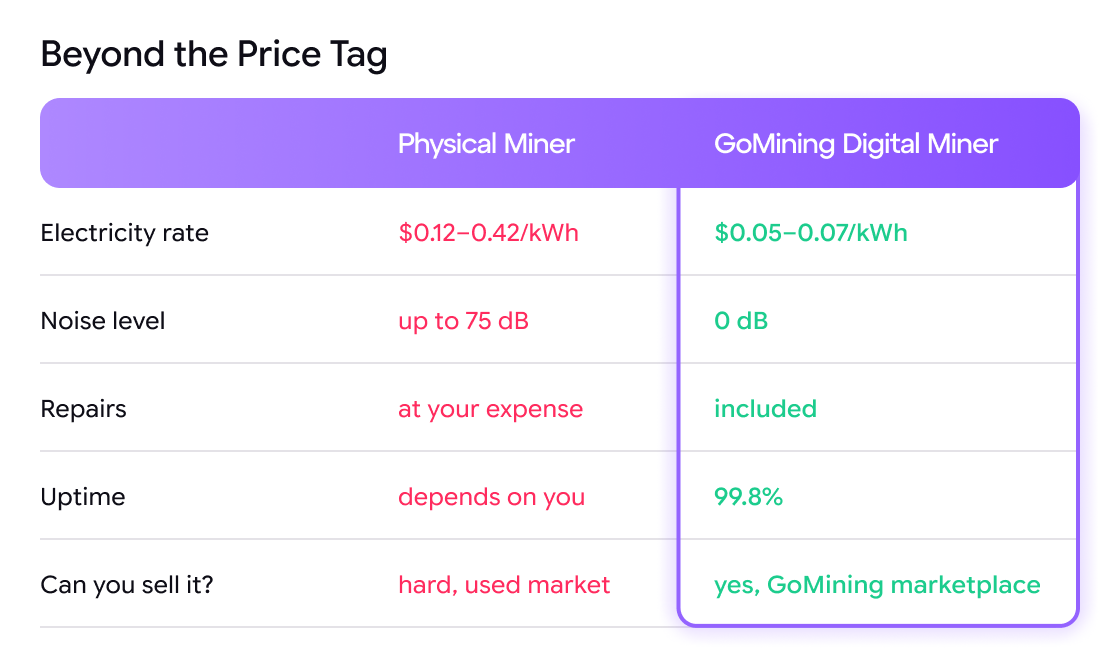
Two separate things are going on, and it’s worth pulling them apart: how much power a machine needs to do its job, and how much you pay for that power in the first place.
First, efficiency. This is about the machine itself: how much electricity it burns to produce that guessing power.
The key efficiency metrics for bitcoin mining hardware are W/TH and J/TH. The car analogy holds throughout: if TH/s is horsepower, then W/TH is fuel consumption.
If TH/s is how fast a machine works, W/TH is how much electricity it needs to work that fast: watts consumed for each terahash per second it produces. A machine rated at 15 W/TH running 100 TH/s draws 1,500 watts, about the same as a hairdryer left on permanently.
Lower is better. Two machines at 100 TH/s earn the same rewards, but one at 12 W/TH burns a fifth less electricity than one at 15 W/TH. Over a year of running non-stop, that difference is the whole margin.
You’ll also see J/TH (joules per terahash) on manufacturer spec sheets. For practical purposes the two are the same number — a watt is a joule per second, so 15 J/TH and 15 W/TH describe identical machines. If you’re comparing a spec sheet to a GoMining miner, you can read them interchangeably.
With GoMining, energy efficiency is a parameter of the miner itself: you choose it when you create the digital miner, and you can upgrade it later, up to the best tier currently available on the platform.
Miners created on GoMining’s primary market are issued at the best current tier, 12 W/TH. That’s more efficient than every machine in our comparison set — and more efficient than any ASIC you could realistically run at home.
The best purpose-built residential machines sit near 15 W/TH, and Bitmain’s previous flagship generation, the S21 line, averaged ~13-17 depending on the model. The only hardware that currently does better is Bitmain’s newest S23 family at 9.5 to 11 J/TH, and those are industrial units: three-phase 380-415V power, a coolant loop to plumb in, and five figures of capital before you mine anything. Nothing that plugs into a domestic socket comes close to 12.
That matters because your electricity fee is calculated directly from that number — fewer watts per TH means a smaller fee and a larger net reward.
Second, the price of that electricity. Even the most efficient machine still needs a power source, and what that power costs depends entirely on where it's running:
- Home electricity: around $0.12-$0.42 per kWh, depending on the country.
- GoMining’s data centers: the average project rate used to calculate electricity fees ranges from $0.05 to $0.07 per kWh.
That’s a meaningful gap at either end of the household range. Data centers buy power on industrial contracts that no individual household can access.
Put the two together and the difference compounds: a digital bitcoin miner from GoMining is billed at a better efficiency figure and at a lower rate per unit of electricity. A home ASIC machine has neither advantage, so electricity eats further into whatever it earns. In a country where rates sit near the top of the household range, a real share of the machine's output goes straight back out to keep it running.
Side by Side: Five ASICs and a Digital Miner
The chart above compares the two approaches in the abstract. Here’s the same comparison machine by machine, with the specifications behind each claim. Two rows are worth reading before the price rows: efficiency, because it determines your electricity cost for as long as you own the thing, and upgradeable, because it determines whether that number can ever improve.
Bitaxe Gamma | Fluminer T3 | Canaan Avalon Q | Antminer S21+ | Antminer S21 Pro | GoMining digital miner | |
Type | Open-source hobby board | Home-class ASIC | Home-class ASIC | Industrial ASIC | Industrial ASIC | No hardware on your side |
Mining power | 1.2 TH/s | 115 TH/s | 90 TH/s | 216 TH/s | 234 TH/s | You choose, starting from 1 TH/s |
Efficiency | ~14 W/TH | 14.8 W/TH | 18.6 W/TH | ~16.5 W/TH | ~15 W/TH | 12 W/TH (platform's best current tier) |
Entry price | $120 | $1,200 | $1,900 | $3,350 | $4,030 | From $21.99 |
Cost per TH/s | ~$100 | ~$10 | ~$21 | ~$16 | ~$17 | $17.60-21.99 |
Power draw | 17 W | 1,700 W | 830-1,674 W (3 modes) | ~3,564 W | ~3,510 W | None on your side |
Noise | Desk-quiet | ~50 dB | 45-65 dB by mode | ~75 dB | ~75 dB | No device in your home |
Wiring needed | Standard outlet | Standard outlet, 110-240V | Standard outlet; 20A circuit at full power | Dedicated 200-240V circuit | Dedicated 200-240V circuit | None |
Electricity paid at | Your household rate | Your household rate | Your household rate | Household / data center rate | Household / data center rate | Data-center rate + scale ( deducted from rewards) |
Repairs | Yours | Yours | Yours | Yours | Yours | Handled by GoMining, covered by the maintenance fee |
Upgradeable? | No (efficiency is fixed at manufacture) | No | No | No | No | Yes — power across 20 levels to 5,000 TH/s, efficiency to the platform’s best tier |
Resale route | Scattered used market | Scattered used market | Scattered used market | Scattered used market | Scattered used market | GoMining marketplace or public NFT marketplaces, subject to platform conditions |
Bitter Truth: Your ASIC Machine Gets Worse Every Year (and What to Do With It)
Mining hardware doesn’t wear out so much as fall behind. Every generation of ASIC does the same work for less power, and the pace is relentless. Bitmain’s flagship efficiency over ~18 months, in W/TH (lower is better):
- The Antminer S21 generation sat around 15-17.5 J/TH.
- The S21 XP brought air-cooled hardware to 13.5 J/TH, and the S21 XP Hydro to 12 J/TH.
- The S23 family arrived in January 2026: 11 J/TH air-cooled, and 9.5 J/TH for the S23 Hydro.
- At the end of August 2026, Bitmain announced the S23 XP Hydro at 8.9 J/TH, shipping from November 2026.
In under 2 years, the top of the range roughly halved the electricity needed for the same amount of work.
This isn’t a spec-sheet curiosity. As more efficient machines join the network, difficulty rises and the same hashrate earns less. Your machine's absolute output doesn't change; its position relative to everyone else’s does, and its share of the reward shrinks accordingly. A machine bought in June is already competing against hardware that does the same work for a third less power.
Here’s where the two options genuinely diverge: a physical machine cannot be made more efficient. The chips are the chips. You can underclock it: the Avalon Q’s eco mode trades hashrate for a better J/TH figure, dropping from 90 TH/s to around 55 TH/s, and firmware tuning wins a few percent. But you’re trading output for efficiency, not gaining any. The only real upgrade is buying a new machine, which means finding a buyer for the old one on the used market, at whatever that generation is worth by then.
A GoMining digital miner is not a fixed object. It’s two numbers, and both can be raised:
- Computing power scales through 20 levels, from 1 TH/s up to 5,000 TH/s. Upgrading costs less than buying a separate miner with the same added power, and the price per TH falls at higher levels.
- Energy efficiency can be upgraded down to the best tier currently available on the platform. As GoMining’s data centers refresh their fleet, that floor moves down, and existing miners can follow it.
Both changes apply to the miner you already own, take effect immediately, and require no hardware, shipping or disposal. Second-hand miners bought on the marketplace can carry older tiers and be upgraded the same way — and per GoMining’s documentation, an upgraded miner can be sold on and upgraded again.
Two honest limits. Upgrades cost money: efficiency upgrades are priced per TH and track the market cost of the underlying difference, so this is a purchase decision, not a free refresh. And there’s a floor: once a miner reaches the platform’s best available tier, that’s as far as it goes until GoMining introduces a better one.
Taken together with the entry cost, that’s the practical difference. With hardware, the decision is front-loaded: you commit a few hundred or a few thousand dollars to a specific machine at a specific efficiency, and that choice is locked in for as long as you own it. With a digital miner you can start at $20, see how it behaves, and scale power and efficiency from there.
What It Actually Takes to Run a Bitcoin Miner at Home
This part rarely makes it into the ads. Running an ASIC at home means dealing with:
- Noise. Small open-source devices like the Bitaxe are quiet enough for a desk, and purpose-built residential machines like the Fluminer T3 stay well below farm hardware at around 50-55 dB. The Antminer S21+ and S21 Pro are rated near 75 dB, comparable to a vacuum cleaner running nonstop. Most apartments can't absorb that.
- Wiring. Those same Antminer models draw ~3,500-3,600 watts and need their own dedicated 220-240V circuit, which most homes don’t have, plus extra ventilation for the heat.
- Know-how. Smaller devices are fairly plug-and-play. The industrial machines assume you already know what you're doing.
None of that applies to a bitcoin digital miner from GoMining, because there's no physical unit in your home to begin with.
Bitcoin Miner Maintenance: When Something Breaks
Every physical option in our comparison shares the same maintenance reality: a failed hashboard, fan or power supply is your problem to fix — both the cost and the downtime while it sits at a repair center. Uptime depends on you noticing the problem in the first place.
Digital miners work differently. Equipment service and electricity are handled by GoMining’s service center and charged as a daily maintenance fee deducted from your BTC rewards rather than billed to you separately, so there’s no repair invoice and no hardware to chase. GoMining reports industrial-grade device uptime, maintained through round-the-clock monitoring by on-site engineers.
That fee has two components: an equipment service charge per TH per day, and an electricity charge based on your miner’s efficiency, its power, and the data-center rate.
Several discounts can reduce that fee, and they stack: a discount of up to 20% when maintenance is paid in GOMINING tokens, a VIP-status discount, a daily service-button streak, and a Mining-mode discount.
So “repairs included” in case of digital bitcoin miners is accurate in the sense that matters — you never receive a repair bill — but maintenance isn’t free. It’s bundled into a recurring fee taken from your rewards.
Two Scenarios for Exiting Bitcoin Mining
At some point most people stop, whether to upgrade, cash out, or just move on. That means selling the miner, and this is where the two options really part ways.
Used bitcoin mining machines sell on a scattered secondary market where price depends on model, condition, and how much demand exists for that generation of hardware right now. You're usually negotiating directly with a stranger, and buyers are wary of hardware they can't inspect in person, so finding someone willing to pay a fair price can take weeks. And the clock is against you: the newer, more efficient generation that made you want to upgrade is the same thing depressing what your machine is worth.
A GoMining digital bitcoin miner is listed from your account and appears on the platform’s secondary marketplace, where other users can buy it.
Because miners are issued as NFTs on Ethereum, BNB Chain (BSC), Solana and TON, they can also be sold on public NFT marketplaces. There’s no shipping, no inspection and no one-on-one negotiation.
Worth knowing before you get there: buyers need at least one active miner and completed basic verification, purchases are made in GOMINING tokens, and miners bought through in-app payment methods can take some time to verify before they can be listed. Prices are set by sellers, so a sale still depends on a buyer accepting yours.
Often, though, the exit isn’t necessary in the first place: if the reason you wanted to sell was to move to newer, more efficient equipment, upgrading the miner you already own does the same job without a transaction.
Physical vs. Digital Bitcoin Miners: Which One Makes More Sense?
There’s a real case for physical BTC mining if you’re drawn to it for its own sake: tinkering with hardware, learning how these machines work, running a small quiet unit as a hobby project. Some people genuinely enjoy that, separate from whatever it earns. And if you have access to cheap power and the skills to run and repair the equipment, owning hardware keeps you in full control of it.
But for anyone who mainly wants to mine Bitcoin without becoming a part-time hardware technician, the differences stack up. A physical machine generally costs more to start, runs on a worse electricity rate unless you have unusual power access, comes with real logistical work, is harder to sell when you’re done — and gets steadily less competitive from the day it arrives, with no way to fix that short of buying its replacement.
A digital BTC miner changes both ends of that.
It starts at a fraction of the price: ~$20 against $120 for an ASIC (at the very cheapest), or several thousand dollars for anything industrial. So, the decision to try it isn’t really a capital decision at all. And because what you own is a configuration rather than an object, it doesn’t have to be replaced to be improved: you scale the same miner up as you go, rather than buying a bigger box and reselling the old one.
What it doesn’t remove is the underlying variability: rewards depend on Bitcoin network difficulty and price, maintenance fees are deducted from them daily, and upgrades cost money. Neither route offers a guaranteed return.
FAQ
Is it legal to mine Bitcoin at home? In most countries, yes, but rules differ, and some places tax or restrict it specifically. Check your local regulations before setting anything up.
What do TH/s and W/TH actually mean? TH/s (terahashes per second) is how much mining work a machine does: trillions of attempts per second at the calculation that earns Bitcoin rewards. More is better. W/TH (watts per terahash) is how much electricity it needs to do that work. Less is better. J/TH on a manufacturer's spec sheet means the same thing as W/TH. Think horsepower and fuel consumption: you want a lot of the first, and as little of the second as you can get.
Can I make my physical ASIC more efficient? Not really. You can run it in a lower power mode or apply tuned firmware, which improves the W/TH figure but reduces the machine's output at the same time. The chips’ efficiency is fixed at manufacture, so the only genuine upgrade path is replacing the machine.
Can I upgrade a GoMining digital miner? Yes, in two ways. Computing power scales through 20 levels up to 5,000 TH/s, and energy efficiency can be upgraded to the best tier currently available on the platform. Both apply to the miner you already own, and both cost less than buying an equivalent new one.
Is buying a used physical bitcoin mining machine risky? More so than buying new. You're relying on the seller's account of how heavily the machine was used and how much life it has left, and there's no fixed reference price, so it's easy to overpay for hardware that's close to worn out.
Do I own physical hardware with GoMining? No. Your digital bitcoin miner is backed by real computing power in GoMining’s data centers, so there’s no device to buy, ship, install or maintain yourself.
Disclaimer
Hardware prices and platform parameters in this article were collected from June to September 2026. Prices for mining hardware move constantly. Check current listings and the GoMining app before making any decisions. This article is general information, not financial, legal or tax advice.