
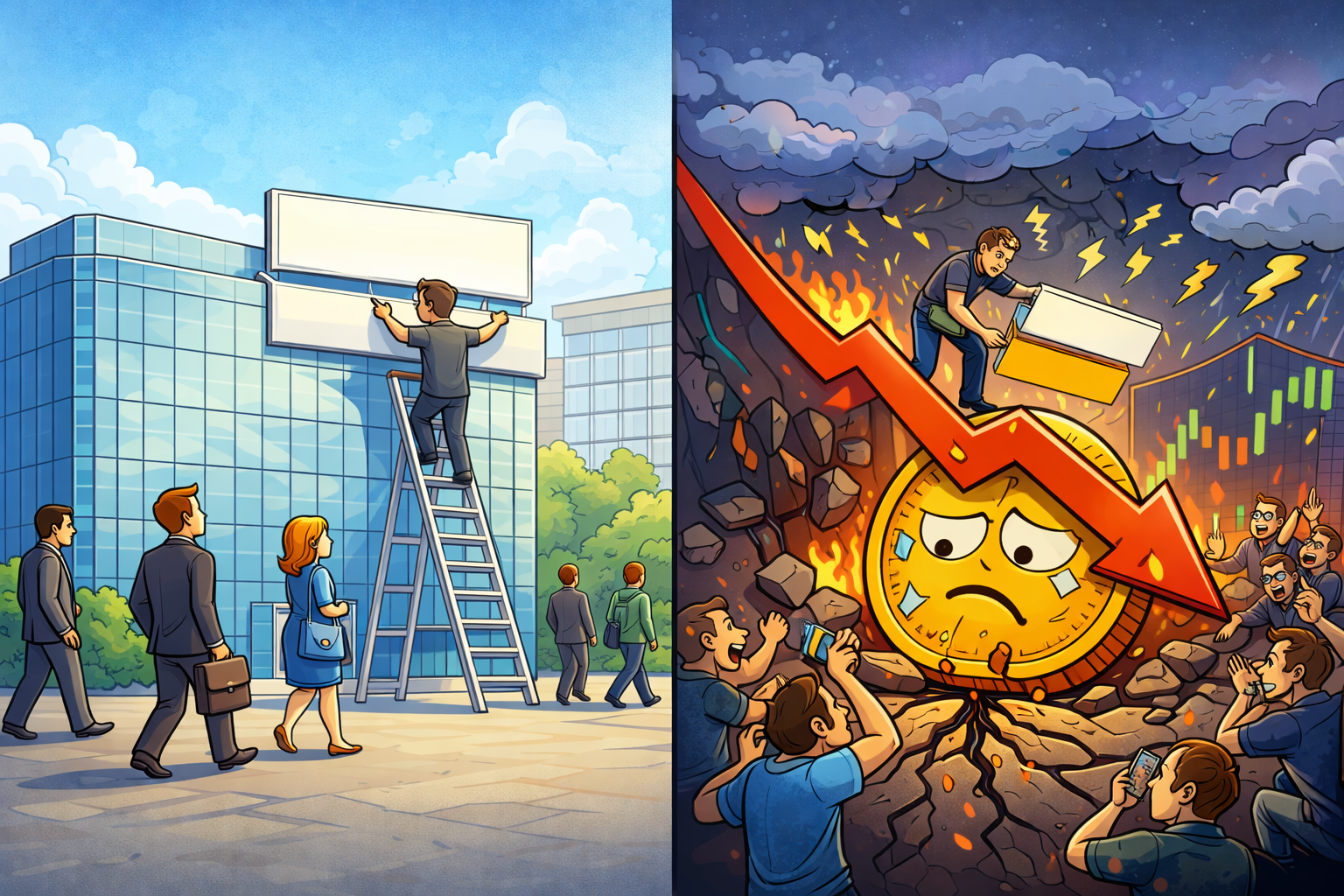
In traditional business, rebranding is almost always a growth story. A company changes its name when its scale, market, or long-term vision changes. When Facebook became Meta, the market understood the message: the company was trying to move beyond social networks and reshape its entire business model.
In crypto, things work differently — and far more brutally.
Here, rebranding usually happens not at a moment of strength, but during market fatigue, price stagnation, or narrative loss. In simple terms, a token changes its name not because it has “grown bigger,” but because the old name no longer sells.
That is why in crypto, rebranding is not a marketing event — it is a market stress test. Token rebranding in crypto is almost always a classic “Buy the Rumor, Sell the News” scenario.
Sometimes it creates short-term alpha. Almost never does it create sustainable growth. And very often, it punishes long-term holders.
Source: GoMining.com
The key thing to understand is simple: the market does not pay for a new name. The market pays for demand growth, changes in tokenomics, and new liquidity flows. If those are missing, rebranding becomes nothing more than a convenient exit point for smart money.
Why It Worked in 2021 — and Why It Doesn’t in 2025
Many people still point to the LEND → AAVE rebrand as proof that rebranding can “restart” a project. And they are right — for that time. But the 2021 market and the 2025 market are two very different organisms.
In 2021:
- DeFi was new
- Liquidity flowed blindly
- Retail bought narratives, not numbers
- Governance and tokenomics barely mattered
In 2025:
- The market has survived multiple bear cycles
- Participants calculate FDV, emissions, and unlock schedules
- The word “rebrand” triggers suspicion, not excitement
The market has become less naive and more cynical — and this shift is critical for understanding everything that follows.
The Three Types of Token Rebranding That Actually Exist
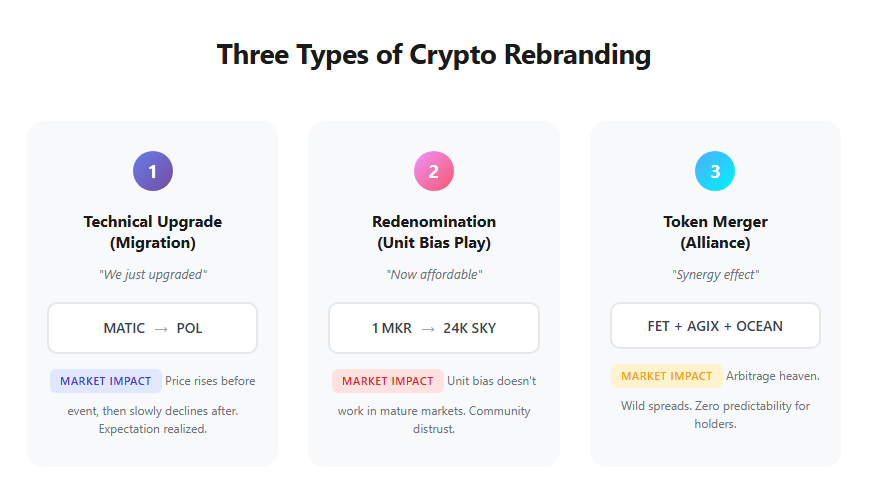
Despite hundreds of different labels, nearly all crypto rebrands fall into three real categories. The difference is not in the name, but in what actually changes under the hood.
1. The Technical Upgrade (Migration): “We Just Upgraded”
The most common type of rebrand is a technical migration. The mechanics are simple:
- A new token is introduced
- The old token is swapped 1:1
- The team promises that “nothing changes for holders”
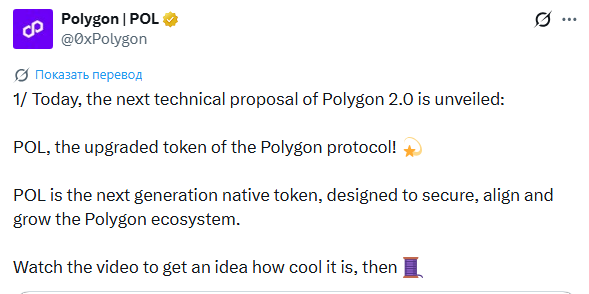
A textbook example is the MATIC → POL transition in the Polygon ecosystem.
Source: GoMining.com
Polygon prepared the market for years: explaining the AggLayer architecture, outlining the token’s new role, and announcing the migration well in advance. From a technical standpoint, the execution was nearly flawless. From a market standpoint — almost useless.
Why? Because the market hates surprises — but it hates the absence of new reasons to buy even more.
A technical upgrade improves the product, reduces costs, and increases scalability. But it does not automatically create new token demand. As a result, price appreciation happens before the event, while successful migration triggers profit-taking and a slow post-event decline.
This is not a failure. It is the classic realization of expectations.
2. Redenomination and the “Cheap Token” Illusion
The second type of rebranding is far more dangerous and psychologically loaded. This is redenomination — when one expensive token is converted into many cheaper ones, while market capitalization remains unchanged. The bet is placed on unit bias.
Unit bias is a cognitive distortion where people feel more comfortable buying 10,000 tokens at $0.05 than 0.005 tokens at $2,000.
In traditional markets, this is known as a stock split. In crypto, it is often framed as “making the token more accessible.”
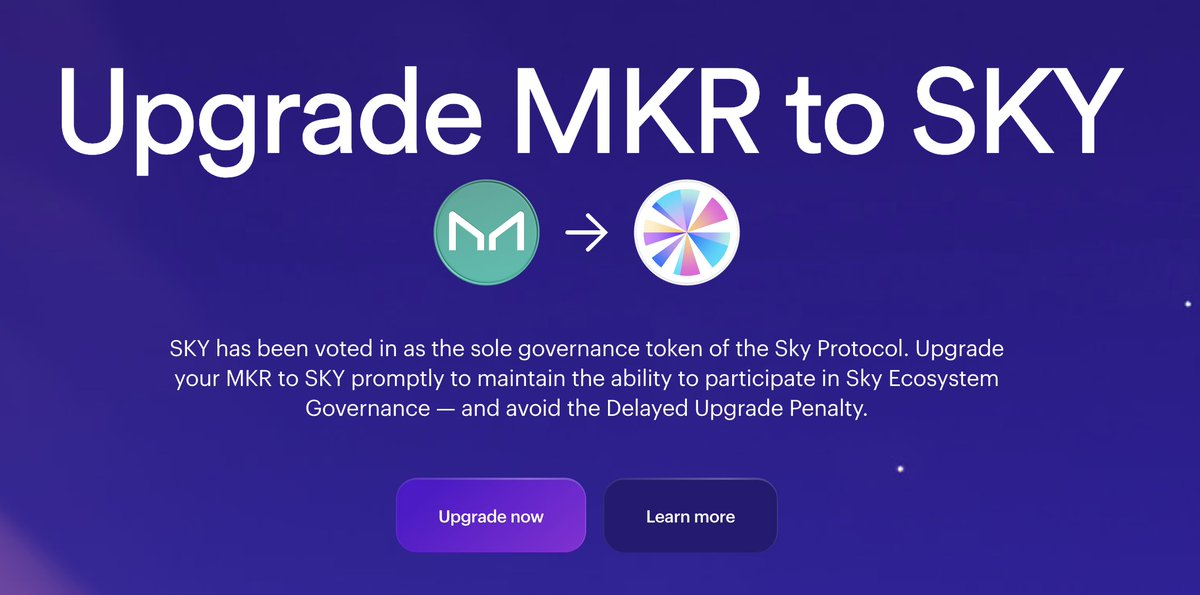
The most illustrative case is MakerDAO’s rebrand into Sky (SKY). The mechanics were straightforward:
- 1 MKR → 24 000 SKY
- A new brand launched alongside the USDS stablecoin
- The narrative focused on audience expansion
Source: GoMining.com
But the market saw something very different: dilution of governance power, increased complexity, and loss of Maker’s brand identity. In 2019, this might have worked. In 2025, the market simply said “no.”
Price reacted with a decline, and community trust deteriorated so badly that a full rollback of the rebrand was seriously discussed.
The conclusion here is harsh but clear: in a mature crypto market, unit bias no longer works.
3. Token Mergers: A Trader’s Paradise, a Holder’s Nightmare
The third type of rebranding is the merger of multiple tokens into one. On paper, it looks like synergy. In the market, it looks like an arbitrage playground.
The clearest example is the ASI Alliance, where FET, AGIX, and OCEAN were set to merge into a single token — ASI.
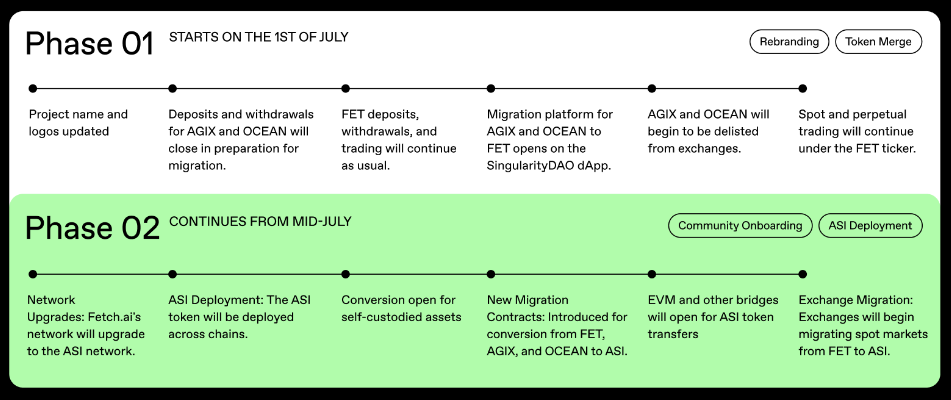
Source: GoMining.com
During such events, the market stops being “investor-friendly” and becomes purely mathematical. Traders ask only one question: “Which of the input tokens is currently the cheapest relative to the future ASI?”
They start buying one asset, shorting another, and aggressively widening spreads. The result:
- extreme divergence in price action,
- short-term pumps and dumps,
- near-zero predictability for long-term holders.
Mergers are not a story about “believing in the project.” They are a story about trading inefficiencies.
Put simply, rebranding is rarely the beginning of a trend. More often, it is the final act. It looks good in announcements, sells well in narratives, and is almost always used by the market as an exit point.
Source: GoMining.com
Why the Market Keeps Stepping on the Same Rake
Every crypto rebrand starts with the same set of phrases. Teams talk about a “new era,” promise that “now everything will finally work,” and assure investors that the market simply hasn’t priced in the changes yet.
These words sound convincing — especially against the backdrop of a tired chart and prolonged stagnation.
But almost every time, the market responds in the same way. Price rises on expectations, then stalls, and eventually starts to decline.
This does not happen because market participants are stupid or misunderstand something. The reason is much simpler and deeper: human psychology does not change, even if token names and tickers do.
The market reacts not to statements, but to incentives. If a new name is not backed by new demand, a change in tokenomics, or fresh liquidity inflows, rebranding stops being a growth story and turns into a standard expectation-realization event.
In that sense, the crypto market is brutally honest. It follows the same path again and again because participant motivations remain unchanged.
The Rebrand Cycle: The Full Lifecycle
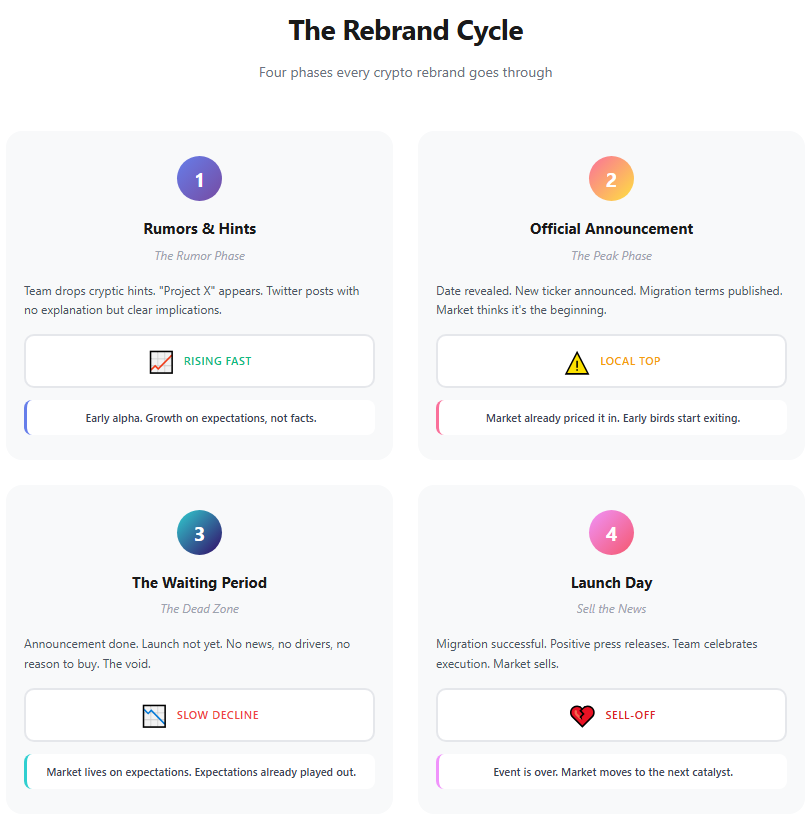
If you strip away the noise, logos, and presentations, almost every crypto rebrand goes through the same four phases — not sometimes, but almost always.
Phase 1: Rumors and Hints — The Rumor Phase
Everything starts quietly.
The team doesn’t say anything directly, but subtle hints appear. A mysterious “Project X” gets mentioned. Phrases like “new economy” or “next stage of development” surface. Twitter posts appear that explain nothing, yet clearly hint that something is coming.
The market reads these signals instantly. Retail buys “just in case,” traders position early, and price begins to rise — sometimes aggressively.
At this point, it feels like the project is coming back to life.
But it’s important to understand one thing: this is not growth based on facts. It’s growth based on expectations that something will change. Like a movie trailer — the film hasn’t been released yet, but emotions have already been sold.
This is where the first alpha appears for those who entered early.
Phase 2: The Announcement — The Peak Phase
Next comes the official announcement. A date is set. The new ticker is revealed. Migration or upgrade terms are published.
From the outside, it looks like everything is just getting started — like the market should now “properly appreciate” the news.
In reality, the opposite happens.The market has already bought everything.
Very often, price forms a local top right at the announcement. Volatility increases, moves become sharp, and early entrants begin to reduce exposure.
For newcomers, this feels like confirmation of a bullish scenario: “It’s official now.” For the market, it’s simply the point where expectations get realized.
Phase 3: Waiting — The Dead Zone
This is the most unpleasant and exhausting phase.
The announcement is done, but the launch hasn’t happened yet. In between — emptiness. No news, no new drivers, no reasons to buy. Everything important has already been said, but nothing new is happening.
Price usually starts to drift slowly downward. Volumes fade. Interest cools. Chat discussions grow quieter.
And this is where holders start asking the most dangerous question: “Why is the price falling if everything is going according to plan?”
The answer is simple but uncomfortable: the market lives on expectations — and those expectations have already been played out.
Phase 4: Launch — Sell the News
Day X arrives. The token goes live. Migration runs smoothly. Positive press releases are published. The team celebrates flawless execution.
And the market… sells.
Not because something went wrong. But because the event is over.
Everyone who wanted to buy already did. Everyone who wanted to profit is already in the green. Now the market is no longer looking for confirmation of the old story — it’s looking for the next catalyst.
The crypto market doesn’t applaud execution. It simply closes the chapter and moves on.
Source: GoMining.com
When Rebranding Can Actually Be Bullish
It’s important to state this clearly: rebranding itself is not doomed to fail. It can work. The problem is that cases where it truly works are rare.
In most situations, the market has already seen everything and treats name changes with cold skepticism. For a rebrand to give price a real chance to grow, it’s not the name that must change — it’s the economics.
Condition 1: A Radical Change in Tokenomics
Rebranding only starts to matter when it is immediately followed by a real change in token value — not in presentations, not in promises, but in practice. This can include:
- token burns starting immediately,
- activation of a fee switch,
- the emergence of a clear and transparent revenue stream.
The key word here is immediately. Not “someday.” Not “after the next upgrade.” But here and now.
If, right after rebranding, tokens actually start getting burned or begin receiving a share of protocol fees, the market notices and reacts. Because at that point, it’s no longer a story that changes — it’s the math.
Condition 2: Escaping a Toxic Past
Historically, the most successful example remains LEND → AAVE.
It worked not because the team invented a new name, but because the old one was holding the project back. LEND was strongly associated with 2017 and a prolonged bear market. AAVE became a symbol of the new DeFi cycle — a period when the market started growing again and actively using the product.
Behind that rebrand was real demand growth and real user activity.
The name change was not the goal. It was the consequence of a genuine transformation.
That’s why the market accepted this rebrand instead of punishing it.
Why Rebrands Will Work Even Worse in 2025–2026
Today, the market has entered a mature phase — and that changes the rules dramatically. In practice, this means:
- retail investors are more cautious and buy “on faith” far less often,
- funds analyze project economics instead of listening to slogans,
- narratives without cash flow simply don’t get bought.
At the same time, the influence of ETF structures, regulatory frameworks, and institutional capital continues to grow. And institutions do not enter assets because of a new name. They care about very different things:
- predictability,
- profitability,
- simplicity and transparency of the model.
Rebranding rarely delivers any of this. As a result, in the coming years it will increasingly be perceived not as a growth signal, but as an attempt to restart without real fundamentals.
A Practical Market Rule (Important)
If you remember only one idea from this entire article, let it be this:
If you’re up on the rumor — sell before the ticker changes.
Not after.Not “let’s see how it goes.”Before.
Because the market rewards early risk — and punishes waiting for a “miracle at launch.”
Final Takeaway
Rebranding in crypto is not a “new beginning.” It is a moment of truth. It shows:
- whether there is real economics behind the project,
- or whether only a story and a logo remain.
Don’t believe in “new ticker, new moon.” Believe in demand, tokenomics, and cash flow.
Follow Gomining Academy and get access to crypto and Bitcoin courses — while they remain free, even as the market keeps waiting for the “perfect entry.”
Telegram | Discord | Twitter (X) | Medium | Instagram
FAQ
Q: Will I lose my tokens if I don’t migrate?A: Usually no. Old tokens typically remain, but liquidity and support gradually dry up.
Q: Why does price often drop after a “successful launch”?A: Because success was expected — and already priced in.
Q: Does unit bias still work today?A: Almost not. In 2025, the market focuses on FDV, emissions, and cash flow.
Q: Are token mergers bad?A: No. But they are not an investment thesis — they are a trading strategy.
Q: Can you make money on rebrands?A: Yes — but as a trader, not as a holder.
Q: Is rebranding always bad?A: No. But most of the time it’s neutral or negative for price.
Q: Why do teams keep rebranding anyway?A: Because it’s often useful for the product.But product ≠ token price.
Q: The main rule?A: Execution matters more than the name.