In this article, you will learn which blockchains will accumulate the bulk of tokenized real-world assets (RWA) in 2025–2026, why capital is concentrated in a narrow set of networks, and what factors determine the winners and losers. We will explain what RWA is, how "distributed" and "represented" values differ, what metrics are important for assessing the quality of placements, and provide practical recommendations on which networks to look at for institutional issues and which are suitable for mass micro-emissions.
"RWAs offer institutional investors returns with less volatility compared to traditional crypto lending" — Brickken
Intro Block: The $17 Billion Stock Asset Migration to Crypto
The tokenized real asset (RWA) sector has moved beyond the pilot stage. By the end of 2025, more than $16.5 billion in real assets will already be on blockchains, with capital concentrated in a narrow set of networks.
The top five chains control over 95% of the value, creating a "winner takes most" scenario: Ethereum maintains its leadership in terms of asset volume and quality, while BNB, Solana, and L2 solutions are actively capturing market share in niches with smaller tickets and high transaction speeds. Below is a ranking of networks by total value of tokenized RWAs and an analysis of the reasons for their success and vulnerabilities in 2025–2026.
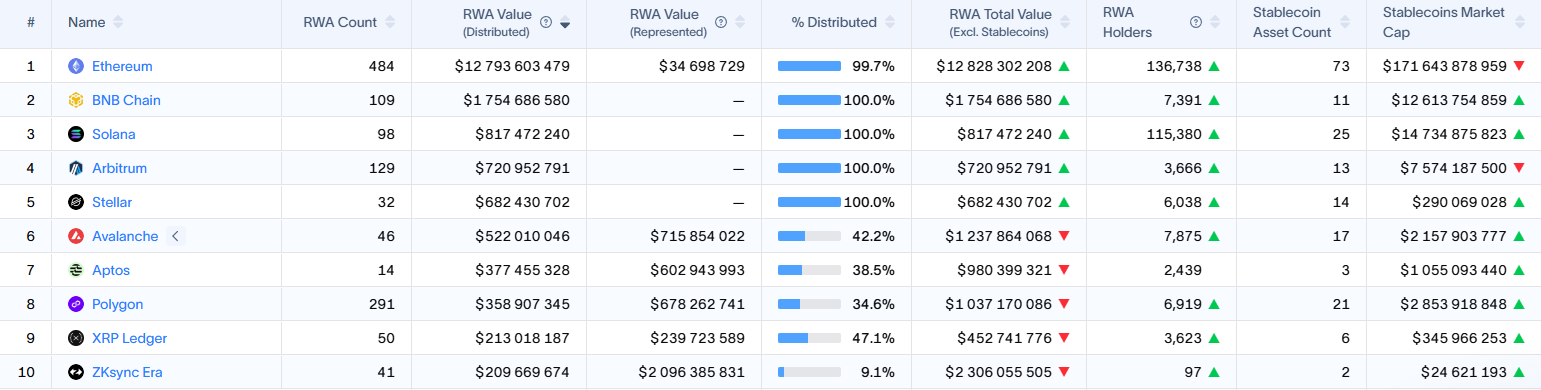
Source: rwa.xyz
"The tokenized real asset market has moved from pilots to large-scale issuances — institutions are already placing billions on-chain," says CryptoVat.
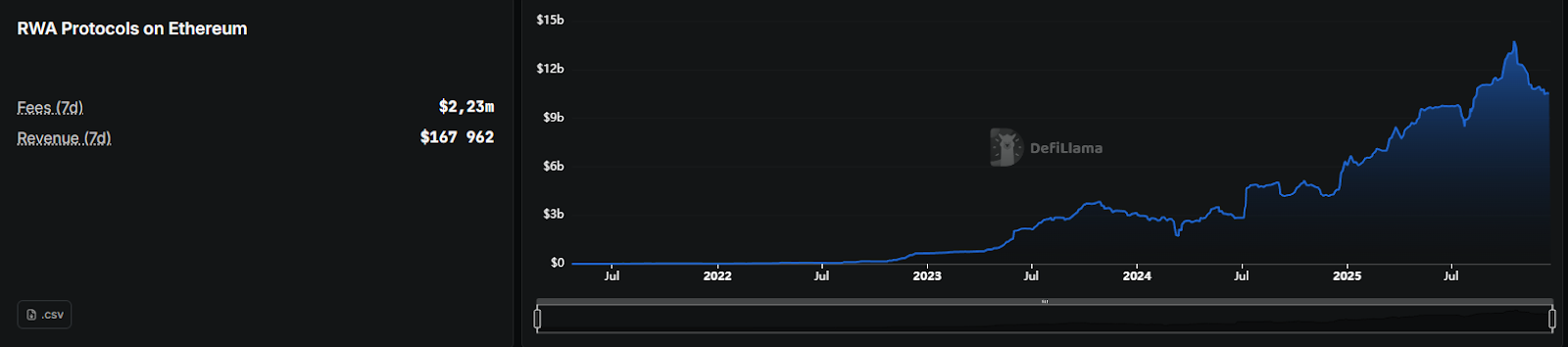
#1 Ethereum (ETH) – The "Institutional Vault"
RWA Value: ≈ $12.79 billion
Source: defillama.com
Key driver: institutional products (including major tokenization initiatives from traditional players), stable issuers, and integration with DeFi infrastructure.
Why it wins:
- Liquidity gravity. Most large issuances are placed on Ethereum, where credit markets (Aave, Maker, etc.) are available with minimal slippage on large trades.
- Security premium. Institutions prioritize reliability and proven infrastructure, and Ethereum remains the primary settlement layer for large tokenized treasuries.
Forecast for 2026: Ethereum will maintain its dominance in the large issuance segment (typically $10 million and above). Competitors will actively compete for small and medium-sized issuances, but for large institutional placements, the advantage of security and liquidity remains with ETH.
#2 BNB Chain (BNB) – The "Retail RWA" Giant
RWA Value: ≈ $1.75 billion
Key driver: projects targeting mass users (Matrixdock, Avalon Finance, OpenEden) and integration with the Binance ecosystem.
Why it wins:
- Accessibility. Low fees and easy integration attract small-ticket issuers and retail investors.
- Ecosystem. Direct liquidity channel through the exchange and Binance products accelerates capital inflows.
2026 forecast: leader in the "consumer" RWA segment; will grow in terms of number of issuances, but is unlikely to catch up with ETH in terms of total value of large assets.
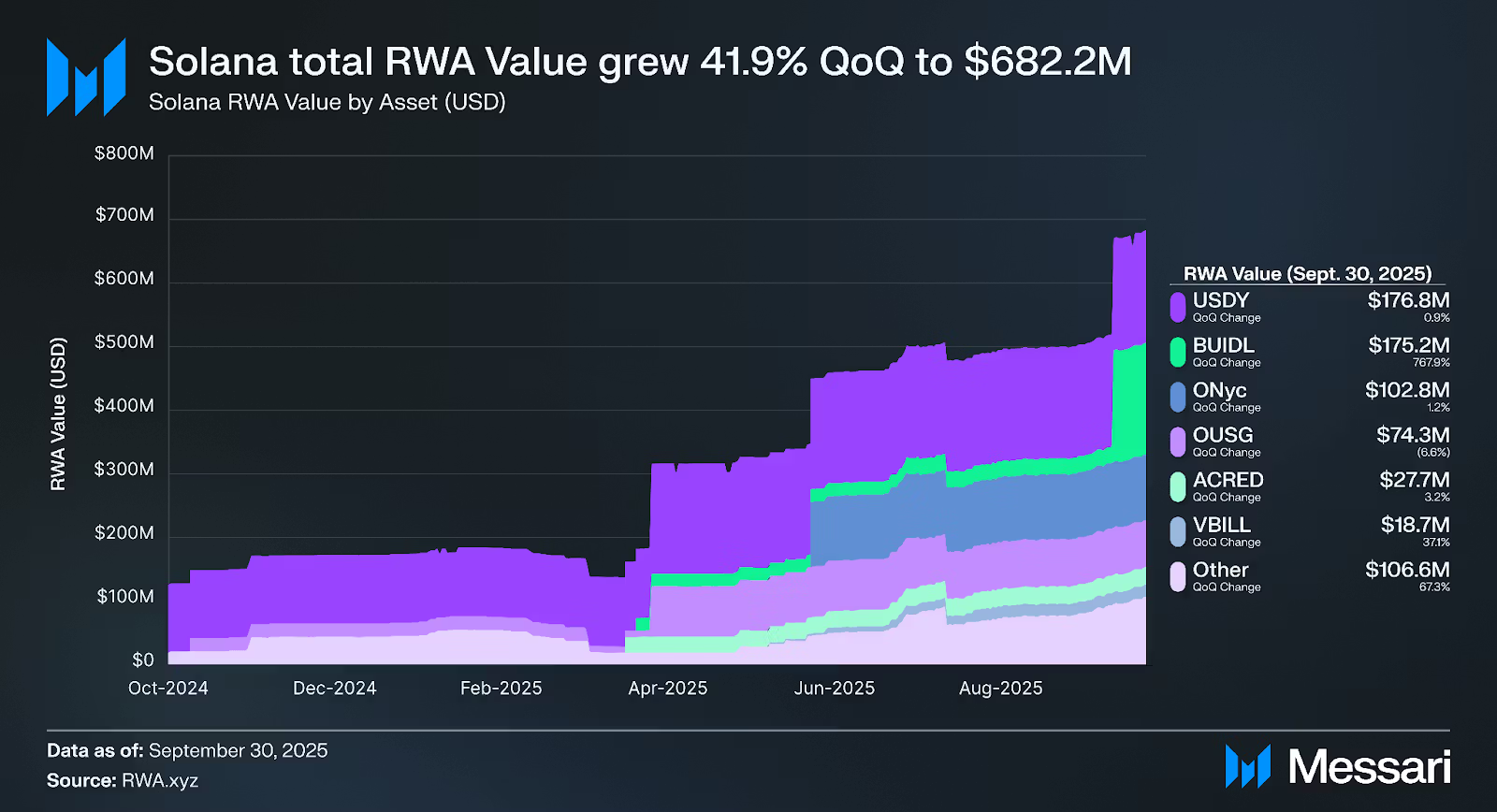
#3 Solana (SOL) – The "High-Frequency" Challenger
RWA Value: ≈ $817 million
Key driver: projects involving yield-bearing stablecoins and real assets (Ondo USDY, Parcl, Securitize), institutional income storage.
Why it wins:
- Yield layer. Solana is becoming a platform for yield-oriented stablecoins and fast margin strategies.
- Speed and low fees. Suitable for scenarios where settlement speed and frequent transactions are important.
Source: messari.io
2026 forecast: With the development of PayFi and the use of RWA for instant payments, Solana could outpace BNB in terms of growth.
#4 Arbitrum (ARB) – The "Tokenized Stock" Hub
RWA Value: ≈ $720 million
Key driver: expansion of institutional products (including plans to integrate brokers and funds), convenience of EVM compatibility.
Why it wins:
- L2 liquidity for trading. Arbitrum attracts those who want to trade tokenized stocks and bonds without the costs of Ethereum Mainnet.
- Regulatory compliance. EVM compatibility and speed make Arbitrum a convenient platform for regulated issuers.
2026 forecast: Will become the primary market for active trading of RWAs, not just for storing them.
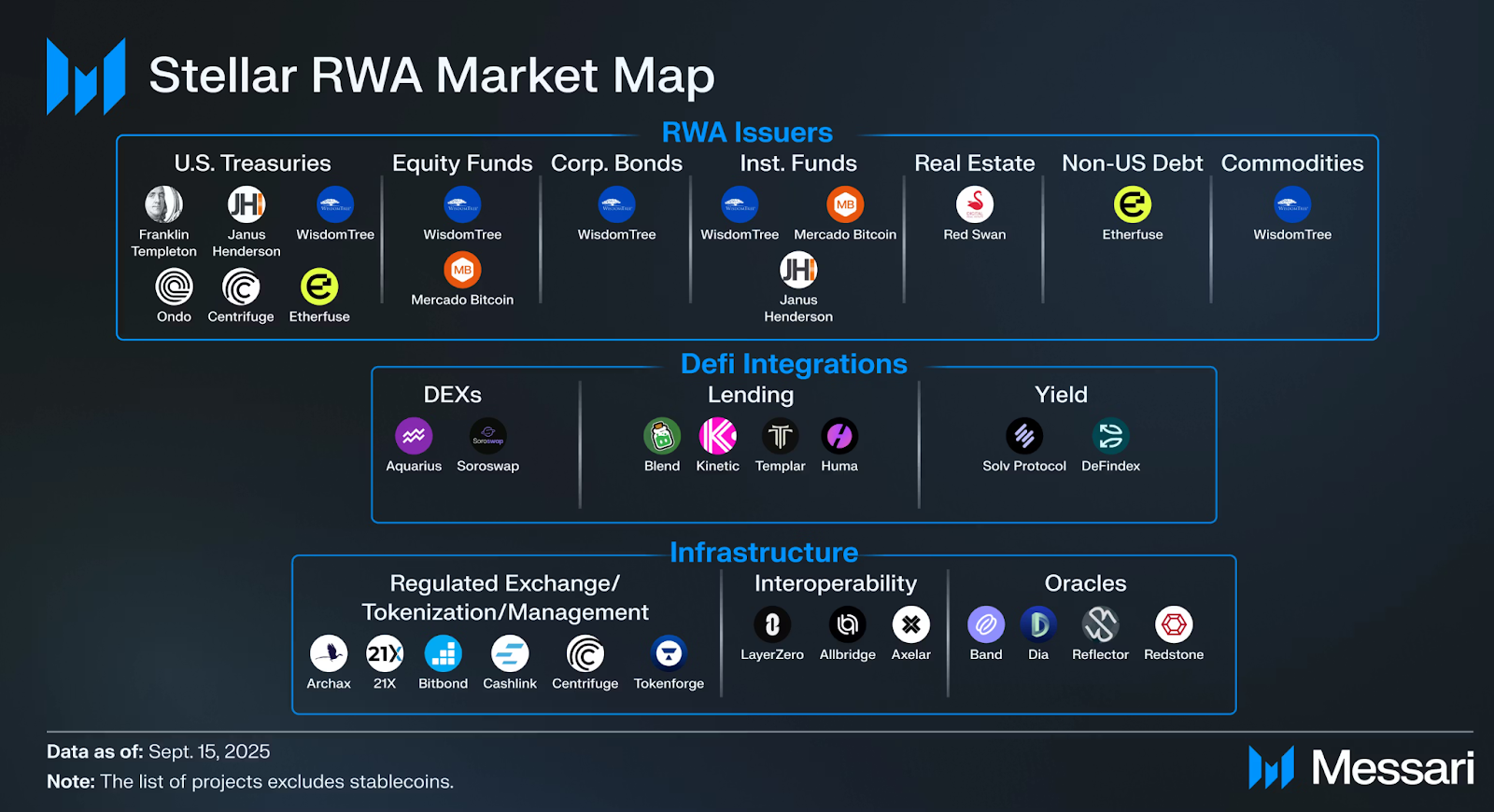
#5 Stellar (XLM) – The "Regulated Rail"
RWA Value: ≈ $682 million
Key driver: large institutional issuers focused on regulatory compliance (Franklin Templeton, etc.).
Source: messari.io
Why it wins:
- Control over assets. The possibility of clawback and other mechanisms for regulatory compliance make Stellar attractive to traditional banks.
- Low issuance cost. Ideal for mass micro-issues and micro-bonds.
Forecast for 2026: stable but slow growth; dependence on a few large partners remains a key limitation.
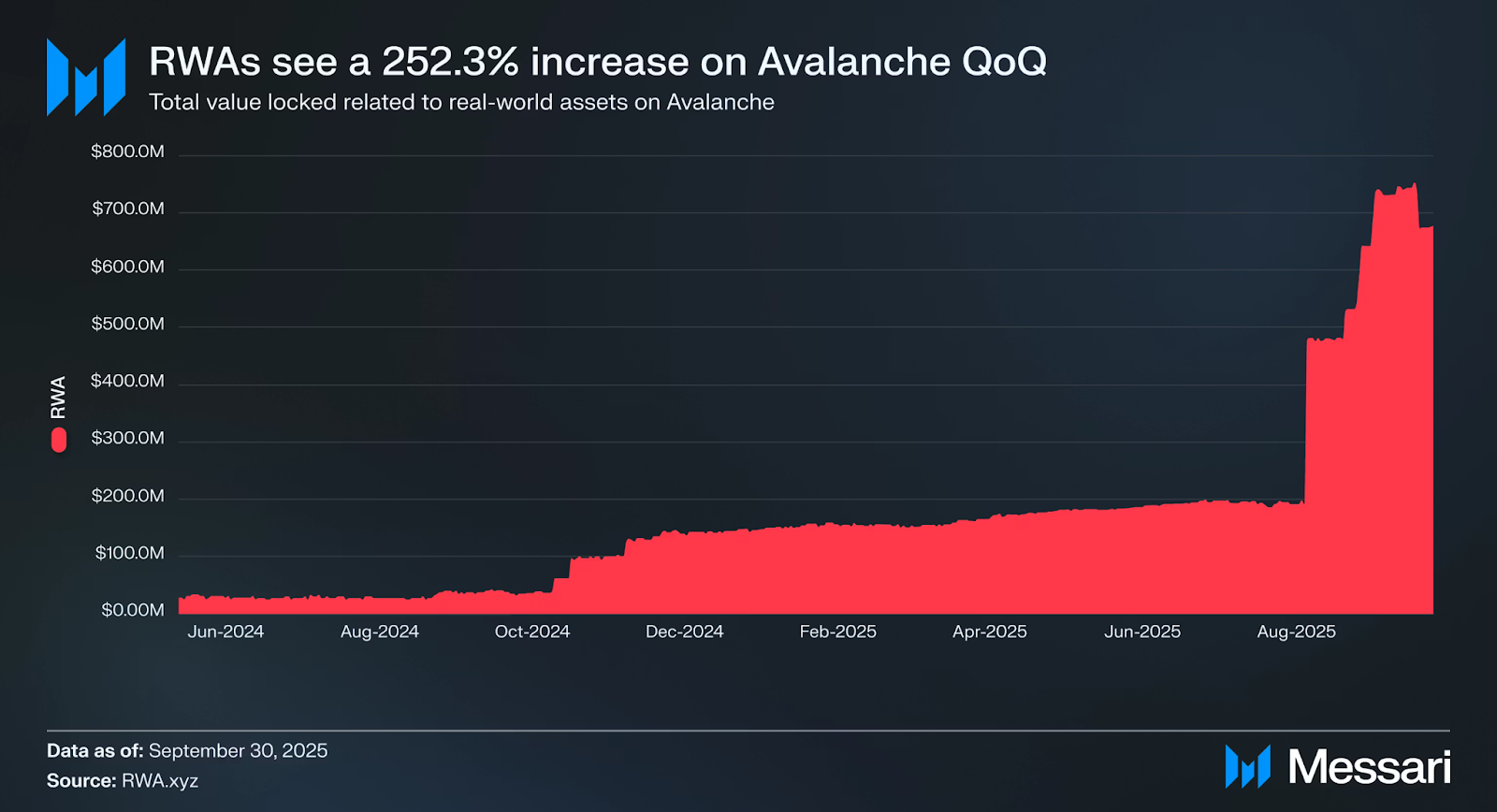
#6 Avalanche (AVAX) – The "Institutional Subnet"
RWA Value: ≈ $522 million
Key driver: banks and major financial players using private subnets (Citi, JP Morgan, reinsurance projects).
Why it wins:
- Subnets and privacy. The ability to build private networks with access to the public world attracts corporate clients.
- Represented value. A significant portion of RWA is "represented" in contracts rather than freely traded, reflecting the corporate model of use.
Source: messari.io
2026 forecast: A dark horse, AVAX could rise sharply in the rankings with the opening of private subnets for public liquidity.
Comparative Analysis of RWA Blockchains and Tokens
Here we move from descriptions of individual networks to comparisons: where the value of RWA is concentrated and where the number of issuances is concentrated; which networks serve as "storage" for large issuances and which serve as a platform for mass small products. This analysis helps to understand where assets are actually traded, where value is "represented" in corporate contracts, and which of these characteristics are more important for investors or issuers in 2026.
- Ethereum — high value, moderate number of issuances (The "Whale"). Ethereum accumulates the bulk of RWA capital: large institutional issuances and treasuries make the network a "storage place" for expensive assets. This means a high total value with a relatively moderate number of individual issuances.
- Polygon (#8) — low total value, large number of assets (The "Retail Sandbox"). Polygon occupies the position of a "sandbox for retail": many small issues (high count), but the total value is small. It is important to note that Polygon may rank lower in terms of total value, but it is one of the leaders in terms of the number of tokenized assets.
- The Yield Shift. Capital is gradually shifting from risky credit products in DeFi (e.g., lending on Aave) to RWA instruments with yields of ~4–5% (Ondo, BlackRock institutional products, etc.). The reason is more predictable returns and lower volatility compared to traditional crypto loans.
Practical conclusions and what to watch for RWA in 2026
Key metrics: total distributed value of RWA, share of "distributed" vs. "represented," number of holders, integration of stablecoins, activity of institutional issuers.
Tactics for investors/analysts:
- Keep an eye on large issuers and their choice of chain, as this is the main indicator of capital flow.
- Assess not only the total value, but also the structure (distributed vs. represented), as it shows where assets are actually traded.
- For exposure to "high reliability" — Ethereum; for mass and consumer cases — BNB; for high-frequency and payment scenarios — Solana/Arbitrum.
Conclusion on RWA assets
The RWA market is no longer experimental: capital is concentrating, and in 2026 we will see several platforms consolidate their niches. Ethereum remains a "savings account" for large institutional issuances; Solana and Arbitrum are "trading" and "payment" accounts; BNB is the "retail account." Investors should focus on where issuers place their assets and how the "distributed/represented" ratio changes, as this will determine which networks will win in the long run.
For those considering alternative ways to profit from crypto infrastructure, GoMining offers easy access to BTC mining through cloud contracts: buy a virtual miner and receive regular payments in BTC, a convenient option for those who want to participate in mining without purchasing and maintaining physical equipment.
Subscribe and get access to GoMining's free course on crypto and Bitcoin.
Telegram | Discord | Twitter (X) | Medium | Instagram
FAQ
- Why is BNB Chain in second place? It has a huge user base in Asia and a strong focus on retail-oriented RWA projects such as Matrixdock and Avalon.
- Where is the BlackRock BUIDL fund located? Mainly on Ethereum, but recently expanding to Arbitrum, Aptos, and Polygon.
- What is the difference between "Distributed" and "Represented"? "Distributed" tokens are held in user wallets; "Represented" tokens are "represented" in protocols/subnets and are often locked.
- What is driving Solana's growth in the RWA segment? Transaction speed and low fees make it convenient for high-frequency payments and margin trading with tokenized income.
- Why does Ethereum remain the choice for large issuances? Because of its proven security, deep liquidity, and institutional infrastructure, which reduce operational and regulatory risks.
- What is "Yield Shift" and why is it important? The flow of capital from risky DeFi loans to RWA products with yields of ~4-5% due to more predictable returns and lower volatility.
- Which networks tend to show a high proportion of represented value? Avalanche, Aptos, and some private subnets, where there are many corporate and locked structures.
- What metrics should be tracked in 2026? Distributed vs. represented, holder concentration, TVL by RWA, issuance volume by size (micro/medium/large), and turnover rate.
- What are the key risks for the RWA market? Regulatory uncertainty, counterparty risk of issuers, insufficient transparency of reserves, and technological vulnerabilities of smart contracts.
- How to choose a network for RWA issuance? Focus on the goal: large institutional issues — Ethereum; fast payments and margin trading — Solana/Arbitrum; mass small issues — BNB/Polygon; consider distributed/represented and regulatory requirements.
NFA, DYOR.
The cryptocurrency market operates 24/7/365 without interruptions. Before investing, always do your own research and evaluate risks. Nothing from the aforementioned in this article constitutes financial advice or investment recommendation. Content provided "as is", all claims are verified with third parties and relevant in-house and external experts. Use of this content for AI training purposes is strictly prohibited.
Top blockchains by tokenized RWA 2025–2026: network ranking (Ethereum, BNB, Solana, Arbitrum, Stellar, Avalanche), distributed vs represented analysis, key drivers and metrics for investors.