What if you wanted a bank account nobody, even the government, can’t take from you? With a bit of «you are your own tech support» that’s possible for free with a Non-Custodial Crypto Wallet. Unlike with regular apps, «free» doesn’t mean you are the product, much the opposite — you are the owner of the entire crypto address and all of its contents.
«Quis Custodiet Ipsos Custodes?» — Who Guards the Guards? is the ancient Latin proverb, which highlights the core idea behind Non-Custodial Wallets.
In a blockchain ownership is defined by one thing: who holds the keys. A non-custodial wallet is a type of wallet where you, and only you, control the private keys and access to your funds. This is why people say "Not your keys, not your coins." when referring to crypto wallets — if you don’t hold a seed phrase from your wallet then crypto isn’t yours, it belongs to a person who has the keys.
Custodial wallet is maximum freedom and safety: nobody can take your crypto, nobody can block your wallet, not even God or government even if they wanted to. Full control, only in your hands alone. Drawback — you are your own tech support, and if you handle the seed phrase to anyone there’s no takebacks. Non-custodial wallets are essential for anyone wanting to use DeFi, collect NFTs, or store crypto long-term without risk of losing it.
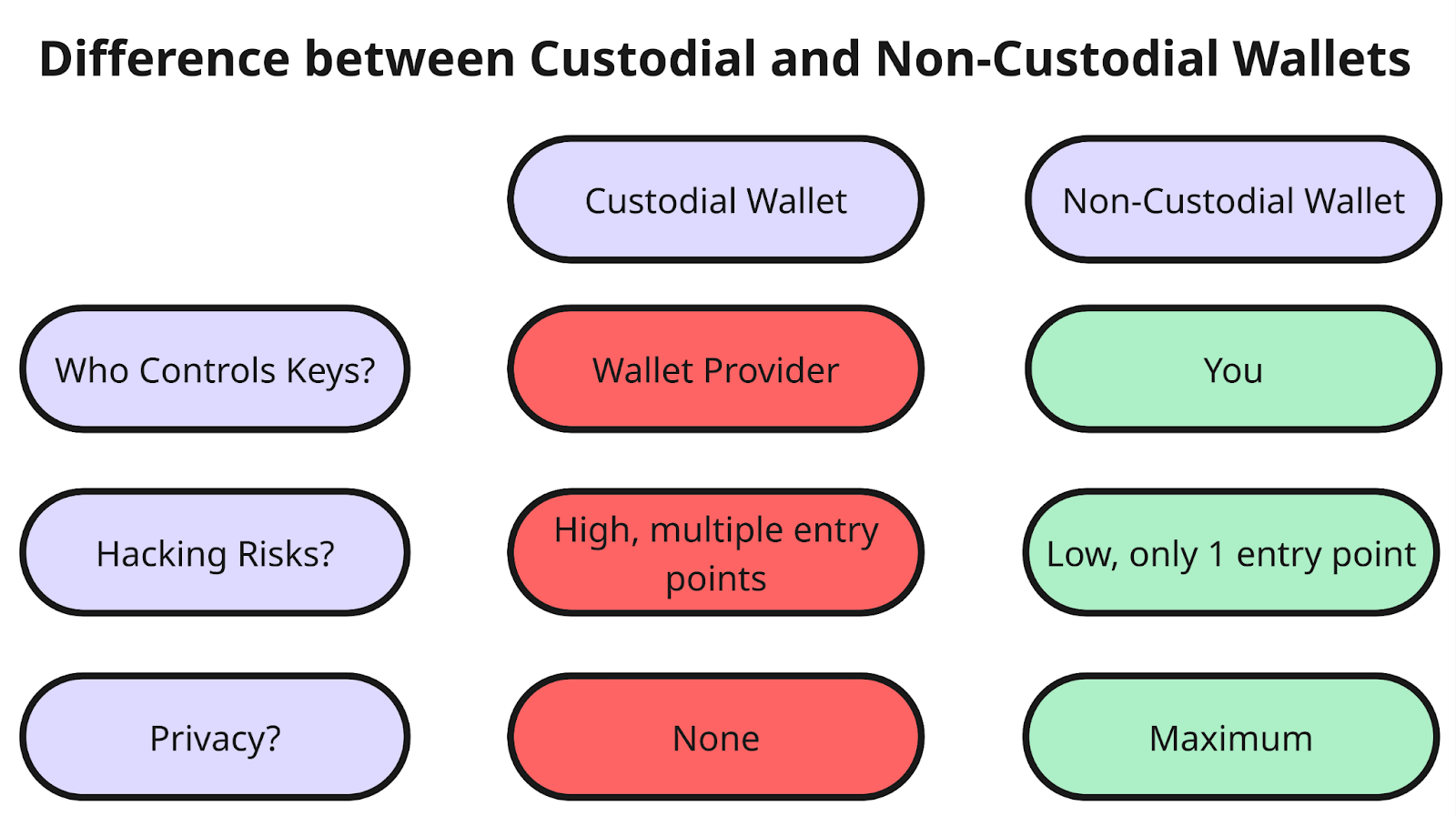
Key difference between Non-Custodial and Custodial Wallets:
- Сustodial wallets (like exchanges) take power to hold keys from you;
- Non-custodial wallets give you the power to hold the keys.
What Is a Non-Custodial Wallet?
Definition
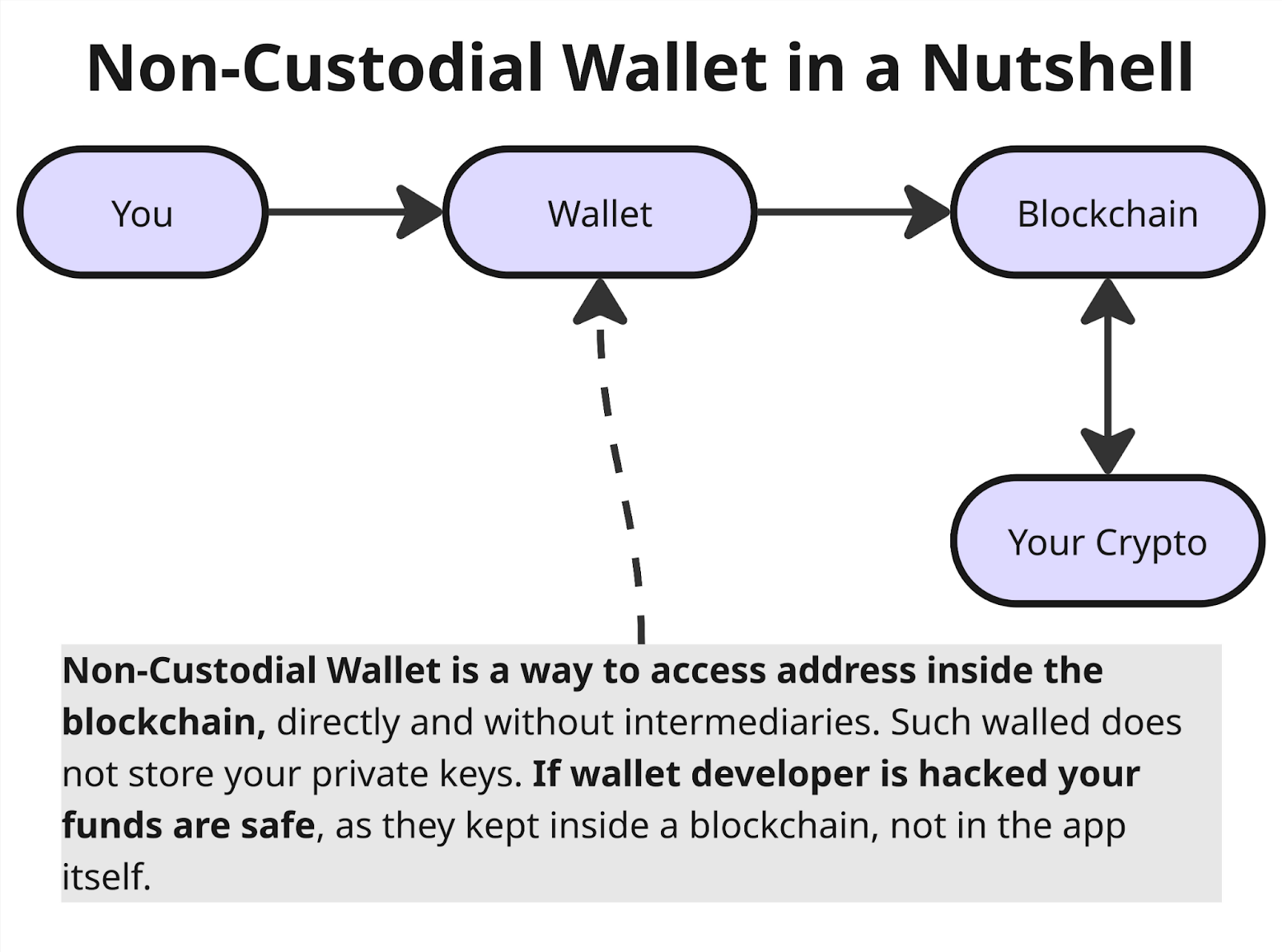
A non-custodial wallet is a software to access blockchain where the private keys (seed phrase) is held solely by the user. There is no middleman, no bank, and no custodian. The wallet software is simply a way to access your account inside the blockchain, and does not store any arbitrary data about what you do, what checkboxes you tick and how often you use the wallet app.
How Non-Custodial Wallets Work
In simple English, Non-Custodial wallet uses cryptography to generate a seed phrase, which serves as a way to access an account inside the blockchain. Each seed phrase corresponds to one account, certain wallets allow the use of the same account inside a range of blockchains.
- Seed Generation: Upon setup, the wallet generates a Recovery Phrase (usually 12 or 24 words). This is the master key to your funds, this key is stored only on your device.
- Key Creation: Mathematical algorithms derive your public address (for receiving) and private key (for signing) from that seed phrase.
- Local Signing: When you send crypto, the transaction is signed locally on your device before being broadcast to the network. Your private key is never revealed.
Source: GoMining.com
Types of Non-Custodial Wallets
Hardware Wallets (Cold Storage)
Devices like Ledger, Trezor, or Keystone.
These physical devices store your private keys offline. They are immune to online hacks because the keys never touch the internet. Albeit, they can be hacked if the attacker takes the stick from you — there’s plenty of ways to hack a hardware wallet, and it takes 3 to 8 hours at most. If you keep the hardware wallet safe — it's a very secure way to store the seed phrase, but also very obvious if anyone tries to rob you.
Software Wallets (Hot Wallets)
Browser Wallets: Extensions like MetaMask, TronLink, Phantom, or Keplr. These are the primary gateway to Web3 and DeFi apps. However, because they live in your browser, they can be hacked if you click a phishing link or download a malicious extension.
Mobile Wallets: Apps like Trust Wallet, Exodus, or Rainbow. These offer a balance of security and convenience for daily use. They are vulnerable to the same risks as regular browser extensions, plus if anyone steals your phone that wallet is gone too.
Smart-Contract Wallets
Wallets like Safe (formerly Gnosis Safe) or Argent.
These use smart contracts on the blockchain to manage assets. They introduce features like "Social Recovery" (trusted friends can help restore access) and multisig (requiring multiple approvals), setting a new standard for security.
Paper Wallets — Ultimate Cold Storage
A paper note with handwritten Seed Phrase, word by word. It is called a Cold Storage because Seed Phrase is not stored on a digital medium. Can the paper wallet become compromised? Only if you post a photo of it online or stored on any electronic device. Technically, you can carve it out on a stone, in a metal sheet — the options are limitless.
There’s a funny story about cold wallet storage. One man printed it out on parts of his old BMW, and only he knew the proper sequence for the seed phrase. The machine got stolen, resold and arrived at an unnamed car shop. Certain kinds of people came to the car shop, asking to buy the machine, but failed to negotiate. Later, the owner traced down the car and managed to buy it back, since only he knew the proper way to assemble and read the seed phrase. So even if your seed phrase is in plain sight but words are placed randomly nobody will be able to deduce what it is.
Pros of Non-Custodial Wallets
Full Ownership and Control
Only you control access to assets. No government, exchange, or corporation can freeze your funds or block your transactions — there is no such backdoor. As long as you own the seed phrase, you own the crypto.
Privacy & Autonomy
Crypto Wallet without KYC: there’s no need to show your ID, email, phone number or any other personal data to create a non-custodial wallet, so there’s no risk that those will show up online if the company fails to protect the data.
Unlimited Access to DeFi
To use decentralized applications (dApps) like Uniswap, Aave, or OpenSea, you can connect a non-custodial wallet via WalletConnect — a special protocol that makes a wallet your login+password.
Cons of Non-Custodial Wallets
You are your own tech support
There is no "Forgot Password" button or Technical Support for Non-Custodial Wallet by design. If non-custodial wallet had “Recover Seed Phrase” it would mean your crypto was never secure in the first place. Scammers often try to pose as wallet “Technical Support” in order to steal crypto. By default, no wallet has any technical support.
If you fail to protect the seed phrase — crypto will be stolen. The burden of protection is on you, for some it’s too tiresome so they pick custodial wallets instead.
Security Model Explained
Most wallets use the BIP-39 standard. Your wallet generates a random string of words (entropy). This phrase is your money. Anyone who knows it can access your wallet and steal your funds.
Non-Custodial Wallets Use Seed Phrase to sign transactions: The software creates a digital signature on your device using the private key. Only this signature is broadcasted online, not the key itself.
Backup Techniques
To ensure secure crypto storage, follow these rules:
- Metal Backups: Use steel plates to record your seed phrase (fireproof/waterproof).
- Offline Only: Never save your seed phrase in cloud storage, notes apps, or email.
- Redundancy: Keep multiple offline backups in different physical locations.
Custodial vs Non-Custodial — Full Comparison
Source: GoMining.com
Who Should Use Non-Custodial Wallets?
Every other crypto user
Non-Custodial wallet is the norm in crypto space, it’s the ultimate protection and a sign you understand what you’re doing. It is also essential to access basic crypto functions: interact with smart contracts, yield farms, or provide liquidity and earn APY from Liquidity Pools.
Long-Term Holders
Investors looking to hold assets for years should use cold storage crypto solutions to avoid exchange bankruptcy risks (e.g., FTX or Celsius).
Privacy-Oriented Users
Those who value financial anonymity and want to transact without leaving a data trail.
Web3 Natives
If you collect NFTs, play blockchain games, or vote in DAOs, you need a Web3-compatible non-custodial wallet.
Conclusion — The Power & Responsibility of Self-Custody
Non-custodial wallets offer the true promise of cryptocurrency: financial sovereignty. They allow you to be your own bank, giving you uncensored access to the global economy.
However, this freedom requires discipline. You must protect your seed phrase with your life. For beginners, it is often best to start small, learn the basics of private key backup, and transition to a hardware wallet as your portfolio grows.
Subscribe and get access to the GoMining course on cryptocurrency and Bitcoin, which is still free: https://academy.gomining.com/courses/bitcoin-and-mining
FAQ
Is a non-custodial wallet safe?
Yes, if managed correctly. It is generally safer than custodial wallets because it removes the risk of a third-party exchange hack. However, it is vulnerable to user error and phishing.
What happens if I lose my seed phrase?
If you lose your seed phrase and your device breaks, your funds are permanently lost. There is no way to restore a crypto wallet without the recovery phrase.
Who owns the keys in non-custodial wallets?
You do. The keys are encrypted and stored on your device (phone, computer, or hardware wallet). The wallet developer has no access to them.
What is the safest type of crypto wallet?
A hardware wallet (cold storage) is the safest option. It keeps private keys offline, protecting them from online viruses and hackers.
Do I need KYC for a non-custodial wallet?
No. Non-custodial wallets do not require identity verification. You can generate a wallet instantly without providing personal data.
Can I switch from one non-custodial wallet to another?
Yes. Since you own the seed phrase, you can import that phrase into any compatible wallet software (e.g., moving from Trust Wallet to MetaMask).