
The November market update reveals a period of intensified volatility and shifting sentiment in the Bitcoin ecosystem. After reaching record highs in October, Bitcoin’s price has suffered a steep decline, with technical indicators and institutional flows signalling weakness. Market participants face renewed fear as long-term holders and digital asset treasury firms react to changing conditions, while a select group of strategic buyers continues to accumulate. In parallel, the mining landscape is undergoing rapid evolution, as new hardware innovations promise improved efficiency amid historically low miner revenues. The current environment presents both significant challenges and emerging opportunities for the sector.
TLDR;
BTC: $90,382 ▼ -17.5%
Open: $109,554 | Close: $90,382 | High: $107,465 | Low: $80,537
Hashprice $36.01/PH/day ▼ -19.6%
Open: $44.77/PH/day | Close: $36.01/PH/day | High: $44.77/PH/day | Low: $35.20/PH/day
Hashrate 1,073 EH/s ▼ -13.6%
Open: 1,118 EH/s | Close: 1,073 EH/s | High: 1,118 EH/s | Low: 1,055 EH/s
Bitcoin Slips Below Key Support
After reaching an all-time high of $126,272 on October 6, Bitcoin began to slide. The decline accelerated through November. Once BTC fell and held below the $100,000 level, several bearish technical indicators started to emerge.
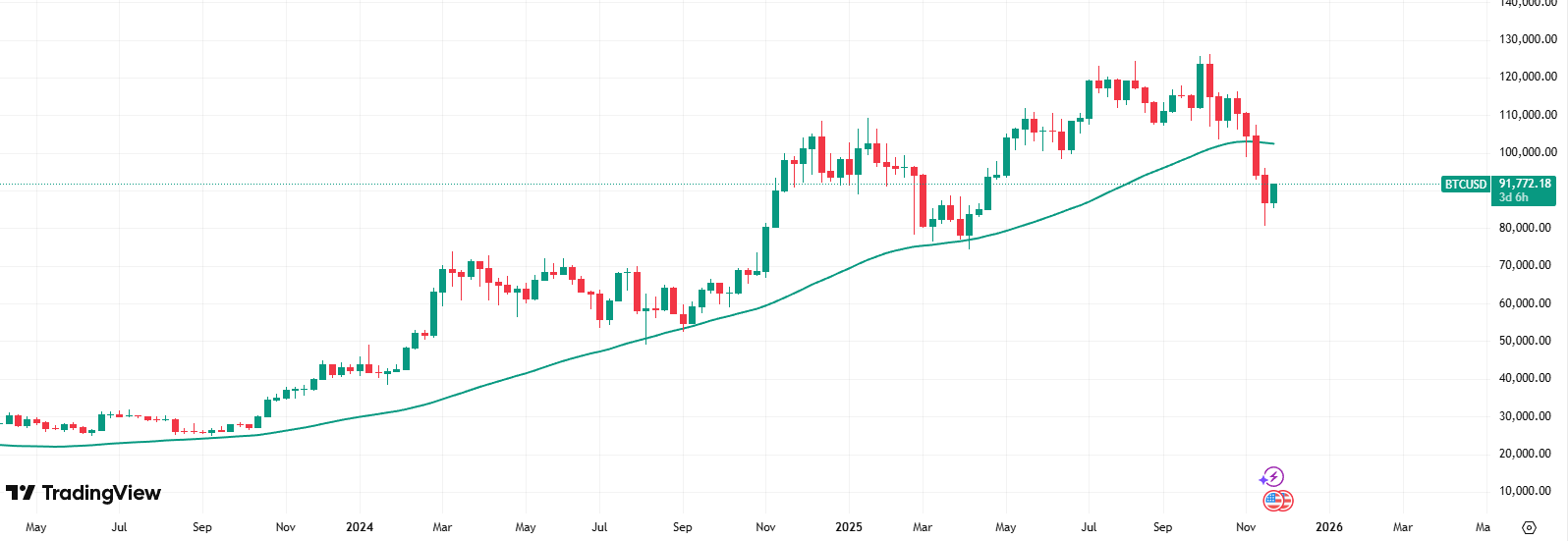
For the first time since Q1 2023, Bitcoin closed below its 50-week moving average—a level that has repeatedly acted as structural support during prior bull markets. Until the price reclaims this level, the break should be interpreted as a short-term bearish signal.
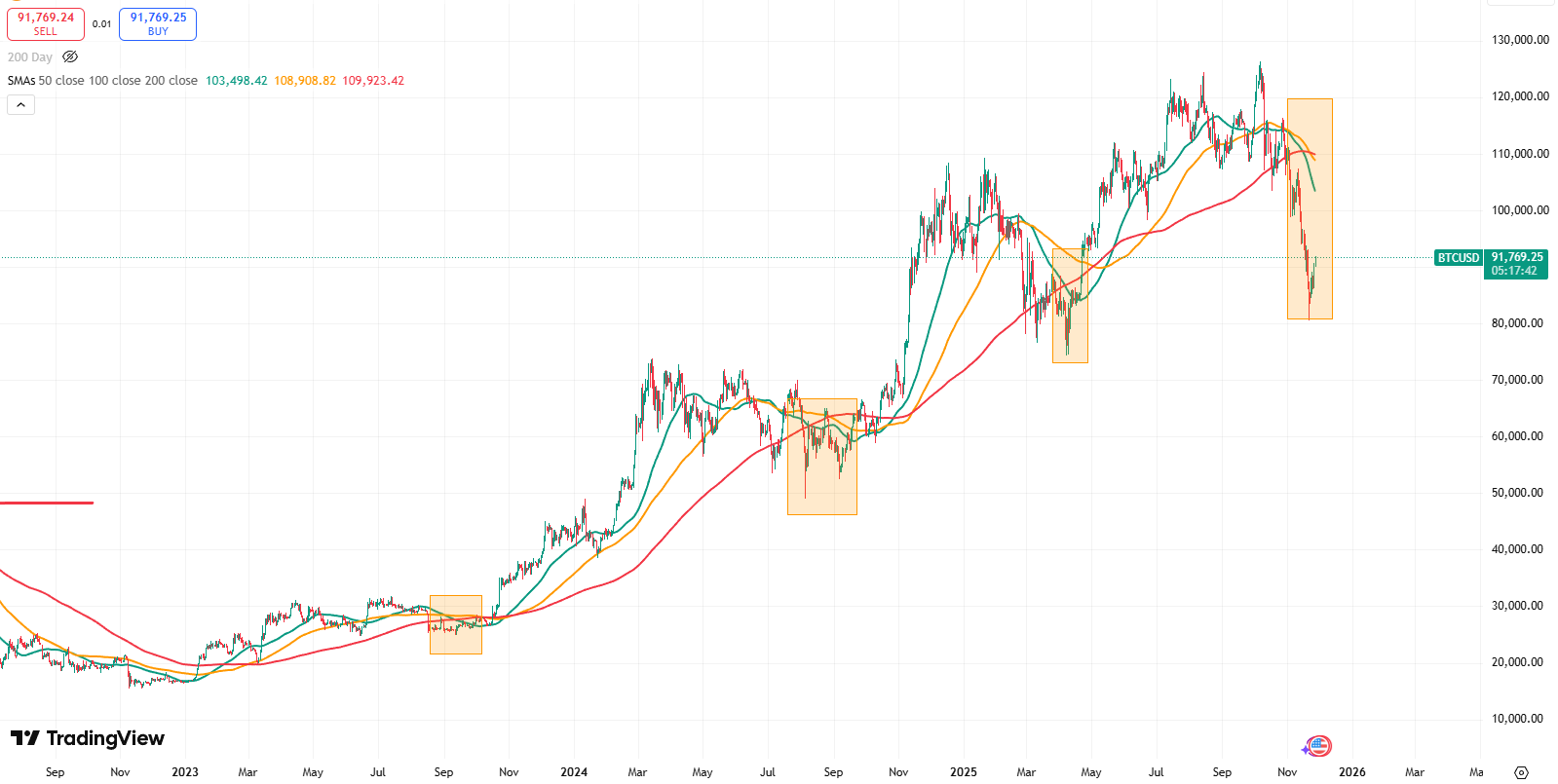
On the daily chart, Bitcoin also formed a death cross, as the 50-day simple moving average (SMA) crossed below the 200-day SMA. Historically, death crosses have often coincided with local market lows. This time, however, we have not seen a rebound, and the gap between the two SMAs continues to widen, signalling persistent weakness.
Extreme Fear Returns, but the Market Isn’t the Same
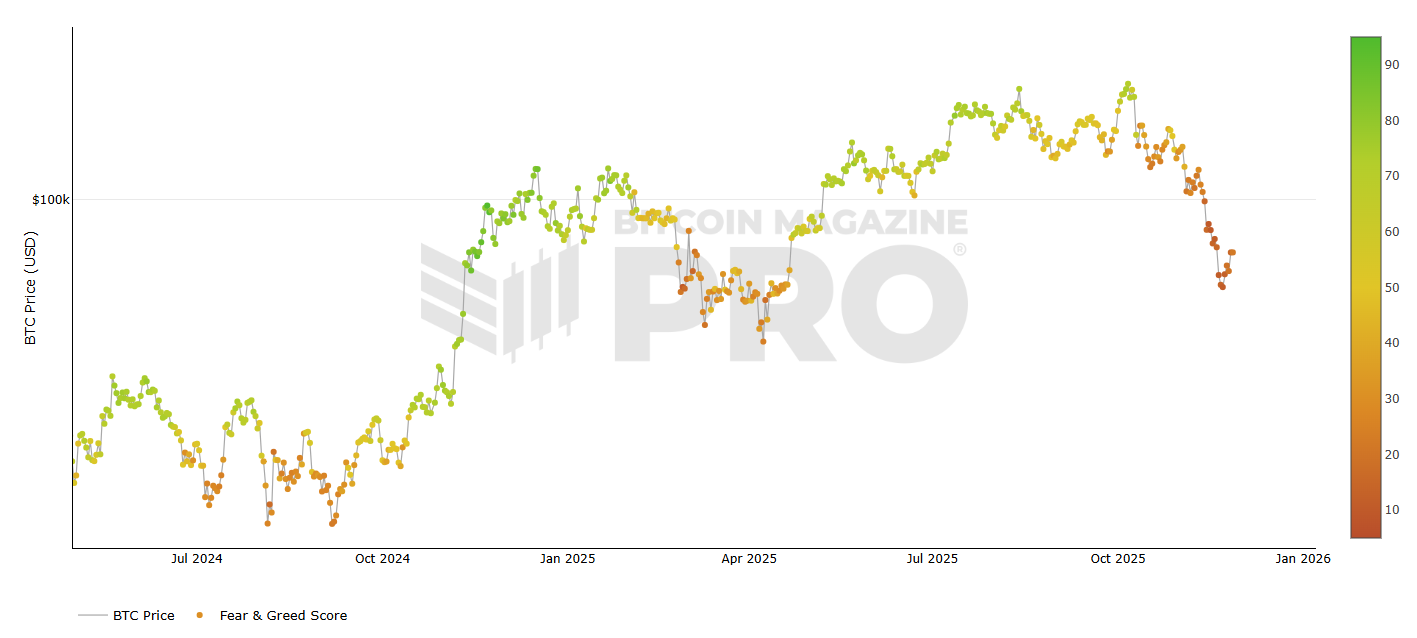
The Bitcoin Fear & Greed Index has fallen to 11, levels we haven’t seen since the deep capitulation of the 2022 bear market following the FTX collapse. Back then, Bitcoin had already retraced more than 70% from its all-time high, and FTX acted as the final washout.
Today, despite similar sentiment readings, the market is fundamentally stronger. The ecosystem is more mature, institutional participation is deeper, and structural demand for Bitcoin continues to rise.
Sell Pressure by Long-Term Holders
The primary force behind this bearish trend is long-term holders selling substantial amounts of Bitcoin. This behaviour is clearly reflected in the HODL Waves chart. The bands represent coins that have remained untouched for longer periods, with the deepest purple indicating those held for over ten years.
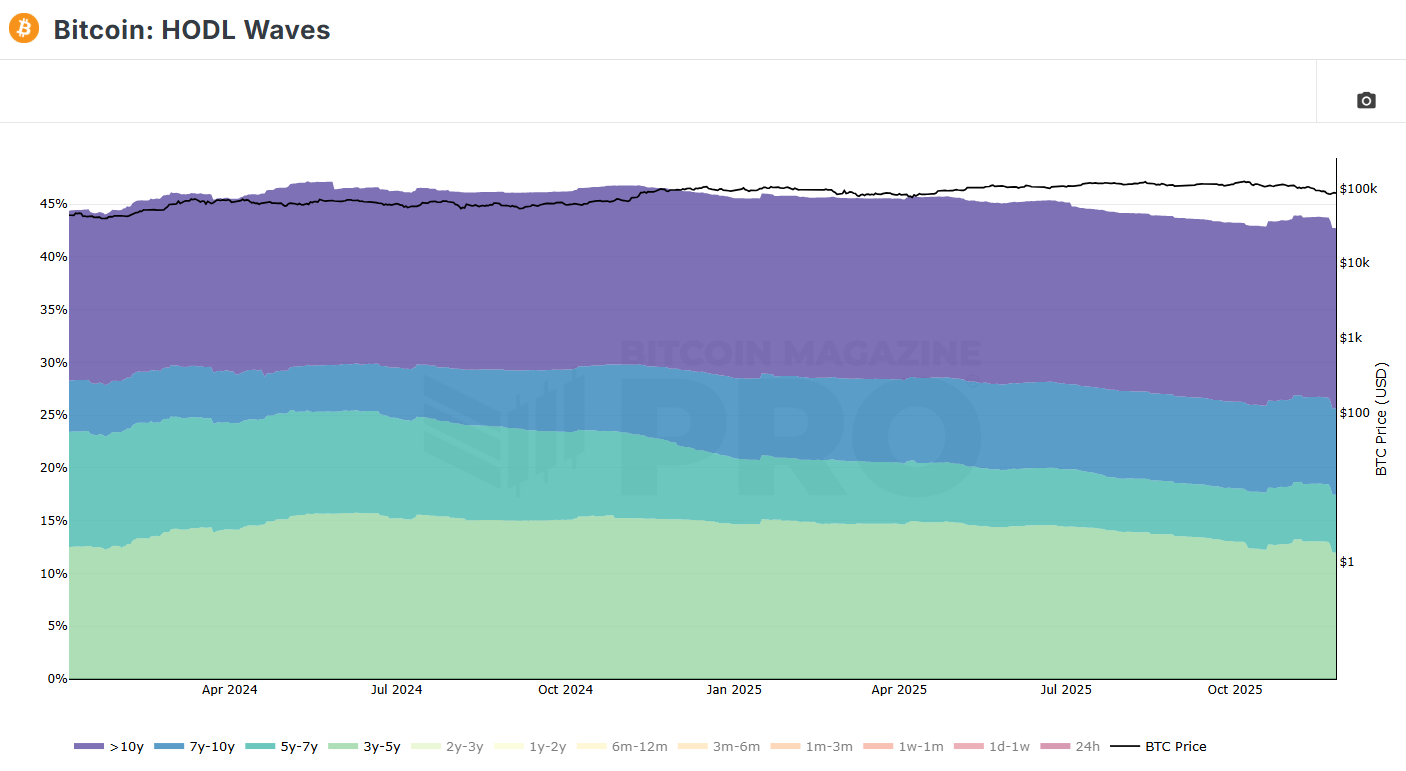
When these darker bands begin to contract, it signals that veteran holders are moving their coins, typically in preparation to sell. Over the past year, these long-term bands have steadily declined, indicating a persistent wave of distribution from long-term holders into the market.
ETFs See Second-Largest Outflow on Record
Bitcoin ETF flows have remained weak in recent weeks. On November 20, the funds experienced net outflows of roughly US$903 million—the second-largest single-day withdrawal in ETF history—as risk-off sentiment spread across the market. The only larger outflow occurred on February 25, when Bitcoin ETFs collectively saw more than US$1.01 billion withdrawn in just 24 hours. The ETFs ended a difficult month of persistent withdrawals with a modest turnaround, recording approximately $70 million in net inflows over the past week. The shift came after four consecutive weeks of heavy outflow.
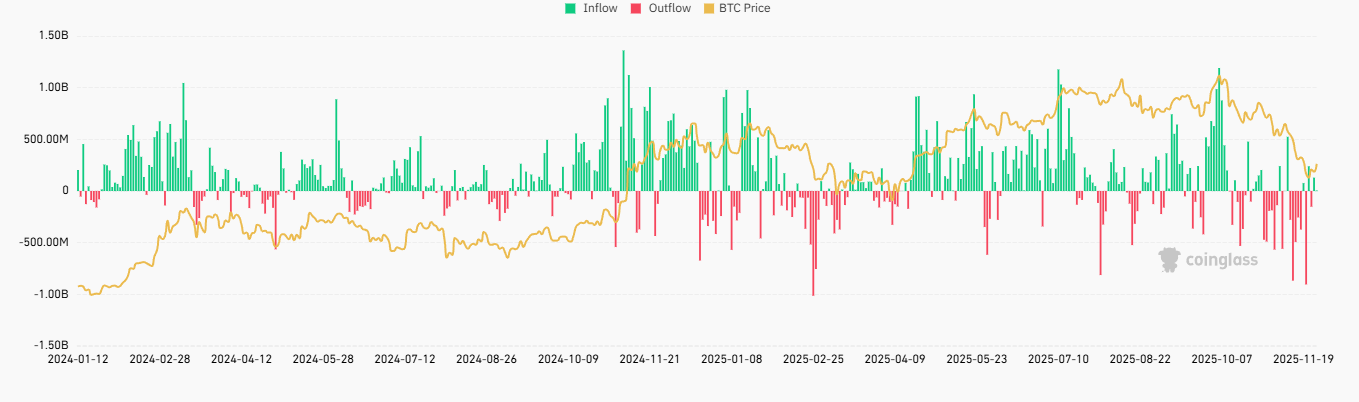
Grayscale’s GBTC accounted for the bulk of the exits, followed by BlackRock’s iShares Bitcoin Trust (IBIT) and Fidelity’s FBTC, indicating that even institutional participants are taking a more cautious stance amid heightened volatility. BlackRock's reported its largest daily net outflow since its January 2024 debut. Around the Bitcoin all-time high, the ETFs had a combined AUM of $165 billion, which declined to $122 billion towards the end of November.
Bitcoin Turns Negative in 2025
Bitcoin is now negative for the year, defying the bullish expectations that dominated early 2025. At the start of the year, BTC traded near $95,000, and many investors anticipated a strong rally driven by the Trump administration’s pro-crypto stance, lower interest-rate expectations, accelerating ETF inflows, and the typical four-year cycle blow-off phase.
Instead, those bullish catalysts collided with a market suffering from thin liquidity and heavy profit-taking by long-term holders. Despite political tailwinds and expanding institutional participation, Bitcoin has slipped into negative territory for the year.
Hashprice Sets Historic Lows
The recent bearish price action has pushed hashprice down to $35/PH/day, a new all-time low and $3 below the previous record of $38/PH/day set in August 2024. Since the July 2025 hashprice peak, a clear divergence has emerged: network hashrate keeps climbing while miner revenue per unit of compute continues to fall.
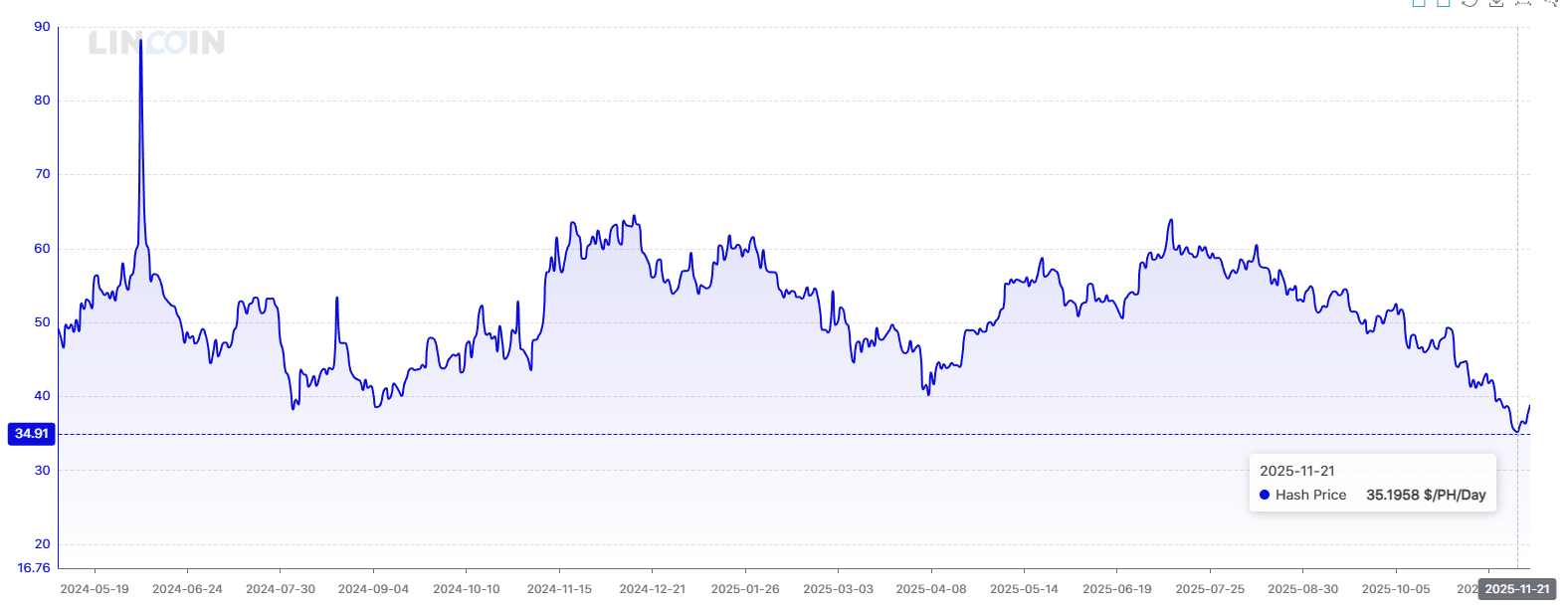
With transaction fees contributing less than 1% of total block rewards, mining economics are tightening in a way that leaves little margin for resilience. Unless hashrate begins to come offline or Bitcoin’s price meaningfully recovers, miners are on the verge of operating through the lowest revenue environment in Bitcoin’s history.
Digital Asset Treasury Firms Lose Nearly Half Their Market Value
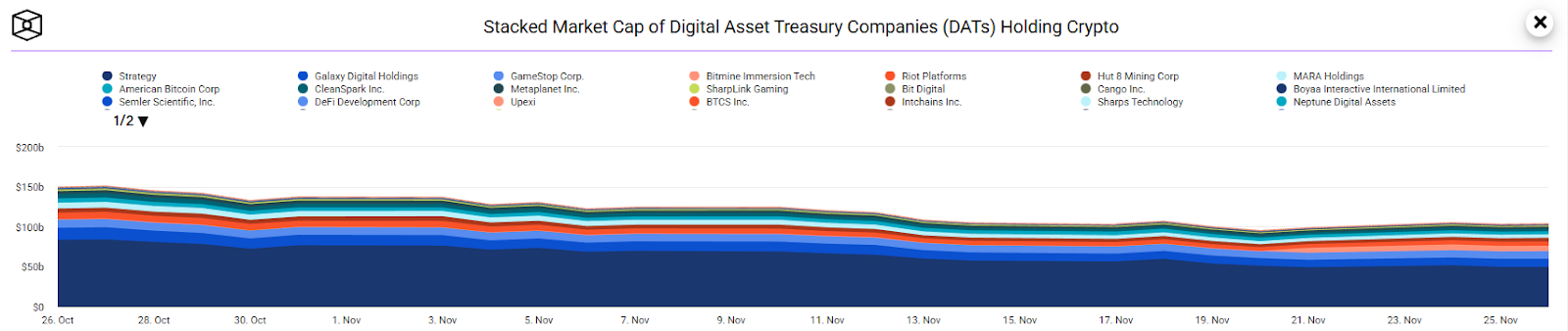
Digital asset treasury firms are taking heavy losses. Their combined market caps have nearly halved, plunging from a $176 billion peak in July to roughly $95 billion on November 20th, mirroring the sharp downturn in digital asset prices.
Companies like Strategy, Bitmine, and Forward Industries are facing steep stock drawdowns as their BTC, ETH, and SOL positions unwind. While Michael Saylor’s firm remains above water, most DATs are now sitting on significant unrealized losses, highlighting how quickly treasuries can be stressed when markets correct.
Conviction Buyers Are Accumulating Despite the Bearish Sentiment
Even as Bitcoin faces renewed volatility and bearish sentiment, some of the most strategic players are quietly accumulating. Harvard University’s endowment, the largest in the world, has boosted its stake in BlackRock’s IBIT by roughly $443 million, making the Bitcoin ETF its largest disclosed equity holding. This 257% increase in Q3 is a striking move for a conservative institution that typically avoids ETFs, signalling that Bitcoin is viewed as a core allocation, not an experiment.
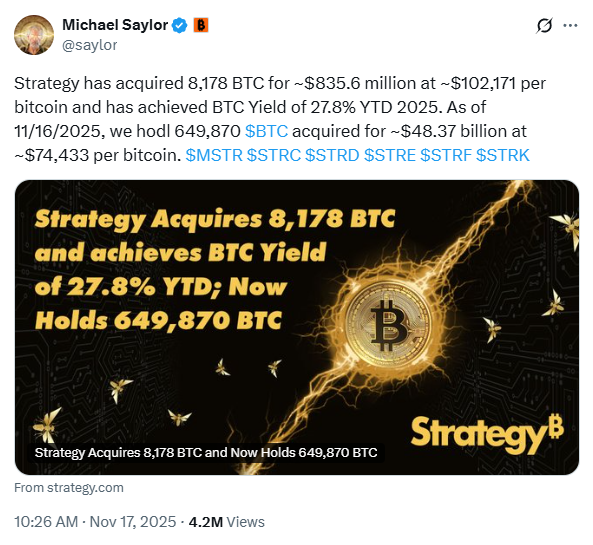
MicroStrategy recently purchased 8,178 BTC for ~$835.6 million at an average of ~$102,171, bringing its total holdings to 649,870 BTC acquired at ~$48.37 billion. Michael Saylor has been vocal in framing Bitcoin as an economic imperative rather than an investment strategy, and MicroStrategy’s consistent accumulation has positioned the company as the largest publicly disclosed holder globally.
On the sovereign level, El Salvador has doubled down as well. Following a price drop below $90,000, the country executed its largest single-day Bitcoin purchase to date—1,090 BTC worth around $100 million—raising its national reserves to 7,474 BTC. President Bukele has maintained a price-driven accumulation strategy, including daily 1 BTC purchases since late 2022.
Taken together, these examples highlight a pattern: while retail traders sell into fear and long term holders exit, the entities with the longest time horizons continue to buy.
Bitcoin Enters the “5% Era”
Bitcoin has crossed a pivotal threshold: more than 19.95 million BTC have been mined, leaving fewer than 1.05 million coins to be created over the next 115 years. This milestone marks the beginning of what many refer to as the 5% Era.
Bitcoin follows geometric decay through halvings, which cut the block reward by 50% every cycle. After the April 2024 halving, block rewards fell to 3.125 BTC per block, meaning 95% of all bitcoins are already issued while the remaining 5% will take more than a century to mine. This engineered scarcity has long been central to Bitcoin’s investment narrative and has fueled institutional interest. In this new phase, only miners with cheap energy access, optimized infrastructure, and disciplined fleet management will remain competitive.
A New Wave of Bitcoin Mining Hardware
Canaan Inc. has re-entered the performance race with the launch of its Avalon A16 series at Blockchain Life 2025. The Avalon A16 delivers 282 TH/s at 3,900 W, achieving 13.8 J/TH, a more than 22% efficiency improvement over the A15 and closing the gap with Bitmain’s S21XP (13.5 J/TH). With hashrates comparable to top-tier air-cooled units such as Auradine’s Teraflux AT2880 and the Bitdeer SEALMINER A3 Pro Air, Canaan now sits firmly in the upper bracket of next-generation hardware.
The Avalon A16XP, the flagship of the lineup, pushes performance a step further: 300 TH/s at 3,850 W, resulting in 12.8 J/TH. Despite delivering 6% more hashrate than the A16, it draws slightly less power, placing it among the most efficient air-cooled ASICs on the market. Only Bitdeer’s A3 Pro Air edges it out, at 12.5 J/TH. The A16 series marks a significant leap in efficiency and power density, signalling Canaan’s renewed competitiveness among global ASIC manufacturers.

Auradine is also pushing boundaries. Its next-generation Teraflux™ systems target 9.8 J/TH, the most aggressive efficiency target in the sector. Engineered and assembled in the United States, the lineup will span air, hydro, and immersion configurations. Air-cooled systems will range from 240–310 TH/s, immersion units from 240–360 TH/s, and hydro systems from 600–900 TH/s. Samples are expected in Q2 2026, with volume shipments in Q3 2026, and pre-orders are now open. The message is clear: Auradine intends to bring high-performance, domestic hardware to scale.

Meanwhile, BGIN Blockchain is preparing to enter the Bitcoin mining arena. The company has completed design and simulation verification for its first Bitcoin ASIC, the BT1, and is now in the tape-out phase, a critical milestone before chip fabrication. BGIN’s R&D team has deep experience from altcoin hardware such as the KS7, which doubled performance over earlier models. Under the ICERIVER® brand, CEO Allen Wu described the BT1 as “a pivotal moment”—a signal that BGIN aims to bring its proven ASIC engineering to Bitcoin with industry-leading efficiency, targeting an early 2026 launch.
In an environment defined by steep price retracements and historically low miner revenues, the pace of innovation has not slowed. From established giants like Canaan and Auradine to ambitious challengers like BGIN, hardware manufacturers are responding to adversity with breakthroughs in efficiency and power density. Rather than signalling contraction, the 2025–2026 cycle points to a renewed arms race in mining technology, setting the stage for one of the most competitive eras in Bitcoin mining history.
Nico Smid – Research Analyst at GoMining Institutional