

SUI is one of the most technologically ambitious next-generation Layer-1 blockchains. And precisely because of that, it attracts some of the most extreme price predictions — ranging from “the next Solana” to “an overvalued VC-driven token.”
In this article, we break down five of the most optimistic and five of the most pessimistic SUI price predictions for 2026, explain why these scenarios exist, which metrics stand behind them, and — most importantly — how beginners can use these forecasts in practice rather than treating them like guesswork or fortune-telling.
Why It Makes Sense to Talk About SUI Price Predictions for 2026
If you are relatively new to crypto, it’s important to clear up one illusion right away. Price predictions are not forecasts of the future — they are scenarios. This is especially true for SUI. Coin entered the market after crypto had already lived through: the collapse of Terra, the FTX scandal, the painful 2022–2023 bear market, and then a renewed wave of interest in infrastructure-focused blockchains.
In other words, SUI is not a “bull-market toy” like many projects launched in 2021. It was born into an environment where investors had become more skeptical, more cautious, and far more demanding. That is exactly why:
- some analysts see SUI as a foundation for DeFi and Web3 applications,
- while others view it as an example of venture capital inflating valuations without sufficient organic user demand.
The year 2026 is not chosen at random. By that point:
- most major token lock-ups will have ended,
- it will be clear whether the ecosystem can survive without constant subsidies,
- and the market will have gone through at least one full macro cycle after Bitcoin’s halving.
What Is SUI in Simple Terms?
SUI is a Layer-1 blockchain developed by Mysten Labs — a team that includes former Meta (Facebook) engineers who previously worked on the Diem project. The core idea behind SUI is not “being the fastest in testnet benchmarks,” but rather: scaling transaction processing horizontally, reducing latency, and simplifying smart contract development for builders.
Unlike Ethereum, which is built around an account-based model, SUI uses an object-oriented model. This matters because:
- not all transactions need to be processed sequentially,
- some operations can run in parallel,
- and the network can theoretically scale better for real-world applications.
The key word here is theoretically — because in crypto, there is always a gap between architectural design and real-world usage.
Why SUI Is Constantly Compared to Solana and Aptos
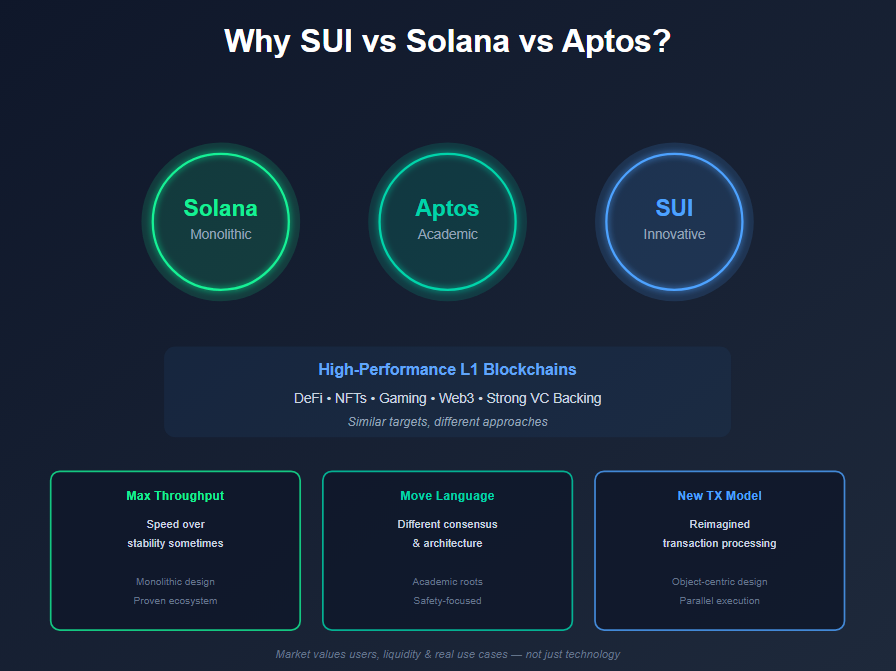
If you’ve been reading market analysis, you’ve almost certainly seen these comparisons — and they are not accidental. SUI, Aptos, and Solana are often grouped into the same category: high-performance Layer-1 blockchains, focused on DeFi, NFTs, gaming, and Web3 services, backed by strong venture capital funding.
However, the differences between them are fundamental.
Solana is a bet on a monolithic blockchain with maximum throughput, sometimes at the cost of stability.
Aptos represents a more academic approach, also using the Move language, but with a different consensus mechanism and architectural philosophy.
SUI goes a step further by attempting to rethink the transaction processing model itself.
And this is where the key issue for price predictions begins. The market does not value code — it values: the number of users, total value locked, developer activity, and real-world use cases.
That is why SUI price predictions vary so dramatically.
Source: GoMining.com
How SUI Price Predictions Are Formed
Before moving on to the “top 5 best and worst price predictions,” it’s important to understand the mechanics behind them. Most SUI price forecasts are built on a combination of four core factors.
1. Historical price action.This involves comparing current price behavior with past market cycles. It’s a weak but very popular method, often used as a rough reference rather than a decisive signal.
2. On-chain metrics.These include TVL, the number of active addresses, transaction volume, and whale behavior. Data from platforms such as CoinGecko, DeFiLlama, and Nansen provides a much more solid analytical foundation here.
3. Tokenomics and issuance.The relationship between FDV and circulating supply is a key risk factor for SUI and plays a major role in both bullish and bearish scenarios.
4. Macro context.Bitcoin, ETFs, interest rates, and overall market liquidity heavily influence how investors price risk across the crypto market.
Beginners often make the same mistake: they focus only on the final number. More experienced investors focus on the reasoning behind the forecast and treat the price target as a scenario range rather than a promise.
The Best SUI Price Predictions for 2026
Let’s start with the optimistic side, since these scenarios tend to dominate headlines. Bullish SUI price predictions are usually built around several recurring ideas: growth of the DeFi ecosystem, increasing developer interest, gradual reduction of token unlock pressure, and overall market expansion after the Bitcoin halving.
Some analysts openly describe SUI as a “bet on next-cycle infrastructure.” In the most bullish scenarios, by 2026 SUI:
- establishes itself as a top-tier Layer-1 blockchain,
- competes for liquidity with Solana and Avalanche,
- and becomes a base layer for gaming, NFTs, and Web3 applications.
These assumptions are what drive forecasts that imply multi-fold upside from current price levels. But this is exactly where a pause is needed.
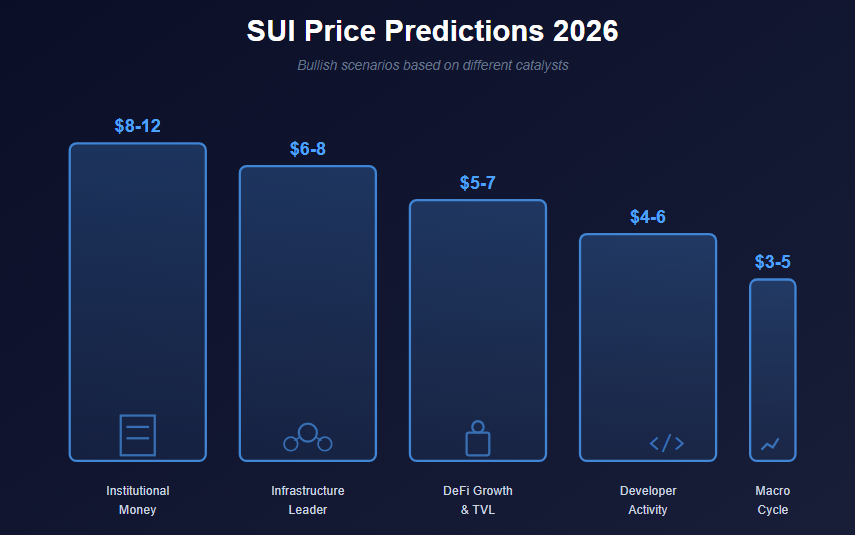
#1: SUI as an Infrastructure Leader of the Next Cycle ($6–8)
The most common bullish scenario looks roughly like this.
By 2025–2026, the market once again starts valuing infrastructure rather than memes and short-term hype. After the Bitcoin halving, liquidity gradually flows back into altcoins, and investors look for blockchains that developers can actually build on. In this scenario, SUI:
- maintains stable network performance,
- shows consistent growth in active addresses,
- increases TVL within its DeFi ecosystem,
- and proves itself as a developer-friendly platform.
In terms of analogies, SUI is often compared to early-stage Solana during 2020–2021. At that time, Solana also appeared “too complex” and “overvalued” — until its ecosystem began to grow in a meaningful way. Under this scenario, analysts model:
- a market capitalization in the $20–30 billion range,
- which, with a moderate token supply, implies a SUI price of $6–8 by 2026.
Importantly, this does not mean SUI is guaranteed to reach those levels. It simply means the market considers such a scenario possible if the right conditions align.
#2: Growth Through DeFi and Liquidity ($5–7)
The second most popular bullish forecast is directly tied to DeFi.
If you’ve followed the crypto market for any length of time, you already know a simple truth: Layer-1 prices usually follow TVL, not the other way around. Analysts using data from DeFiLlama and CoinGecko focus on: growth in locked liquidity, the number of active protocols, and trading volumes on in-network decentralized exchanges.
In an optimistic scenario, SUI: gradually attracts liquidity from Ethereum and other ecosystems, becomes a convenient environment for new DeFi products, and maintains low fees with high throughput.
Once TVL reaches the billions, the market naturally reassesses the value of the underlying token. In these models, SUI often lands in the $5–7 range by 2026, even without speculative euphoria.
The key point here is that this is not a “pump,” but a reassessment of fundamental utility.
#3: A Bet on Developers and Real Applications ($4–6)
Another strong bullish argument is developer activity. Crypto history shows a simple pattern: if new applications keep launching, the network stays alive.
SUI actively promotes: grants, hackathons, team support, and a simplified smart contract model.
Analysts tracking GitHub activity and deployment metrics believe SUI can carve out a niche in: gaming, Web3 services, and applications where speed and low latency matter more than purely financial use cases.
In this scenario, price growth is slower but more sustainable. Forecasts here tend to be more conservative — $4–6 per SUI — with an emphasis on long-term stability rather than explosive spikes.
#4: Macro Cycle and the Bitcoin Halving Effect ($3–5)
It’s impossible to discuss SUI price predictions in isolation from Bitcoin. Many analysts build their scenarios around a classic market cycle:
- Bitcoin halving,
- Bitcoin price expansion,
- capital rotation into Ethereum,
- then into first-tier altcoins,
- and only later into higher-risk assets.
Within this framework, SUI enters a wave of interest toward new Layer-1 blockchains precisely in the 2025–2026 window. If the broader market is in a growth phase, even average-quality projects tend to receive valuation expansion. As a result, some forecasts appear:
- not because SUI is “the best” network,
- but because the market as a whole becomes more willing to price risk.
These scenarios are often described as cyclical, placing SUI in the $3–5 range by 2026 without requiring extraordinary ecosystem success.
#5: ETF Narratives, Institutions, and Infrastructure Bets ($8–12)
The most distant and cautious bullish scenario involves institutional participation. This does not mean an SUI ETF is expected anytime soon. Rather, it reflects a broader shift where: funds, hedge structures, and second-tier crypto investment vehicles begin viewing Layer-1 blockchains as long-term infrastructure bets. If SUI:
- remains among the most stable networks,
- retains its developer base,
- and survives large-scale token unlocks without a price collapse,
it may find a place in portfolios as a high-risk, potentially high-reward infrastructure asset. Under this scenario, a price range of $8–12 by 2026 is viewed not as fantasy, but as an optional outcome.
Source: GoMining.com
The Worst SUI Price Predictions for 2026
There is a simple rule in crypto that almost no one enjoys — but everyone learns it eventually: money is usually lost not because prices fail to rise, but because risks are underestimated.
When beginners read only bullish SUI price predictions for 2026, they often assume the real question is “will it rise a lot or very a lot?” That’s not how markets work.
Bearish forecasts are not “hate.” They are scenarios where: growth logic breaks down, expectations fail to match reality, and price stops justifying optimism.
Understanding these scenarios is what shifts thinking from gambling to investing.
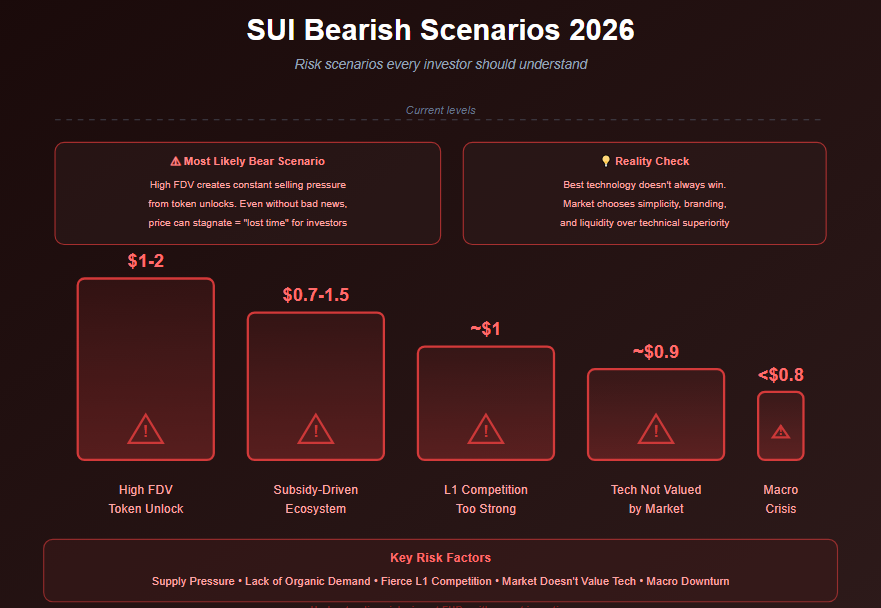
#1: Tokenomics Pressure and High FDV ($1–2)
This is the primary bearish argument against SUI — and it cannot be ignored. FDV (fully diluted valuation) has been high for SUI from the start. This means:
- only a portion of tokens is currently in circulation,
- the remaining supply unlocks over time,
- creating persistent sell-side pressure.
The bearish sequence looks like this: price rises, early holders take profits, newly unlocked tokens enter the market, and demand fails to keep up with supply.
Even with a fully functional network, price can remain stagnant for extended periods. Analysts focused on tokenomics believe SUI could remain in the $1–2 range by 2026 — not a collapse, but a “lost time” scenario, which is often the most expensive outcome for investors.
#2: The Ecosystem Fails to Move Beyond Subsidies ($0.7–1.5)
The second major criticism sounds simple but cuts deep: “The SUI ecosystem grows only while it is subsidized.”
Many Layer-1 blockchains show the same pattern: early activity spikes, TVL increases due to incentives, then declines once grants and rewards fade.
In a bearish scenario for SUI: developers come for grants, users come for yield farming, but organic demand never forms.
As subsidies decrease, activity drops — and market interest follows. In such cases, SUI price forecasts for 2026 often fall into the $0.7–1.5 range, even without negative headlines.
#3: Layer-1 Competition Is Stronger Than It Appears ($1)
Beginners often think the Layer-1 race is about speed alone. In reality, it’s far more complex. SUI competes not only with: Solana, Aptos, Avalanche, but also with: Ethereum Layer-2 solutions, modular blockchains, and emerging designs that haven’t yet entered mainstream awareness.The bearish logic assumes:
- developers prefer familiar environments,
- liquidity concentrates where users already exist,
- and SUI remains a niche platform.
In this case, the market may value SUI not as a flagship network, but as a secondary Layer-1 — placing its price around $1 in 2026, without catastrophe, but without recognition.
#4: The Market Is Not Ready to Pay for Technology ($0.9)
This is one of the most uncomfortable scenarios — especially for technically minded investors. Crypto history shows that: the best technology does not always win, markets often choose simplicity, branding, and liquidity instead.
SUI is genuinely complex to explain. Its object-based model, parallel execution, and architectural choices sound impressive, but they are not easily communicated to a mass audience.
If the market: does not feel the difference in real usage, does not see “killer applications,” and does not receive a clear, intuitive value proposition,
the token price may fail to reflect SUI’s technical strengths. Under this scenario, analysts allow for long-term stagnation, with the price hovering around $0.9, largely independent of news or updates.
#5: Macroeconomics Breaks All Scenarios (Below $0.8)
The final — and most universal — risk is macroeconomic. If during 2025–2026: interest rates remain high, liquidity continues to exit risk assets, and investor appetite for altcoins weakens, even strong projects can struggle.
In this environment, the market does not differentiate architectural nuances. It simply:
- reduces risk exposure,
- shifts capital into safer assets,
- and ignores second-tier Layer-1 networks.
As a result, SUI’s price may: temporarily fall below expectations, and remain below $0.8 even in 2026.
Source: GoMining.com
Why Worst-Case Scenarios Matter as Much as the Best Ones
In short, they show where you can be wrong. A professional approach is not blind belief in growth, but:
- understanding the full range of scenarios,
- working with probabilities,
- and managing risk.
When reading price predictions, it’s essential to keep both sides in view.
Why Price Predictions Alone Are Useless
Here’s an uncomfortable but important truth: most people lose money not because the market “tricks” them, but because they misuse information.
A SUI price prediction for 2026 is not a “make money” button. It’s a thinking tool. If you simply read a number and buy a token, you’re no different from someone betting on red or black at a casino. The purpose of predictions is to help you:
- understand possible scenario ranges,
- identify risks,
- and choose a strategy that fits your profile.
How Beginners Should Read SUI Price Predictions
Whenever you see a forecast, ask yourself three simple questions.
First: under what conditions is this possible?If an analyst says “SUI at $7 in 2026,” they assume market growth, liquidity inflows, and ecosystem expansion. If those conditions fail, the forecast loses meaning.
Second: what needs to go wrong for this forecast to fail?A good forecast always includes risks. If you don’t see them, it’s not analysis — it’s promotion.
Third: what will I do if this scenario does not play out?This is where most beginners break down. A strategy without a Plan B is a bet, not an investment.
Which Metrics Actually Matter for SUI in 2025
You don’t need to become an on-chain analyst. A few core metrics are enough.
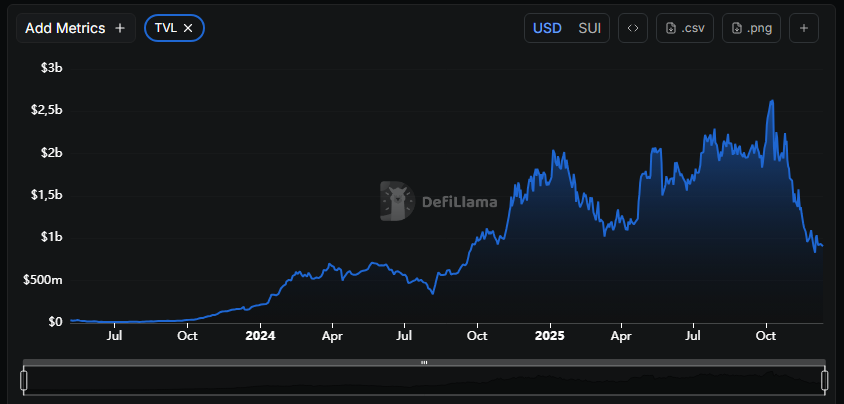
TVL (Total Value Locked).If TVL grows steadily, it signals real liquidity rather than short-term speculation. This can be tracked via DeFiLlama:
Source: GoMining.com
Active addresses and transactions.User growth matters more than short-lived activity spikes. These metrics are easy to follow through CoinGecko and network explorers.
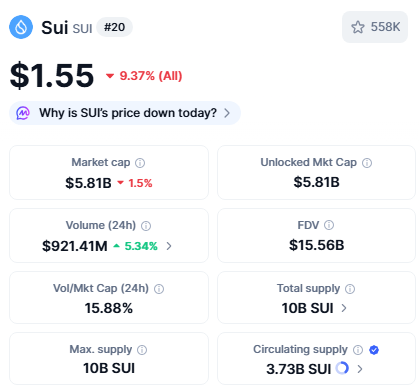
FDV versus current market capitalization.If FDV significantly exceeds market cap, future supply is already priced in — a risk that cannot be ignored.
Source: CoinMarketCap.
Whale behavior.If large holders accumulate rather than sell into rallies, it’s a constructive signal. Tools like Nansen are commonly used for this analysis.
The broader market.SUI does not exist in isolation. When Bitcoin and Ethereum are weak, altcoins almost always suffer more.
A Simple Framework for Using Predictions
For beginners, the most reasonable approach is not trading, but structured decision-making. You define:
- your base scenario,
- your downside scenario,
- and your upside scenario.
Then you set clear boundaries:
- where you are willing to buy,
- when you would take partial profits,
- and where you admit you were wrong.
For example, if you believe in moderate SUI growth:
- you don’t wait for $10,
- you don’t buy during hype phases,
- and you don’t panic during corrections.
It’s boring — but that’s how money actually works.
Common Beginner Mistakes with SUI Price Predictions
The most frequent errors are:
- trusting a single source,
- buying after loud bullish headlines,
- ignoring time horizons,
- overlooking tokenomics and unlock schedules.
Token unlocks and emissions can easily absorb price growth, even if the project itself continues to develop.
How SUI Predictions Connect to Broader Market Trends
SUI should not be analyzed separately from:
- DeFi trends,
- the evolution of PoS networks,
- Layer-1 versus Layer-2 competition,
- institutional interest,
- and macroeconomic conditions.
Rising interest in infrastructure and scalable networks strengthens bullish scenarios. Risk-off environments and liquidity contraction favor bearish ones.
FAQ: SUI Price Predictions for 2026
What does “top 5 best and worst SUI price predictions” mean?It’s an analysis of extreme bullish and bearish scenarios to understand the full range of possible outcomes, not to guess a single number.
Are SUI price predictions accurate forecasts?No. They are scenario-based estimates that help evaluate probabilities, not guarantees.
Why is 2026 a key year for SUI?By then, major token unlocks will have ended, the post-halving cycle will be visible, and the ecosystem’s sustainability can be assessed.
Which factors most influence SUI’s price?TVL growth, user activity, tokenomics (FDV and unlocks), and overall crypto market conditions.
Why do SUI forecasts vary so widely?Because the market prices technology and real user demand very differently.
Can SUI reach $8–12 by 2026?Yes, but only if ecosystem growth, market conditions, and supply dynamics align.
Is long-term stagnation or decline possible?Yes. With weak markets, strong L1 competition, and limited organic demand, SUI could remain in the $0.8–2 range.
What should beginners focus on first?TVL, active addresses, FDV versus market cap, and the state of Bitcoin and Ethereum.
Can you make money using SUI price predictions?Yes — if they’re used for risk management rather than buy/sell signals.
Summary
SUI is not a story about quick multiples, nor is it a guaranteed market winner. It is an infrastructure asset with a wide range of possible outcomes.
By 2026, its future will depend not on narratives, but on whether the ecosystem can absorb token unlocks, attract real users, and fit into the broader market cycle.
If you treat SUI price predictions as a framework of probabilities rather than promises, they become a useful decision-making tool. If you expect precise answers, the market — as always — will punish that illusion.
Want to Continue?
If you’ve made it this far, you’ve already stopped gambling and started thinking systemically. Save this article and revisit it in a few months to see which scenarios are beginning to play out. In upcoming materials, we’ll break down:
- how to read on-chain data without technical overload,
- how to track capital flows and whale behavior,
- how markets build trends around infrastructure projects.
Follow Crypto Blog / GoMining Crypto Academy for guides and checklists on the crypto market — free, while most are still waiting for a “signal.”
Telegram | Discord | Twitter (X) | Medium | Instagram