Just 10 mining pools now find more than nine out of every ten Bitcoin blocks, and the 3 largest find over 50% of them between them. That concentration is why “which pool should I join” has a duller answer than most people expect when they start mining BTC. Your choice of pool barely moves how much BTC you earn. What it moves is when you get paid, who holds the coins until you do, how much of each payout disappears into on-chain transaction fees, and whether you have any say over what goes into the blocks you help build.
What a Mining Pool Actually Does with Your Hashrate
A Bitcoin mining machine is a device that guesses. An ASIC produces hundreds of trillions of guesses per second, measured in terahashes per second (TH/s), and almost all of them are worthless. Occasionally one lands under the network’s target and becomes a valid block, worth the 3.125 BTC (until the next halving) subsidy plus that block’s transaction fees.
A pool sits between your machine and the network. It builds the candidate block, hands your ASIC a slice of the search space, and counts the near-misses your machine sends back. Those near-misses are called shares, and they are the pool’s measure of how much work you did. When any member of the pool finds a real block, the pool splits the reward according to everyone’s share count.
Think of it as a crew that agrees to pool its output before anyone knows who will get lucky. Alone, an Antminer S21 running at 200 TH/s against a network averaging roughly 950 exahashes per second (EH/s) as of mid-September 2026 would expect to find a Bitcoin block about once every 90 years. In a pool, that same machine earns a small, steady amount every day. The total BTC produced is identical either way. Only the shape of the payments changes.
Who Finds the Bitcoin Blocks Right Now
Mining pool share is estimated from the tag each pool writes into the coinbase transaction of the blocks it mines. The mempool.space pool ranking and the Blockchain.com hashrate distribution chart both derive their numbers this way. The table below shows you the top-10 mining pools by their share of found Bitcoin blocks (as of September 2026):
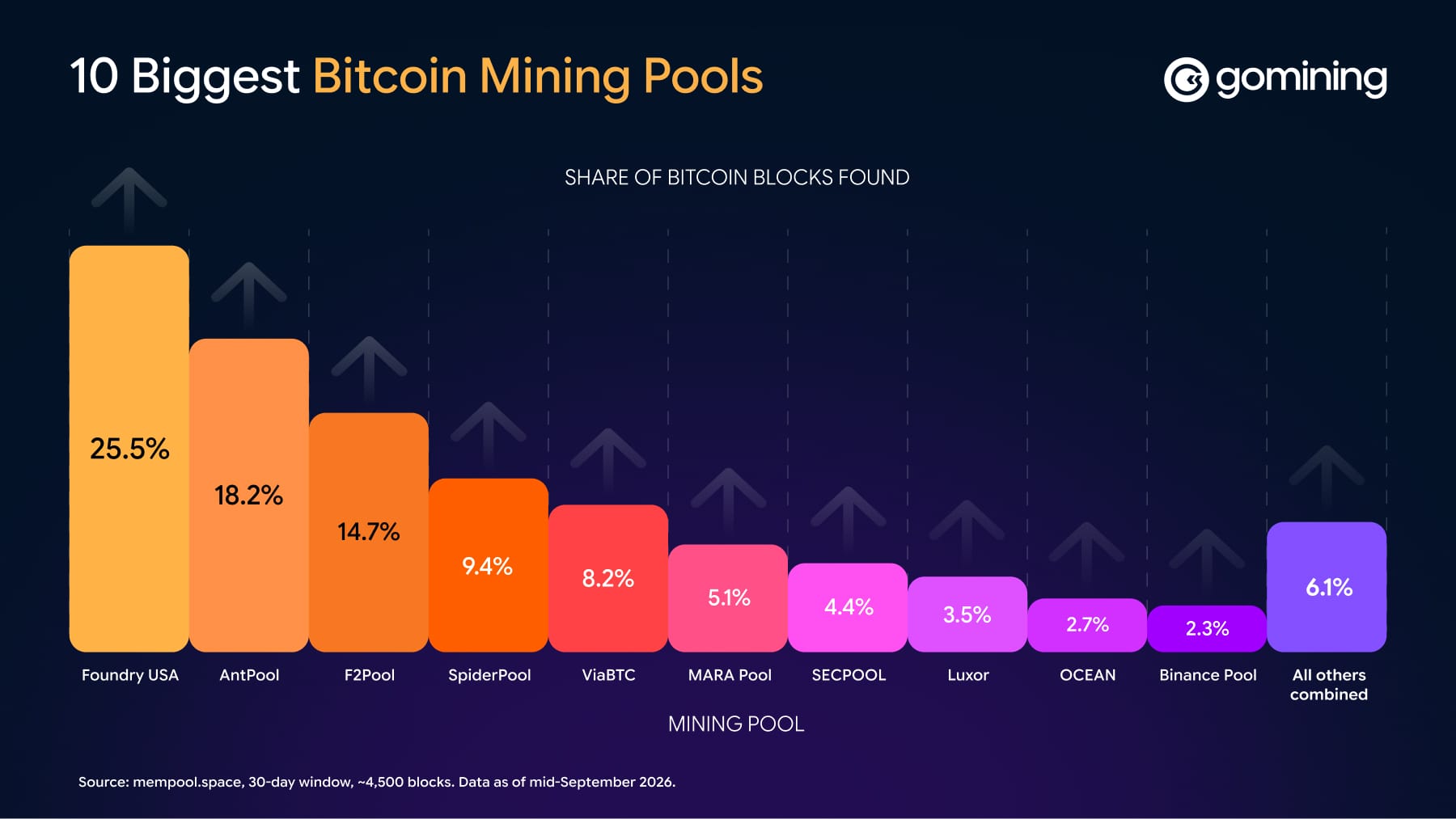
Here’s a caveat: a pool’s share tells you who assembles the block template and coordinates the payout, not who owns the machines.
Foundry’s 25.5% is thousands of independent operators. AntPool’s 18.2% includes fleets that have nothing to do with Bitmain. A single large fleet can be the reason one row is three points higher than another and still appear nowhere in any public ranking, because it never runs a pool of its own. Read these charts as a map of coordination, not of ownership.
It also explains why the industry has been nervous lately. Seven pools representing close to 75% of global hashrate agreed in May 2026 to adopt Stratum V2, a protocol that lets individual miners rather than pool operators choose which transactions go into a block. Adoption is early, but it is the clearest sign that template control, not hashrate share, is the thing people are actually arguing about.
Where Your Risk Goes: FPPS, PPS+, PPLNS, and TIDES Explained
Every mining pool employs a certain payout model that answers one question: when the pool has a bad month, who eats it? Here’s an explanation of the most common types:
- Full Pay Per Share (FPPS) pays a fixed amount per share whether or not the pool finds a block, including an estimated slice of transaction fee income. The pool absorbs the variance and charges more for doing so. Your revenue tracks your hashrate and nothing else.
- Pay Per Share Plus (PPS+) pays the block subsidy on that same fixed basis but distributes actual transaction fees proportionally as blocks come in. Slightly bumpier than FPPS, usually slightly cheaper.
- Pay Per Last N Shares (PPLNS) pays only out of blocks the pool actually finds, split across recent shares. Headline fees are the lowest in the market, sometimes zero. You carry the luck. Over a long enough window PPLNS and FPPS converge. Over a bad fortnight they do not.
- TIDES, used by OCEAN, is a PPLNS variant with one structural difference. Payouts are written straight into the coinbase output of each block the pool finds, so the coins go from the Bitcoin protocol to your address without passing through a pool wallet. However, TIDES public documentation sets out the mechanism, though it deliberately leaves fee structure to the implementation.
If you are running a hosted fleet with a monthly power bill, FPPS is worth paying for. If you are a hobbyist who can shrug at a quiet week, PPLNS keeps more of the reward.
The 10 Largest Bitcoin Mining Pools Compared
Talking about the biggest mining pools, it’s worth noting a few things. Published fees are not comparable across pools, because some deduct a stated percentage and others embed their margin in how the payout rate is calculated. And fee transparency varies more than you would expect from an industry this large: F2Pool, ViaBTC, and OCEAN publish clear schedules, while several top-ten pools publish no flat rate at all for BTC. Figures below are as of mid-September 2026.
SpiderPool, MARA Pool, and SECPOOL sit in the top-10 and are left out above because they serve negotiated industrial accounts rather than retail miners, so there is no published rate to compare. MARA Pool is generally described as closed to outside miners.
One number that gets overlooked: the minimum payout threshold. If you run a single machine, a 0.005 BTC threshold can mean months of waiting, and each on-chain payout then costs a network fee that does not care how small your balance is. Lightning payouts at Braiins Pool and OCEAN exist precisely to solve this, and for a home miner they matter more than a percentage point of fee.
Is Going Solo in Bitcoin Mining Better Than Joining a Pool?
Solo bitcoin mining means keeping the whole block reward when you find one and nothing when you do not. The arithmetic is unforgiving. As we already noted, at the current network size, a 200 TH/s machine expects roughly 1 block per 90 years, and a 1 TH/s desktop device expects 1 per 15,000.
People do it anyway, and sometimes it works. CoinDesk reported in April 2026 that a solo miner running about 230 TH/s found block 943,411 and collected 3.139 BTC, worth around $210,000 at the time. Twenty-odd such finds were recorded across the twelve months to mid-2026.
There is also a middle path that confuses a lot of newcomers. Solo mining pools for Bitcoin, such as Solo CKPool and Public Pool, are pools in the technical sense only: they run the node and hand out work, but the full reward goes to whoever solves the block, minus a small service fee. You get the infrastructure without the shared payout. That is where most documented solo wins have come from.
So, treat solo bitcoin mining as entertainment with a small expected value, not as a plan. And be clear that the variance is real in both directions: a decade of nothing is the most likely outcome, not a bad run.
Joining a Mining Pool, Step by Step
There’s one prerequisite, necessary if you want to join a mining pool — getting physical hardware for bitcoin mining. After you finished setting everything up, and is ready to connect your miner to a global Bitcoin network, mining pool is one of the last stages that takes about 15 minutes for experienced users. Here’s a step-by-step instruction:
- Pick a pool and check it accepts you. Foundry requires institutional onboarding. Braiins Pool and OCEAN need no identity documents. Binance Pool routes through an exchange account.
- Create an account and set your payout address. On OCEAN the address is the account. On most others you register a worker sub-account under a username.
- Choose the payout model and threshold. This is the decision that matters. Set the threshold as low as the pool allows if you are running one or two machines, and enable Lightning if it is offered.
- Point your machine at the pool’s stratum URL. In your miner's web interface, open the pool configuration page and enter the primary server address, your worker name, and a password (usually anything, or x). Add the pool's backup servers in the second and third slots so a dropped connection fails over instead of idling your hardware.
- Confirm the pool sees you. Accepted shares should appear in your miner's log within a minute or two, and your hashrate on the pool dashboard within roughly fifteen. Dashboard hashrate lags and wobbles by design, so judge it over hours, not minutes.
- Watch the reject rate for a day. Anything above about 1% usually means latency or an overclocked chip, and it is money leaking out. Switching to a closer regional server often fixes it.
Which Pool Suits Which Kind of Miner
There is no single best pool for Bitcoin mining. Work through 4 questions in order, because the first two can eliminate most of the table before fees matter at all:
- Can you open an account? Foundry is institutional onboarding only, so for most readers it is closed regardless of its fee. Binance Pool needs an exchange account, which is unavailable or restricted in a number of jurisdictions. Braiins Pool and OCEAN require no identity documents, and OCEAN needs no account at all: the payout address is the account. Check this first.
- Where are your machines? Stratum latency shows up as rejected shares, and a 2% reject rate costs more than a 2% fee. F2Pool publishes regional endpoints for Asia, Europe, North America, Africa, and Latin America, and AntPool, ViaBTC, and SpiderPool all run distributed server infrastructure across Asia in particular. If you are mining outside North America and Western Europe, test two or three pools for a day each and compare reject rates before comparing anything else.
- How will you actually receive the coins? A 0.005 BTC threshold on one machine can mean months of waiting, and OCEAN's on-chain threshold is the highest in the table above. Lightning solves this, but OCEAN requires a BOLT12 offer, which few wallets support. If Lightning is not practical for you, an adjustable on-chain threshold like F2Pool's, or a pool paying into an exchange account you already hold, is the workable answer.
- What obligations do you have? Fixed costs on fixed dates favor FPPS or PPS+, where revenue tracks your hashrate and the pool absorbs the luck. That is the case for hosted fleets and anyone on a metered utility contract. If your costs are variable or behind the meter, PPLNS keeps more of the reward and the quiet weeks cost you less.
Two notes that apply to everyone. Braiins Pool’s 0% rate requires flashing its own firmware onto your machines, which is a genuine saving and also a vendor commitment, so price it as both. And most operators above a few machines run two or three pools rather than one, less for decentralization than because a pool outage or a frozen account with a single provider stops all your revenue at once.
How Does GoMining Relate to Bitcoin Mining Pools?
Everything above assumes you own machines. A digital bitcoin miner, offered by GoMining, is the other arrangement: an NFT representing a defined amount of mining power inside a working data center owned or operated by GoMining. A digital miner pays out BTC daily and charges a daily maintenance fee covering equipment service and electricity. You skip the hardware purchase, the shipping and customs, the power contract, and the noise of a machine.
GoMining does not operate a mining pool. Its farms are pool customers like everybody else, and it publicly lists which ones, farm by farm, with the current observer links into AntPool, SpiderPool, and Binance Pool dashboards. You can open data pages for the company’s farms Yellowstone Draw or Highland Vein and verify their hashrate on the pool’s own page rather than on GoMining’s. That is an unusual thing to publish, and it is the most useful check available to anyone evaluating this kind of product.
GoMining accounts for about 2% of the global Bitcoin hashrate, with its total mining power passed 18 million TH as of mid-September 2026. Put that number back into the table above and it would sit between OCEAN and Binance Pool, except it appears in none of those rows, because it is distributed across 3 pools as a customer.
Three things are worth saying plainly. First, the per-pool figures on that page do not add up to the total, and GoMining says why on the page itself: not every pool it uses publishes observer links, some machines are paused or in transit between data centers, and the dashboards refresh on different schedules. Second, the bulk of that hashrate sits inside AntPool, so it adds to exactly the concentration this article has been criticizing. Third, you give up the choice this whole article is about. You do not pick the pool, the payout model, or the fee, and rewards still move with network difficulty and the BTC price like everyone else’s.
What you get in exchange is the part that stops most people from mining at all: no threshold problem, no hardware that becomes a doorstop, and a mining power figure that can be changed without a shipping label.
Closing Thoughts
Pool choice is a second-order decision. Power cost and hardware efficiency determine whether you make money at all. The pool determines the texture of the payments. Pick the payout model that matches how patient you can afford to be, set the lowest payout threshold on offer, check your reject rate for the first day, and then stop thinking about it.
Every figure in this article moves, so verify fees and thresholds on each pool’s own page before you point a machine anywhere.